




Fiery Bottlebrush
Callistemon phoeniceus
In propagation
Currently rooting cuttings. Expected Winter 2028.
Add your name with the notify button below, and we will email you the moment this plant is ready to bring home.
Learn how we grow on The Prop House.
Pickup currently unavailable at Aiken Nursery
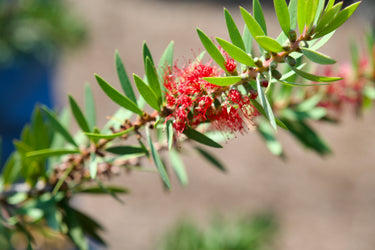
Of the thirty-odd bottlebrushes, this is the one Australian growers reach for when they want the word spectacular to mean something. Callistemon phoeniceus is endemic to the southwest corner of Western Australia, a hard, sandy, summer-dry country, and the shrub arrives in spring and summer carrying scarlet brushes four to six inches long, each one finished with a dark tip so the whole spike reads as red shading into near-black. The leaves are the other half of the appeal: thick, stiff, and distinctly blue-green, holding that cool grey cast right through the year, which makes the red land harder than red on ordinary green ever does.
The genus name is a small piece of Greek praise, kallos for beauty and stemon for a thread or stamen, and for once a botanist named a plant for the part that actually matters. What looks like petals is nothing of the kind; the true petals are small, round, greenish, and gone almost before you notice. The show is stamens, dozens to every flower, standing free of one another in a loose forest around the stem. Phoeniceus means crimson, from the Tyrian purple-red the Phoenicians traded, and the epithet is doing honest work here. Robert Brown described the genus in 1814; the molecular work of the last twenty years has since argued that the bottlebrushes sit inside Melaleuca rather than beside, so you will also find this plant as Melaleuca phoenicea. We keep the name gardeners search for and note that a botanist correcting you is not wrong, only reading from a different book.
Watch the shoot after bloom and the genus gives away where the plant comes from. The tip does not stop at the flower; the stem pushes a tuft of new leaves straight out past the brush and carries on, so by late summer you find a spent ring of woody capsules sitting partway down a branch with a foot of ordinary foliage beyond. Those capsules stay shut and clustered along the old wood like buttons pressed into the bark, waiting on fire to crack them open over ash-cleared ground. A shrub whose reproduction assumes the landscape will burn is a shrub built for hardship, and the drought toughness gardeners notice first and the fire history they learn later are the same fact seen from two directions.
Site the plant in the hottest, brightest, sharpest-drained spot on the property, the west-facing bank where a hydrangea would sulk, and expect eight to twelve feet in time. Lean ground gives better brush than rich ground, which buys leaf instead. The one thing no bottlebrush forgives is wet feet in winter, so plant high on heavy clay and let gravity do the work. In flower the nectar draws hummingbirds and carpenter bees the way the same flowers draw honeyeaters at home. One honest caution: C. phoeniceus takes frost and drought in stride but has not been proven through a piedmont winter the way our own Callistemon 'Woodlander's Hardy' has, so treat the plant as zone 8b to 10, give a sheltered wall in 8a, and consider a container north of that. These are the first cuttings we have struck, and the plant is very rarely offered in American horticulture at all.
- Hardiness
- USDA Zones 8–10
- Sun
- Full Sun
- Soil
- Well-drained
- Mature size
- Height 8–12 Feet · Spread 5–8 Feet
- Growth rate
- Medium
- Seasonality
- Evergreen
- Provenance
- Cuttings taken on the Armstrong Campus, Savannah, Georgia, August 2026.
Scarlet brushes 4 to 6 inches long with dark tips, spring into summer
From rooting to shipping, our top priority is ensuring you receive healthy, thriving plants for your garden’s success.
Because most of our plants are grown from rooted cuttings — alongside seed, air layering, and grafting chosen for each variety — you receive a stronger, true-to-type plant that establishes quickly in your garden.
Raised on organic soil blends and eco-friendly pest management — never harsh chemicals — your plant arrives healthy for your garden, your family, and the pollinators they feed.
Every purchase gives back. We donate to the Aiken Arboretum and support local wildlife conservation, so growing your garden helps protect the wider ecosystem too.

All our plant material is carefully propagated, grown, and nurtured at our humble nursery in Aiken, South Carolina.

Your plant arrives carefully packed and ready to settle in. Unpack them promptly, give them a day or two to acclimate, then plant following the notes we include — that’s all it takes. Clear care guidance comes with every order, so success is the easy part.
What to expect upon delivery
All our plants are sold in 1-gallon sizes, though the height of each plant can vary depending on its growth rate and seasonality, typically ranging from 1/2 to 2.5 feet.
Each plant is carefully packaged with its roots enclosed in a secure plastic bag containing moist soil, forming a compact root ball. To ensure safe transport, the box is padded with recycled newspaper, providing both stability and eco-friendly protection from weather during shipping.
What is your return policy?
Review our full return policy information on our SHIPPING AND RETURNS POLICY page.
What payment methods can I use?
We offer 35 different payment methods including major providers like Mastercard, Visa, PayPal, American Express and Diners as well as many different local payment methods including Klarna, iDEAL, AliPay, Sofort, giropay, and many more.
Can I make changes to my order after it’s been placed?
At Woodlanders, we strive to fulfill orders as quickly as possible. Therefore, we can only accommodate changes to your order within the first 24 hours after it has been placed. These changes include adding or removing products and modifying the delivery address. If you need to make any changes or if there has been a mistake with your order information, please reach out to us promptly via our CONTACT page with your order number for the quickest resolution.
Your satisfaction is our priority, and we appreciate your understanding and cooperation.