


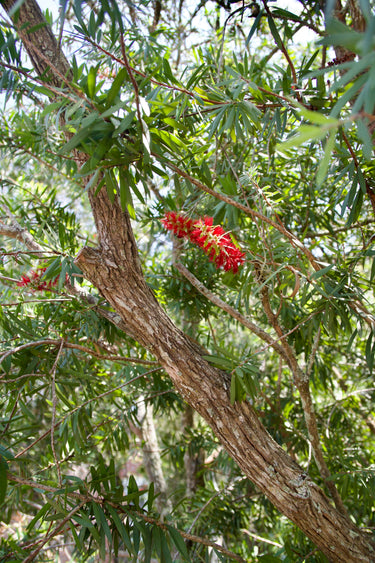


Weeping Bottlebrush
Callistemon viminalis
In propagation
Currently rooting cuttings. Expected Winter 2028.
Add your name with the notify button below, and we will email you the moment this plant is ready to bring home.
Learn how we grow on The Prop House.
Pickup currently unavailable at Aiken Nursery
The weeping bottlebrush is the one most Americans have already met without knowing the name, a small tree of crimson brushes and long hanging branchlets planted through Florida and the Gulf Coast until a hard freeze thins the ranks and somebody plants them again. In the wild Callistemon viminalis runs down the eastern edge of Australia from Cape York into northeastern New South Wales, and almost always along water: creek banks, seasonal channels, the damp sand beside a watercourse. That habitat explains the two things that set this species apart from the rest of the genus. The branches hang rather than stand, giving the whole tree a fountain habit that carries even out of flower, and the roots will tolerate heavier ground and less than perfect drainage, which almost no other bottlebrush will.
The name is unusually literal. Callistemon is Greek praise, kallos for beauty and stemon for a thread, because the show is stamens rather than petals; the true petals are small, round, greenish, and drop away almost unnoticed. Viminalis comes from the Latin vimen, a pliant shoot, the same root behind the withies a basket maker cuts, and anyone who has watched these branchlets move in a summer storm will grant the point. Under the newer taxonomy the plant is Melaleuca viminalis, since molecular work placed the bottlebrushes inside the paperbarks; the nursery trade and the Australian Plant Census have largely kept Callistemon, and so do we, while noting the argument honestly.
This species carries a piece of Woodlanders history whether or not the botany ever gets settled. Decades ago the growers here selected and fixed a single cold-tough bottlebrush clone and introduced the plant to the American trade as Callistemon 'Woodlander's Hardy'. Nobody wrote down the parentage, and to this day the clone is sold variously as a citrinus, as a viminalis, and, under the new names, as Melaleuca viminalis 'Woodlander's Hardy'. That selection carried the genus a full hardiness zone north, from the Gulf Coast into the piedmont, and now grows coast to coast. The straight species offered here is the wild plant behind at least one half of that argument, which makes growing the two side by side a genuinely interesting exercise for anyone who cares where a garden plant came from.
Give the tree full sun and room; fifteen to twenty-five feet in time in a mild climate, less where winter cuts back the growth, and the fountain habit wants space rather than a tight corner. Crimson brushes come through spring and summer on new wood, and the nectar pulls hummingbirds and carpenter bees the way the same flowers pull honeyeaters and lorikeets at home. One honest caution, and this one matters: the straight species is a zone 9 to 11 plant, tender where 'Woodlander's Hardy' is tough. Every few winters a hard freeze reminds the Deep South exactly where that line sits. Plant with that knowledge in the Lowcountry and along the Gulf, keep the tree in a container further north, and if what you want is the look with the hardiness, buy the clone we made instead.
- Hardiness
- USDA Zones 9–11
- Sun
- Full Sun
- Soil
- Well-drained, Moist
- Mature size
- Height 15–25 Feet · Spread 12–20 Feet
- Growth rate
- Fast
- Seasonality
- Evergreen
- Provenance
- Cuttings taken on the Armstrong Campus, Savannah, Georgia, August 2026.
Crimson brushes on pendulous branchlets, spring into summer
From rooting to shipping, our top priority is ensuring you receive healthy, thriving plants for your garden’s success.
Because most of our plants are grown from rooted cuttings — alongside seed, air layering, and grafting chosen for each variety — you receive a stronger, true-to-type plant that establishes quickly in your garden.
Raised on organic soil blends and eco-friendly pest management — never harsh chemicals — your plant arrives healthy for your garden, your family, and the pollinators they feed.
Every purchase gives back. We donate to the Aiken Arboretum and support local wildlife conservation, so growing your garden helps protect the wider ecosystem too.

All our plant material is carefully propagated, grown, and nurtured at our humble nursery in Aiken, South Carolina.

Your plant arrives carefully packed and ready to settle in. Unpack them promptly, give them a day or two to acclimate, then plant following the notes we include — that’s all it takes. Clear care guidance comes with every order, so success is the easy part.
What to expect upon delivery
All our plants are sold in 1-gallon sizes, though the height of each plant can vary depending on its growth rate and seasonality, typically ranging from 1/2 to 2.5 feet.
Each plant is carefully packaged with its roots enclosed in a secure plastic bag containing moist soil, forming a compact root ball. To ensure safe transport, the box is padded with recycled newspaper, providing both stability and eco-friendly protection from weather during shipping.
What is your return policy?
Review our full return policy information on our SHIPPING AND RETURNS POLICY page.
What payment methods can I use?
We offer 35 different payment methods including major providers like Mastercard, Visa, PayPal, American Express and Diners as well as many different local payment methods including Klarna, iDEAL, AliPay, Sofort, giropay, and many more.
Can I make changes to my order after it’s been placed?
At Woodlanders, we strive to fulfill orders as quickly as possible. Therefore, we can only accommodate changes to your order within the first 24 hours after it has been placed. These changes include adding or removing products and modifying the delivery address. If you need to make any changes or if there has been a mistake with your order information, please reach out to us promptly via our CONTACT page with your order number for the quickest resolution.
Your satisfaction is our priority, and we appreciate your understanding and cooperation.