




Willow-leaf Camellia
Camellia salicifolia
In propagation
Currently rooting cuttings. Expected Winter 2028.
Add your name with the notify button below, and we will email you the moment this plant is ready to bring home.
Learn how we grow on The Prop House.
Pickup currently unavailable at Aiken Nursery
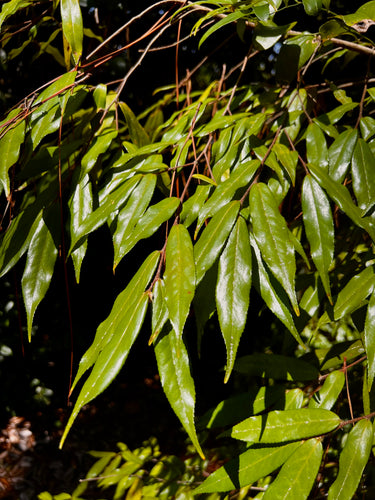
Most camellias are bought for the flower. This one is bought for the leaf, and anyone who has met the plant in person understands why within about four seconds. Camellia salicifolia carries long, thin, lance-shaped leaves that hang rather than sit, closer to a willow or a bamboo than to the stiff glossy ovals of a japonica, so the whole shrub moves in a breeze and reads soft where the rest of the genus reads architectural. New growth comes out coppery and silky, covered in fine hairs, and the young branchlets are villous enough to feel like felt between the fingers. Some growers call the species the willow-leaf camellia and some the Hong Kong camellia; both names point at something true.
The wild plant grows under the canopy of evergreen broadleaf forest in Guangdong, Guangxi, Fujian, Taiwan, and Hong Kong, at moderate elevations between roughly a thousand and twenty-six hundred feet. That is a shade plant's pedigree, and the shrub behaves accordingly in the garden: happiest in high filtered light beneath tall pines or oaks, tolerant of quite deep shade, and unhappy in the full southern sun that a sasanqua will shrug off. Flowers come in autumn and early winter, white, five or six obovate petals, only an inch or so across, and lightly fragrant. Beside a big formal japonica bloom they are almost nothing. Beside the foliage they are exactly the right amount.
Species camellias like this one matter more than their modest flowers suggest, because breeders keep going back to them. Narrow foliage, fine hairs, scent, and small-flowered grace are traits that the great formal hybrids largely traded away, and C. salicifolia has been used in crosses aiming to bring fragrance and a lighter habit back into the group. The genus honors Georg Josef Kamel, the Moravian Jesuit and pharmacist who worked in the Philippines and sent careful plant descriptions back to Europe, and whom Linnaeus commemorated in a genus Kamel himself never worked on. Salicifolia is plain description: willow-leaved, from Salix.
Site the shrub in a woodland bed where the hanging foliage can be seen against something darker and stiller, and where a hand can reach the new growth in spring, because the felted young shoots are half the pleasure of growing the plant. Eight to fifteen feet in time, open and graceful rather than dense; resist shearing, which destroys the very habit worth having. Acid, humus-rich, well-drained soil, even moisture, and shelter from cold dry wind. One honest caution: this is a subtropical species, hardy in roughly zones 8 to 10 and less cold-tolerant than the japonicas most Southern gardeners know, so give a protected corner in 8a and be prepared to lose the tips in a hard winter. Very few American nurseries have ever offered the plant, which is reason enough to try.
- Hardiness
- USDA Zones 8–10
- Sun
- Part Shade, Full Shade
- Soil
- Well-drained, Moist
- Mature size
- Height 8–15 Feet · Spread 6–10 Feet
- Growth rate
- Medium
- Seasonality
- Evergreen
- Provenance
- Cuttings taken on the Armstrong Campus, Savannah, Georgia, August 2026.
Small white flowers about an inch across, lightly fragrant, autumn into early winter
From rooting to shipping, our top priority is ensuring you receive healthy, thriving plants for your garden’s success.
Because most of our plants are grown from rooted cuttings — alongside seed, air layering, and grafting chosen for each variety — you receive a stronger, true-to-type plant that establishes quickly in your garden.
Raised on organic soil blends and eco-friendly pest management — never harsh chemicals — your plant arrives healthy for your garden, your family, and the pollinators they feed.
Every purchase gives back. We donate to the Aiken Arboretum and support local wildlife conservation, so growing your garden helps protect the wider ecosystem too.

All our plant material is carefully propagated, grown, and nurtured at our humble nursery in Aiken, South Carolina.

Your plant arrives carefully packed and ready to settle in. Unpack them promptly, give them a day or two to acclimate, then plant following the notes we include — that’s all it takes. Clear care guidance comes with every order, so success is the easy part.
What to expect upon delivery
All our plants are sold in 1-gallon sizes, though the height of each plant can vary depending on its growth rate and seasonality, typically ranging from 1/2 to 2.5 feet.
Each plant is carefully packaged with its roots enclosed in a secure plastic bag containing moist soil, forming a compact root ball. To ensure safe transport, the box is padded with recycled newspaper, providing both stability and eco-friendly protection from weather during shipping.
What is your return policy?
Review our full return policy information on our SHIPPING AND RETURNS POLICY page.
What payment methods can I use?
We offer 35 different payment methods including major providers like Mastercard, Visa, PayPal, American Express and Diners as well as many different local payment methods including Klarna, iDEAL, AliPay, Sofort, giropay, and many more.
Can I make changes to my order after it’s been placed?
At Woodlanders, we strive to fulfill orders as quickly as possible. Therefore, we can only accommodate changes to your order within the first 24 hours after it has been placed. These changes include adding or removing products and modifying the delivery address. If you need to make any changes or if there has been a mistake with your order information, please reach out to us promptly via our CONTACT page with your order number for the quickest resolution.
Your satisfaction is our priority, and we appreciate your understanding and cooperation.