



Yuletide Camellia
Camellia sasanqua 'Yuletide'
In propagation
Currently growing out 1 Gallon pots. Expected season to be announced.
Add your name with the notify button below, and we will email you the moment this plant is ready to bring home.
Learn how we grow on The Prop House.
Pickup currently unavailable at Aiken Nursery
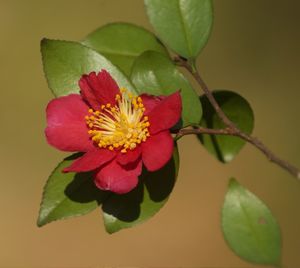
'Yuletide' is one of the most widespread and instantly recognizable red camellias in the trade, and the popularity is well earned. Dense growth carries lustrous dark green foliage on an upright, tidy, naturally columnar frame, and against that backdrop the flowers arrive in real quantity from late fall into early winter: single blooms about three inches across in a clean fire red, each one centered on a boss of bright golden stamens. The contrast is the thing. Very few plants are doing anything at all in December in a southern garden, and a shrub covered in red and gold at that moment tends to end arguments about where to put it.
The origin is well documented. 'Yuletide' arose as a chance seedling of Camellia × vernalis 'Hiryu' at Nuccio's Nurseries in Altadena, California, first flowering in 1959 and released to the trade in the years that followed. That parentage is why you will see the plant listed two ways. Most American nurseries, ours included, sell 'Yuletide' as a Camellia sasanqua, which is how the trade has always handled it; the Royal Horticultural Society and a number of camellia authorities file the same clone under Camellia × vernalis, a hybrid group between C. sasanqua and C. japonica that sits between the two parents in leaf size and blooms in the gap between their seasons. Both labels point at the same plant.
Camellias came to the American South by way of Europe in the late eighteenth century and became so thoroughly naturalized in southern garden culture that most people assume they were always here. The genus belongs to Theaceae, the tea family, and the same botanical neighborhood produces Camellia sinensis, from which every cup of black, green, and oolong tea is made. In Japan sasanqua is sazanka, valued for centuries for autumn bloom and for the oil pressed from the seed, which has long been used on hair and skin and to protect steel blades from rust. The sasanquas differ from the showier japonicas in three useful ways: they take considerably more sun, they flower months earlier, and they shed their petals cleanly instead of hanging on to brown flowers.
Plant in semi-shade in sandy, slightly acid soil, kept mulched and watered; morning sun with afternoon shade is close to ideal in the Deep South, though 'Yuletide' tolerates more sun than a japonica ever would. The columnar habit makes this a natural for a narrow bed, a foundation planting under eaves, a screen, or a pair flanking a door, and the same habit means very little pruning is required. When pruning is needed, do it right after flowering, since next year's buds form on new growth through summer. Set where the December bloom will be seen from indoors. Bees still working on a mild winter afternoon will find these flowers when there is almost nothing else on offer.
- Hardiness
- USDA Zones 7–9
- Sun
- Part Shade, Full Sun
- Soil
- Well-drained, Moist
- Mature size
- Height 8–10 Feet · Spread 6–8 Feet
- Growth rate
- Moderate
- Seasonality
- Evergreen
single fire-red flowers about three inches across with bright golden stamens, late fall into early winter
From rooting to shipping, our top priority is ensuring you receive healthy, thriving plants for your garden’s success.
Because most of our plants are grown from rooted cuttings — alongside seed, air layering, and grafting chosen for each variety — you receive a stronger, true-to-type plant that establishes quickly in your garden.
Raised on organic soil blends and eco-friendly pest management — never harsh chemicals — your plant arrives healthy for your garden, your family, and the pollinators they feed.
Every purchase gives back. We donate to the Aiken Arboretum and support local wildlife conservation, so growing your garden helps protect the wider ecosystem too.

All our plant material is carefully propagated, grown, and nurtured at our humble nursery in Aiken, South Carolina.

Your plant arrives carefully packed and ready to settle in. Unpack them promptly, give them a day or two to acclimate, then plant following the notes we include — that’s all it takes. Clear care guidance comes with every order, so success is the easy part.
What to expect upon delivery
All our plants are sold in 1-gallon sizes, though the height of each plant can vary depending on its growth rate and seasonality, typically ranging from 1/2 to 2.5 feet.
Each plant is carefully packaged with its roots enclosed in a secure plastic bag containing moist soil, forming a compact root ball. To ensure safe transport, the box is padded with recycled newspaper, providing both stability and eco-friendly protection from weather during shipping.
What is your return policy?
Review our full return policy information on our SHIPPING AND RETURNS POLICY page.
What payment methods can I use?
We offer 35 different payment methods including major providers like Mastercard, Visa, PayPal, American Express and Diners as well as many different local payment methods including Klarna, iDEAL, AliPay, Sofort, giropay, and many more.
Can I make changes to my order after it’s been placed?
At Woodlanders, we strive to fulfill orders as quickly as possible. Therefore, we can only accommodate changes to your order within the first 24 hours after it has been placed. These changes include adding or removing products and modifying the delivery address. If you need to make any changes or if there has been a mistake with your order information, please reach out to us promptly via our CONTACT page with your order number for the quickest resolution.
Your satisfaction is our priority, and we appreciate your understanding and cooperation.