


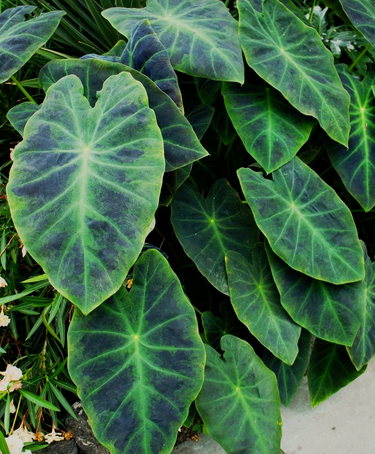


Imperial Taro
Colocasia esculenta var. antiquorum 'Illustris'
Pickup available at Aiken Nursery
Usually ready in 2-4 days
This one comes with a paper trail. 'Illustris' was first described in 1873 by William Bull, the Chelsea nurseryman, who listed the plant as Alocasia illustris in his catalogue of new and rare plants and sold them out of his glasshouses at 536 King's Road. Nobody knows quite where they came from. Colocasia esculenta is a restless, variable species, and Bull had rivers of tropical material moving through the place, so the likeliest story is that he caught a dark-leaved sport among the green, liked what he saw, and kept dividing the stock. Every 'Illustris' in cultivation descends from that one Victorian decision. A 150-year-old clone, still in production.
The drama is all in the leaves. They come up an ordinary bright green and then darken through the season to a deep brownish-purple that reads near-black, the veins left behind in vivid green as though someone traced the architecture and never filled it in. Broad and heart-shaped on long petioles, they hang slightly downward, and in a stand of three or five they stop looking like plants and start looking like set dressing.
They want what taro has always wanted: heat, full sun, and far more water than seems decent. Rich soil and a root run that never dries will carry them to full size through the worst of summer, and they're entirely content grown aquatically, at a pond margin or standing in a few inches of water. Hardier than the tropical look lets on, too. Across the Southeast the corms will often sit out the winter under a blanket of mulch and return on their own.
By August, when the rest of the border has thrown in the towel, this is the one still unrolling new leaves the size of dinner plates, exactly as they did in Bull's glasshouses a century and a half ago. That tends to end the conversation.
Photo courtesy of Skylark.
- Hardiness
- USDA Zones 8–11
- Sun
- Full Sun, Part Shade
- Soil
- Rich, Fertile, Moist, Wet
- Mature size
- Height 5–6 Feet · Spread 5–6 Feet
- Growth rate
- Fast
- Seasonality
- Dies back, depends on zone
From rooting to shipping, our top priority is ensuring you receive healthy, thriving plants for your garden’s success.
Because most of our plants are grown from rooted cuttings — alongside seed, air layering, and grafting chosen for each variety — you receive a stronger, true-to-type plant that establishes quickly in your garden.
Raised on organic soil blends and eco-friendly pest management — never harsh chemicals — your plant arrives healthy for your garden, your family, and the pollinators they feed.
Every purchase gives back. We donate to the Aiken Arboretum and support local wildlife conservation, so growing your garden helps protect the wider ecosystem too.

All our plant material is carefully propagated, grown, and nurtured at our humble nursery in Aiken, South Carolina.

Your plant arrives carefully packed and ready to settle in. Unpack them promptly, give them a day or two to acclimate, then plant following the notes we include — that’s all it takes. Clear care guidance comes with every order, so success is the easy part.
What to expect upon delivery
All our plants are sold in 1-gallon sizes, though the height of each plant can vary depending on its growth rate and seasonality, typically ranging from 1/2 to 2.5 feet.
Each plant is carefully packaged with its roots enclosed in a secure plastic bag containing moist soil, forming a compact root ball. To ensure safe transport, the box is padded with recycled newspaper, providing both stability and eco-friendly protection from weather during shipping.
What is your return policy?
Review our full return policy information on our SHIPPING AND RETURNS POLICY page.
What payment methods can I use?
We offer 35 different payment methods including major providers like Mastercard, Visa, PayPal, American Express and Diners as well as many different local payment methods including Klarna, iDEAL, AliPay, Sofort, giropay, and many more.
Can I make changes to my order after it’s been placed?
At Woodlanders, we strive to fulfill orders as quickly as possible. Therefore, we can only accommodate changes to your order within the first 24 hours after it has been placed. These changes include adding or removing products and modifying the delivery address. If you need to make any changes or if there has been a mistake with your order information, please reach out to us promptly via our CONTACT page with your order number for the quickest resolution.
Your satisfaction is our priority, and we appreciate your understanding and cooperation.