



Swamp Lily
Crinum americanum
Pickup currently unavailable at Aiken Nursery
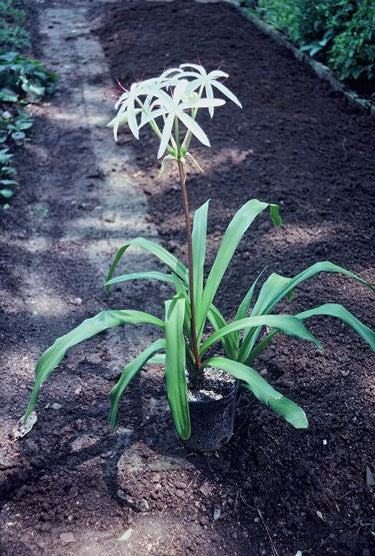
Crinum americanum is the swamp lily of the southeastern coastal plain, a bulb throwing broad strap-shaped leaves two to three feet long in a loose arching rosette, with scapes of about the same height carrying two to six flowers in a terminal umbel. The flowers are the whole event: glistening white, six narrow tepals recurved into a star five or six inches across, the long filaments tipped with dark anthers and often flushed rose-pink toward the base. Fragrance arrives after dark, sweet and carrying, which tells you plainly what does the pollinating. Bloom comes in waves from late spring into autumn, and nearly year-round in frost-free gardens.
Crinum is simply the Greek krinon, lily, and americanum places the species, which grows wild in swamps, marshes, wet hammocks, and stream margins from South Carolina through Florida and west along the Gulf to Texas, with populations in Jamaica, the Cayman Islands, and Mexico. String lily and seven sisters are the older vernacular names, the second counting the flowers in a generous umbel. One honest note carried forward from our earlier catalogs: plants offered under this name may in fact be Crinum erubescens from South America. Scott Ogden observed in Southern Bulbs that this very similar species is the better adapted of the two to ordinary garden conditions, forming colonies and flowering well in soil that is merely moist rather than genuinely wet.
The Amaryllidaceae are a chemically serious family and Crinum is no exception. More than a hundred and seventy alkaloids have been described across the genus, and analysis of C. americanum alone has turned up crinine, lycorine, caranine, hippadine, and crinamine among others. The ethnopharmacological record for the species points to preparations used for asthma and bronchitis, for malaria, and as expectorant, antiemetic, and cardiotonic remedies. Those same alkaloids make every part of the plant, and the bulb above all, toxic to people, dogs, cats, and horses.
Give swamp lily what the wild colonies take: full sun to light shade, rich soil, and as much water as you can manage. Plants thrive at pond margins, along ditches, in rain gardens, and in containers standing in a saucer of water, though they will also grow perfectly well in an ordinary moist border with regular irrigation. Set the neck of the bulb at or just above soil level. Foliage dies back over winter at the cold edge of the range and returns readily from the bulb; in zone ten the leaves simply carry on. Pair with Hymenocallis, Iris virginica, Thalia dealbata, and Zephyranthes for a wet planting that flowers from spring to frost, and site near a porch or an evening path so the night fragrance actually gets used.
- Hardiness
- USDA Zones 8–10
- Sun
- Full Sun, Part Shade
- Soil
- Moist
- Mature size
- Height 2–3 Feet · Spread 2–3 Feet
- Growth rate
- Fast
- Seasonality
- Dies back, depends on zone
umbels of large crystalline white star-shaped flowers, night-fragrant, late spring through autumn
These statements have not been evaluated by the Food and Drug Administration. This information is shared for traditional and educational interest only and is not intended to diagnose, treat, cure, or prevent any disease. Please consult a qualified healthcare professional before any medicinal use.
- All parts are toxic, the bulb most of all
- Toxic to dogs, cats, and horses
- Historic preparations acted as violent emetics and are genuinely dangerous
- Not suitable for self-medication under any circumstances
From rooting to shipping, our top priority is ensuring you receive healthy, thriving plants for your garden’s success.
Because most of our plants are grown from rooted cuttings — alongside seed, air layering, and grafting chosen for each variety — you receive a stronger, true-to-type plant that establishes quickly in your garden.
Raised on organic soil blends and eco-friendly pest management — never harsh chemicals — your plant arrives healthy for your garden, your family, and the pollinators they feed.
Every purchase gives back. We donate to the Aiken Arboretum and support local wildlife conservation, so growing your garden helps protect the wider ecosystem too.

All our plant material is carefully propagated, grown, and nurtured at our humble nursery in Aiken, South Carolina.

Your plant arrives carefully packed and ready to settle in. Unpack them promptly, give them a day or two to acclimate, then plant following the notes we include — that’s all it takes. Clear care guidance comes with every order, so success is the easy part.
What to expect upon delivery
All our plants are sold in 1-gallon sizes, though the height of each plant can vary depending on its growth rate and seasonality, typically ranging from 1/2 to 2.5 feet.
Each plant is carefully packaged with its roots enclosed in a secure plastic bag containing moist soil, forming a compact root ball. To ensure safe transport, the box is padded with recycled newspaper, providing both stability and eco-friendly protection from weather during shipping.
What is your return policy?
Review our full return policy information on our SHIPPING AND RETURNS POLICY page.
What payment methods can I use?
We offer 35 different payment methods including major providers like Mastercard, Visa, PayPal, American Express and Diners as well as many different local payment methods including Klarna, iDEAL, AliPay, Sofort, giropay, and many more.
Can I make changes to my order after it’s been placed?
At Woodlanders, we strive to fulfill orders as quickly as possible. Therefore, we can only accommodate changes to your order within the first 24 hours after it has been placed. These changes include adding or removing products and modifying the delivery address. If you need to make any changes or if there has been a mistake with your order information, please reach out to us promptly via our CONTACT page with your order number for the quickest resolution.
Your satisfaction is our priority, and we appreciate your understanding and cooperation.