


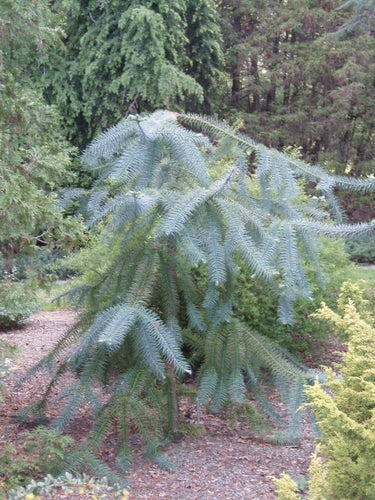


Blue China Fir
Cunninghamia lanceolata 'Glauca'
Pickup currently unavailable at Aiken Nursery
This is the silvery blue-needled form of the China fir, and the color is the reason to choose it over the ordinary green. Needles are broad, flat, stiff, and sharply pointed, an inch or two long, arranged in spirals that read as flat sprays and holding a distinct glaucous blue that intensifies in good light. The frame is boldly pyramidal with tiered horizontal branching, reaching forty to sixty feet in cultivation here, considerably more in China. Old bark peels in long strips to reveal reddish brown beneath. Dead needles hang on inside the crown for a year or two, which some gardeners dislike and others regard as part of the character; either way, a China fir is never mistaken for anything else.
The genus honors James Cunningham, a Scottish surgeon working for the East India Company who collected in Fujian and Zhoushan around the turn of the eighteenth century and became the first Westerner to send this tree home, in 1702. Lanceolata describes the needle. In China the tree is shan mu, and calling it merely important would be an understatement: China fir is among the country's principal timber species, grown in vast plantations on rotations of twenty to thirty years. The wood is soft, light, strongly scented, remarkably resistant to rot, and untouched by termites, which made it the traditional choice for coffins and for temple construction, where the fragrance was valued as much as the durability. Boats, bridges, furniture, and lamp posts all took the same timber.
Alongside the timber tradition sits a smaller medicinal one. Decoctions of the cones were used for coughs, and ash from the burnt bark was applied to wounds and burns. The essential oil distilled from the branches has long gone into perfumery, and modern analysis has found it dominated by cedrol, which laboratory work has shown to be a potent antifungal, outperforming a standard reference compound in trials against a serious tree pathogen. The scent that made the wood desirable for a temple turns out to be doing real chemical work.
Give full sun to light shade, deep moist well-drained soil, and shelter from cold drying wind, which browns the foliage faster than low temperatures do. Growth is steady rather than rushed and the tree wants room; this is a specimen for a lawn, a park, a large garden, or an arboretum, not a foundation plant. One genuinely unusual trait for a conifer: China fir coppices, resprouting readily from a cut stump or from the base, so a storm-damaged or badly sited tree can be cut down and started again, and multi-stemmed specimens arise naturally. Worth knowing that 'Glauca' is a color form rather than a sharply defined clone, and blue-tinged individuals turn up in wild populations, so expect some variation in intensity between plants.
Photos courtesy of the American Conifer Society
- Hardiness
- USDA Zones 6–9
- Sun
- Full Sun, Part Shade
- Soil
- Moist, Well-drained
- Mature size
- Height 40–60 Feet · Spread 15–20 Feet
- Growth rate
- Moderate
- Seasonality
- Evergreen
These statements have not been evaluated by the Food and Drug Administration. This information is shared for traditional and educational interest only and is not intended to diagnose, treat, cure, or prevent any disease. Please consult a qualified healthcare professional before any medicinal use.
- Essential oils are concentrated and should never be taken internally without professional guidance
- Not evaluated for safety in pregnancy or while breastfeeding
- Sawdust and foliage can irritate skin and airways
- Consult a qualified practitioner before use
From rooting to shipping, our top priority is ensuring you receive healthy, thriving plants for your garden’s success.
Because most of our plants are grown from rooted cuttings — alongside seed, air layering, and grafting chosen for each variety — you receive a stronger, true-to-type plant that establishes quickly in your garden.
Raised on organic soil blends and eco-friendly pest management — never harsh chemicals — your plant arrives healthy for your garden, your family, and the pollinators they feed.
Every purchase gives back. We donate to the Aiken Arboretum and support local wildlife conservation, so growing your garden helps protect the wider ecosystem too.

All our plant material is carefully propagated, grown, and nurtured at our humble nursery in Aiken, South Carolina.

Your plant arrives carefully packed and ready to settle in. Unpack them promptly, give them a day or two to acclimate, then plant following the notes we include — that’s all it takes. Clear care guidance comes with every order, so success is the easy part.
What to expect upon delivery
All our plants are sold in 1-gallon sizes, though the height of each plant can vary depending on its growth rate and seasonality, typically ranging from 1/2 to 2.5 feet.
Each plant is carefully packaged with its roots enclosed in a secure plastic bag containing moist soil, forming a compact root ball. To ensure safe transport, the box is padded with recycled newspaper, providing both stability and eco-friendly protection from weather during shipping.
What is your return policy?
Review our full return policy information on our SHIPPING AND RETURNS POLICY page.
What payment methods can I use?
We offer 35 different payment methods including major providers like Mastercard, Visa, PayPal, American Express and Diners as well as many different local payment methods including Klarna, iDEAL, AliPay, Sofort, giropay, and many more.
Can I make changes to my order after it’s been placed?
At Woodlanders, we strive to fulfill orders as quickly as possible. Therefore, we can only accommodate changes to your order within the first 24 hours after it has been placed. These changes include adding or removing products and modifying the delivery address. If you need to make any changes or if there has been a mistake with your order information, please reach out to us promptly via our CONTACT page with your order number for the quickest resolution.
Your satisfaction is our priority, and we appreciate your understanding and cooperation.