


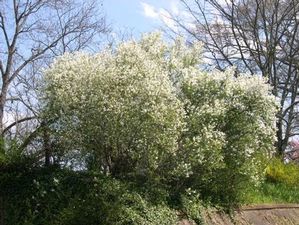

Pearlbush
Exochorda racemosa
In propagation
Currently rooting cuttings. Expected Fall 2027.
Add your name with the notify button below, and we will email you the moment this plant is ready to bring home.
Learn how we grow on The Prop House.
Pickup currently unavailable at Aiken Nursery
Pearlbush is named for the week before the show rather than the show itself. Along each slender arching branch, the flower buds swell into round, hard, pure white beads strung out in a line, and for a few days in very early spring the shrub looks convincingly like a plant hung with pearls. Then the buds open into cupped white flowers an inch or so across, six to ten of them to a raceme, and the whole irregular upright frame of eight to ten feet goes white at a point in the year when almost nothing else has started. The plant is sure to attract attention in flower, and does very well in the South, where pearlbush is a dependable herald of spring.
The genus name is an odd and rather good one, built from the Greek exo, outside, and chorde, a cord, for the fibrous strands that sit outside the placenta in the ovary, which is the sort of detail only a botanist with a hand lens would ever have chosen to name a plant after. Gardeners went with pearlbush instead. Exochorda belongs to Rosaceae, the rose family, in the company of spiraea and physocarpus, and the species came into Western gardens from China in the middle of the nineteenth century. The native range runs across China and Central Asia.
There is no ethnobotany to report here, no medicine, dye or food use of any consequence; pearlbush has always been an ornamental and nothing else. The flowers draw early bees at a moment in the year when forage is thin, which is a quieter argument for the plant than the bloom but a real one. Autumn colour is negligible and the summer foliage is plain, so this is a shrub that earns a season and then steps back, best sited where something else takes over later.
Plant pearlbush in well-drained soil in full sun or part shade; the shrub tolerates a wide range of conditions and shrugs off heat and drought once established. Give room for the arching habit and prune straight after flowering, since next spring's buds form on old wood, and take out a proportion of the oldest stems at the base every few years to keep new growth coming rather than shearing the outline. Hardy through USDA zones 4 to 8. One honest caution, and it is our own observation rather than anything from a book: pearlbush naturalizes sparingly here in Aiken, so keep an eye out for seedlings near woodland edges if you garden where that matters.
- Hardiness
- USDA Zones 4–8
- Sun
- Full Sun, Part Shade
- Soil
- Well-drained
- Mature size
- Height 8–10 Feet · Spread 6–8 Feet
- Growth rate
- Medium
- Seasonality
- Deciduous
- Provenance
- Odoo Source: Old Site. Currently in propagation at the nursery, 32 cuttings entered the PROP stage on 2026-03-11 under manufacturing order F/MO/00692, with a projected availability of Fall 2027.
Round pearl-like white buds opening into cupped white flowers in very early spring, six to ten to a raceme
From rooting to shipping, our top priority is ensuring you receive healthy, thriving plants for your garden’s success.
Because most of our plants are grown from rooted cuttings — alongside seed, air layering, and grafting chosen for each variety — you receive a stronger, true-to-type plant that establishes quickly in your garden.
Raised on organic soil blends and eco-friendly pest management — never harsh chemicals — your plant arrives healthy for your garden, your family, and the pollinators they feed.
Every purchase gives back. We donate to the Aiken Arboretum and support local wildlife conservation, so growing your garden helps protect the wider ecosystem too.

All our plant material is carefully propagated, grown, and nurtured at our humble nursery in Aiken, South Carolina.

Your plant arrives carefully packed and ready to settle in. Unpack them promptly, give them a day or two to acclimate, then plant following the notes we include — that’s all it takes. Clear care guidance comes with every order, so success is the easy part.
What to expect upon delivery
All our plants are sold in 1-gallon sizes, though the height of each plant can vary depending on its growth rate and seasonality, typically ranging from 1/2 to 2.5 feet.
Each plant is carefully packaged with its roots enclosed in a secure plastic bag containing moist soil, forming a compact root ball. To ensure safe transport, the box is padded with recycled newspaper, providing both stability and eco-friendly protection from weather during shipping.
What is your return policy?
Review our full return policy information on our SHIPPING AND RETURNS POLICY page.
What payment methods can I use?
We offer 35 different payment methods including major providers like Mastercard, Visa, PayPal, American Express and Diners as well as many different local payment methods including Klarna, iDEAL, AliPay, Sofort, giropay, and many more.
Can I make changes to my order after it’s been placed?
At Woodlanders, we strive to fulfill orders as quickly as possible. Therefore, we can only accommodate changes to your order within the first 24 hours after it has been placed. These changes include adding or removing products and modifying the delivery address. If you need to make any changes or if there has been a mistake with your order information, please reach out to us promptly via our CONTACT page with your order number for the quickest resolution.
Your satisfaction is our priority, and we appreciate your understanding and cooperation.