


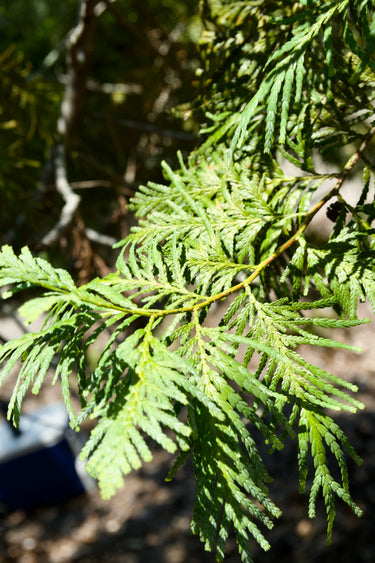


Fujian Cypress, Pemou
Fokienia hodginsii
In propagation
Currently rooting cuttings. Expected Winter 2028.
Add your name with the notify button below, and we will email you the moment this plant is ready to bring home.
Learn how we grow on The Prop House.
Pickup currently unavailable at Aiken Nursery
Fokienia hodginsii is the only living species in the genus, a conifer that looks assembled from parts of several others. The flattened, fanning sprays read as arborvitae from across a lawn. Up close, the scale leaves show chalky white bands on their undersides and the small round cones sit closer to Chamaecyparis and Calocedrus. Botanists have argued about where the tree belongs for more than a century and have not finished. Plants of the World Online still accepts the name Fokienia hodginsii, while several recent phylogenetic studies nest the genus inside Chamaecyparis and would have the tree called Chamaecyparis hodginsii. We keep the older name because that is what the plant is known and traded by, and both are defensible depending on whose treatment you follow.
The name records two accidents of history. Fokien is the old transliteration of Fujian, the Chinese province where the species was first collected, and the epithet honors Hodgins, who sent the original material west. In Vietnam the tree is pơmu, and that name carries far more weight locally than the Latin one. Pơmu wood is aromatic, dense, and famously slow to rot, and the trade in that wood has been both the making and the near unmaking of the species.
Everything about this tree comes back to the scent of the wood. Distilled from foliage and heartwood, pemou oil is sold in the West as Siam wood and is unusual in being almost entirely sesquiterpenes, chiefly nerolidol and fokienol. Published work on the leaf oil has found real activity against Gram-positive bacteria. In southern China and Vietnam the timber has gone into doors, window frames, carved panels, and furniture, and often enough into coffins that English picked up the name coffinwood. The H'Mong of the northern Vietnamese mountains split pơmu for roof planks and wall partitions. All that value has come at a cost. Illegal logging continues to thin the mature trees across most of the range despite legal protection, and the IUCN lists the species as Near Threatened.
Here in Aiken, South Carolina, the tree has grown very well for a number of years, which is more than most conifers of this provenance manage in the humid Southeast. Give reasonably moist but well-drained ground, acid rather than sweet, and either full sun for a dense columnar habit or partial shade for something looser and more open. Full shade will not do. Expect forty to sixty feet in time and twenty-five to thirty-five feet across, with a narrow pyramidal crown filling in unhurriedly. Hardiness runs to zone 8, and gardeners north of that line should not count on the tree outdoors.
The stock behind these plants was struck from cuttings taken on the Armstrong Campus in Savannah, Georgia, in August of 2026. That same campus has supplied several of the tender woody plants we grow.
- Hardiness
- USDA Zones 8–10
- Sun
- Full Sun, Part Shade
- Soil
- Well-drained, Moist
- Mature size
- Height 40–60 Feet · Spread 25–35 Feet
- Growth rate
- Moderate
- Seasonality
- Evergreen
- Provenance
- Struck from cuttings taken on the Armstrong Campus in Savannah, Georgia, in August 2026.
None; small round cones, green ripening brown
From rooting to shipping, our top priority is ensuring you receive healthy, thriving plants for your garden’s success.
Because most of our plants are grown from rooted cuttings — alongside seed, air layering, and grafting chosen for each variety — you receive a stronger, true-to-type plant that establishes quickly in your garden.
Raised on organic soil blends and eco-friendly pest management — never harsh chemicals — your plant arrives healthy for your garden, your family, and the pollinators they feed.
Every purchase gives back. We donate to the Aiken Arboretum and support local wildlife conservation, so growing your garden helps protect the wider ecosystem too.

All our plant material is carefully propagated, grown, and nurtured at our humble nursery in Aiken, South Carolina.

Your plant arrives carefully packed and ready to settle in. Unpack them promptly, give them a day or two to acclimate, then plant following the notes we include — that’s all it takes. Clear care guidance comes with every order, so success is the easy part.
What to expect upon delivery
All our plants are sold in 1-gallon sizes, though the height of each plant can vary depending on its growth rate and seasonality, typically ranging from 1/2 to 2.5 feet.
Each plant is carefully packaged with its roots enclosed in a secure plastic bag containing moist soil, forming a compact root ball. To ensure safe transport, the box is padded with recycled newspaper, providing both stability and eco-friendly protection from weather during shipping.
What is your return policy?
Review our full return policy information on our SHIPPING AND RETURNS POLICY page.
What payment methods can I use?
We offer 35 different payment methods including major providers like Mastercard, Visa, PayPal, American Express and Diners as well as many different local payment methods including Klarna, iDEAL, AliPay, Sofort, giropay, and many more.
Can I make changes to my order after it’s been placed?
At Woodlanders, we strive to fulfill orders as quickly as possible. Therefore, we can only accommodate changes to your order within the first 24 hours after it has been placed. These changes include adding or removing products and modifying the delivery address. If you need to make any changes or if there has been a mistake with your order information, please reach out to us promptly via our CONTACT page with your order number for the quickest resolution.
Your satisfaction is our priority, and we appreciate your understanding and cooperation.