



Large Fothergilla
Fothergilla major
Pickup currently unavailable at Aiken Nursery
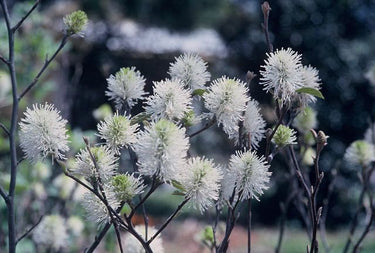
The native fothergillas were choice but scarcely available garden shrubs when Woodlanders first began to offer them in 1980, and mountain witch alder is the largest and, to our eye, the best of them. Fothergilla major makes a rounded deciduous shrub of six to eight feet, slow and dense, and gives two distinct performances a year. In April the bare or barely-leafing branches carry upright white bottlebrushes, an inch or two long, made not of petals but of crowded stamens with pale yellow anthers, and they carry a honeyed scent that reaches further than the flowers look able to manage. In October the blue-green leaves turn all at once to orange, scarlet and yellow, often several colors on a single leaf.
The genus honors John Fothergill, the eighteenth-century English physician and Quaker who kept one of the great gardens of American plants at Upton in Essex and paid collectors to keep it supplied. Witch alder is the country name: alder for the leaves, which look convincingly like an alder's, and witch from the family, Hamamelidaceae, shared with witch hazel, sweetgum and loropetalum. A note on the name for anyone who follows taxonomy, since the labels have shifted: Kew now treats Fothergilla latifolia as the accepted name and files F. major as a synonym, along with the older F. monticola. We keep the name gardeners actually search for.
This is a plant with a real conservation stake. Mountain witch alder is uncommon and local in the wild, scattered through the southern Appalachians and the Alleghenies across five southeastern states with a disjunct outpost in Arkansas, and NatureServe ranks the species G3, vulnerable. There is no ethnobotany to report, no old medicine or dye or food use; the shrub simply never grew commonly enough to become useful to anybody. Growing a nursery-propagated plant is a quiet way of keeping a scarce native in cultivation, and the spring flowers are worked over by bees from the moment they open.
Site mountain witch alder in sun or semi-shade in good, moist, acid, well-drained soil with plenty of organic matter, and give the shrub room to round out rather than shearing the natural shape away. Full sun buys the strongest fall color; too much shade thins the flowering and dulls October. The plant suckers gently at the base, which builds a handsome multi-stemmed clump over years rather than a running colony. Pair with rhododendron, leucothoe, native azaleas and ferns at a woodland edge, or use as a specimen where both the April scent and the autumn blaze will be walked past. Hardy through USDA zones 4 to 8. One honest caution: the roots dislike drying out, so mulch well and water through the first summers.
- Hardiness
- USDA Zones 4–8
- Sun
- Full Sun, Part Shade
- Soil
- Well-drained, Moist, Acid
- Mature size
- Height 6–8 Feet · Spread 4–6 Feet
- Growth rate
- Slow
- Seasonality
- Deciduous
- Provenance
- No Odoo source recorded. Woodlanders has offered the native fothergillas since 1980, a house fact preserved from the original catalog copy.
Fragrant white bottlebrush spikes of crowded stamens, one to two inches long, in April before or with the leaves
From rooting to shipping, our top priority is ensuring you receive healthy, thriving plants for your garden’s success.
Because most of our plants are grown from rooted cuttings — alongside seed, air layering, and grafting chosen for each variety — you receive a stronger, true-to-type plant that establishes quickly in your garden.
Raised on organic soil blends and eco-friendly pest management — never harsh chemicals — your plant arrives healthy for your garden, your family, and the pollinators they feed.
Every purchase gives back. We donate to the Aiken Arboretum and support local wildlife conservation, so growing your garden helps protect the wider ecosystem too.

All our plant material is carefully propagated, grown, and nurtured at our humble nursery in Aiken, South Carolina.

Your plant arrives carefully packed and ready to settle in. Unpack them promptly, give them a day or two to acclimate, then plant following the notes we include — that’s all it takes. Clear care guidance comes with every order, so success is the easy part.
What to expect upon delivery
All our plants are sold in 1-gallon sizes, though the height of each plant can vary depending on its growth rate and seasonality, typically ranging from 1/2 to 2.5 feet.
Each plant is carefully packaged with its roots enclosed in a secure plastic bag containing moist soil, forming a compact root ball. To ensure safe transport, the box is padded with recycled newspaper, providing both stability and eco-friendly protection from weather during shipping.
What is your return policy?
Review our full return policy information on our SHIPPING AND RETURNS POLICY page.
What payment methods can I use?
We offer 35 different payment methods including major providers like Mastercard, Visa, PayPal, American Express and Diners as well as many different local payment methods including Klarna, iDEAL, AliPay, Sofort, giropay, and many more.
Can I make changes to my order after it’s been placed?
At Woodlanders, we strive to fulfill orders as quickly as possible. Therefore, we can only accommodate changes to your order within the first 24 hours after it has been placed. These changes include adding or removing products and modifying the delivery address. If you need to make any changes or if there has been a mistake with your order information, please reach out to us promptly via our CONTACT page with your order number for the quickest resolution.
Your satisfaction is our priority, and we appreciate your understanding and cooperation.