




Ozark Witch Hazel
Hamamelis vernalis
Pickup available at Aiken Nursery
Usually ready in 2-4 days
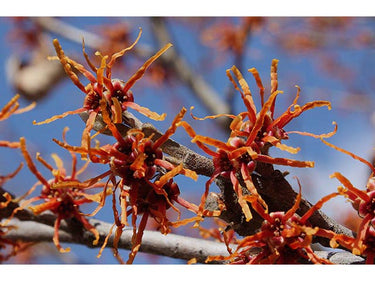
Hamamelis vernalis is the shrub that gets the season wrong on purpose. Somewhere between January and March, on bare grey wood, the buds break into small ragged flowers, four crumpled ribbons apiece, yellow through copper to a deep smoldering red, set in a calyx cup the color of dried blood. The scent arrives before the sight does. On a still cold morning the fragrance carries further than seems reasonable for a flower the size of a fingernail, sweet and spicy with something faintly vanilla behind. And when the temperature drops the petals roll themselves lengthwise into tight coils, wait out the freeze, and unfurl again within hours of the next mild sun, the same flowers opening and closing over and over for weeks.
The Ozark witch hazel came late to botany for a plant hiding in plain sight. Charles Sprague Sargent, collecting in Missouri with Benjamin Franklin Bush in 1907, recognized the shrub as distinct from the familiar eastern witch hazel; a seedling reached the Arnold Arboretum in 1908, and Sargent published the species in 1911. The genus name is older and stranger: Hamamelis comes from the Greek for together with a fruit, because flowers and the previous year’s ripening capsules occupy the branches at the same moment. The English name has nothing to do with witchcraft. Witch here is the Old English wice, meaning pliant or bending, from the forked stems once cut for dowsing rods. Vernalis simply means of spring, which is generous, since the plant usually beats spring by a month.
In the wild this is a plant of Ozark gravel bars and river scour in Missouri, Arkansas and Oklahoma, growing where high-gradient streams flood hard and often, on acid gravel that would drown or starve most shrubs. That habitat explains the garden behavior: real flood tolerance, a suckering habit that binds a bank into a colony, and, usefully, more patience with higher-pH soil than any other witch hazel. The capsules dry through summer and then fire their seed, hard, up to thirty feet from the parent. One correction is worth making plainly, because the genus invites the assumption: the witch hazel of the medicine cabinet is the eastern species, Hamamelis virginiana, which is what the pharmacopoeia means by the name and what the whole extract industry was built on. The Ozark plant shares the family astringency in reputation only. No medicinal tradition and no published chemistry belong to this species. Grow the shrub for the flowers and the scent.
Site Hamamelis vernalis where people actually walk in February, along a path, beside a door, at a gate, because the flowers are small and the scent is the entire payload. Read against dark evergreens or old brick, the ribbons show; against bare woodland they disappear. Give room, since the plant suckers steadily into a wide colony, wider than tall at maturity, which makes this a massing and bank-holding shrub rather than a tidy specimen. Two honest cautions come with the winter flowers. Many plants are marcescent, holding dead brown leaves right through the bloom and hiding the show, and the fix is simply to strip or shear them in midwinter before the buds break. And on hot dry sites the leaves scorch, so keep the roots cool and moist. Cut stems force beautifully indoors, which is the traditional January consolation for anyone who cannot get outside.
Photos courtesy of Julia Fitzpatrick-Cooper
- Hardiness
- USDA Zones 4–8
- Sun
- Full Sun, Part Shade
- Soil
- Moist, Well-drained
- Mature size
- Height 6–10 Feet · Spread 10–15 Feet
- Growth rate
- Slow
- Seasonality
- Deciduous
Ribbon-like petals, yellow through copper to dark red over a red calyx, fragrant, January into March
From rooting to shipping, our top priority is ensuring you receive healthy, thriving plants for your garden’s success.
Because most of our plants are grown from rooted cuttings — alongside seed, air layering, and grafting chosen for each variety — you receive a stronger, true-to-type plant that establishes quickly in your garden.
Raised on organic soil blends and eco-friendly pest management — never harsh chemicals — your plant arrives healthy for your garden, your family, and the pollinators they feed.
Every purchase gives back. We donate to the Aiken Arboretum and support local wildlife conservation, so growing your garden helps protect the wider ecosystem too.

All our plant material is carefully propagated, grown, and nurtured at our humble nursery in Aiken, South Carolina.

Your plant arrives carefully packed and ready to settle in. Unpack them promptly, give them a day or two to acclimate, then plant following the notes we include — that’s all it takes. Clear care guidance comes with every order, so success is the easy part.
What to expect upon delivery
All our plants are sold in 1-gallon sizes, though the height of each plant can vary depending on its growth rate and seasonality, typically ranging from 1/2 to 2.5 feet.
Each plant is carefully packaged with its roots enclosed in a secure plastic bag containing moist soil, forming a compact root ball. To ensure safe transport, the box is padded with recycled newspaper, providing both stability and eco-friendly protection from weather during shipping.
What is your return policy?
Review our full return policy information on our SHIPPING AND RETURNS POLICY page.
What payment methods can I use?
We offer 35 different payment methods including major providers like Mastercard, Visa, PayPal, American Express and Diners as well as many different local payment methods including Klarna, iDEAL, AliPay, Sofort, giropay, and many more.
Can I make changes to my order after it’s been placed?
At Woodlanders, we strive to fulfill orders as quickly as possible. Therefore, we can only accommodate changes to your order within the first 24 hours after it has been placed. These changes include adding or removing products and modifying the delivery address. If you need to make any changes or if there has been a mistake with your order information, please reach out to us promptly via our CONTACT page with your order number for the quickest resolution.
Your satisfaction is our priority, and we appreciate your understanding and cooperation.