


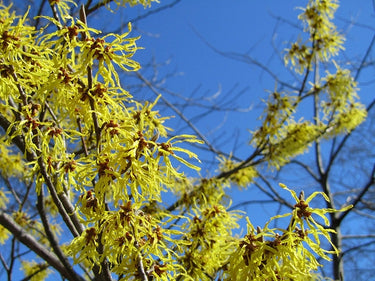


Common Witchhazel
Hamamelis virginiana
In propagation
Currently growing out 1 Gallon pots. Expected season to be announced.
Add your name with the notify button below, and we will email you the moment this plant is ready to bring home.
Learn how we grow on The Prop House.
Pickup currently unavailable at Aiken Nursery
Hamamelis virginiana does everything backwards, and that is the entire appeal. When the rest of the woods has shut down for the year, when the leaves are gone and nothing else is in flower, witch hazel chooses that exact moment to bloom: spidery yellow flowers, all thin crimped strap-like petals, scattered along the bare branches through late fall and into the cold. They carry a faint sweet scent on a mild day and they wait, patiently, for whatever gnat or late fly is still working, because almost nothing else is. This is the shrub that flowers when flowering makes no sense, and is all the more loved for the defiance.
The name written into the genus tells you the other half of the trick. Hamamelis comes from Greek for "fruit at the same time," because this is very likely the only native woody plant in America to carry this year's flowers, last year's ripening seed capsules, and next year's leaf buds on the branch all at once. And those capsules do something worth waiting for: when they finally dry and split, they fire their hard black seeds as far as twenty-five feet, with an audible snap, then hang on the twigs afterward like little open beaks. A plant that blooms in the cold and flings seed across the clearing is not trying to be ordinary.
Then there's the name itself, which is half the romance. Early settlers, confusing the plant with the European hazel and borrowing an old Anglo-Saxon word for "bend," watched Native peoples cut the forked branches into divining rods and walk them over the ground to dowse for water, the fork dipping where the well should go. The Mohegan are credited with teaching the practice, which followed well-diggers into the twentieth century. The famous astringent came later: in 1866 Thomas Dickinson built a distillery and turned the steeped twigs into the witch hazel still sold in every pharmacy, a recipe learned in part from the Cherokee and Iroquois.
For all that history, this is an easy plant. A large multi-stemmed shrub or small tree of the eastern woods, adaptable to most soils and sites, sun to shade, with leaves that turn a clean buttery gold before they drop to reveal the flowers beneath. Notably, after centuries in cultivation the species has produced no garden cultivars worth keeping, a quiet endorsement of the original: nobody has improved on the wild plant, because the wild plant is already right. Hamamelis virginiana is native magic, the kind you plant once and watch do something strange and lovely every November when everything else has called it a year.
Photos courtesy of Kurt Wagner and Randy Harter
- Hardiness
- USDA Zones 3–8
- Sun
- Full Sun, Part Shade
- Soil
- Well-drained, Moist
- Mature size
- Height 12–15 Feet · Spread 8–10 Feet
- Growth rate
- Slow
- Seasonality
- Deciduous
These statements have not been evaluated by the Food and Drug Administration. This information is shared for traditional and educational interest only and is not intended to diagnose, treat, cure, or prevent any disease. Please consult a qualified healthcare professional before any medicinal use.
- Traditionally used externally on the skin
- Oral use of high-tannin preparations may upset the stomach
- Not a substitute for professional medical care
- Consult a qualified professional before use
From rooting to shipping, our top priority is ensuring you receive healthy, thriving plants for your garden’s success.
Because most of our plants are grown from rooted cuttings — alongside seed, air layering, and grafting chosen for each variety — you receive a stronger, true-to-type plant that establishes quickly in your garden.
Raised on organic soil blends and eco-friendly pest management — never harsh chemicals — your plant arrives healthy for your garden, your family, and the pollinators they feed.
Every purchase gives back. We donate to the Aiken Arboretum and support local wildlife conservation, so growing your garden helps protect the wider ecosystem too.

All our plant material is carefully propagated, grown, and nurtured at our humble nursery in Aiken, South Carolina.

Your plant arrives carefully packed and ready to settle in. Unpack them promptly, give them a day or two to acclimate, then plant following the notes we include — that’s all it takes. Clear care guidance comes with every order, so success is the easy part.
What to expect upon delivery
All our plants are sold in 1-gallon sizes, though the height of each plant can vary depending on its growth rate and seasonality, typically ranging from 1/2 to 2.5 feet.
Each plant is carefully packaged with its roots enclosed in a secure plastic bag containing moist soil, forming a compact root ball. To ensure safe transport, the box is padded with recycled newspaper, providing both stability and eco-friendly protection from weather during shipping.
What is your return policy?
Review our full return policy information on our SHIPPING AND RETURNS POLICY page.
What payment methods can I use?
We offer 35 different payment methods including major providers like Mastercard, Visa, PayPal, American Express and Diners as well as many different local payment methods including Klarna, iDEAL, AliPay, Sofort, giropay, and many more.
Can I make changes to my order after it’s been placed?
At Woodlanders, we strive to fulfill orders as quickly as possible. Therefore, we can only accommodate changes to your order within the first 24 hours after it has been placed. These changes include adding or removing products and modifying the delivery address. If you need to make any changes or if there has been a mistake with your order information, please reach out to us promptly via our CONTACT page with your order number for the quickest resolution.
Your satisfaction is our priority, and we appreciate your understanding and cooperation.