


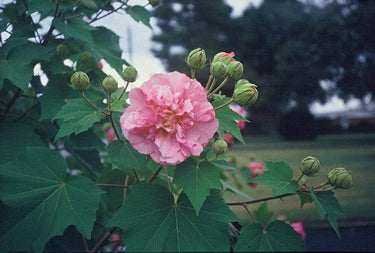


Confederate Rose
Hibiscus mutabilis 'Plena'
Pickup currently unavailable at Aiken Nursery
The name requires a brief clarification, and then we can move on to the more interesting parts. Hibiscus mutabilis has been called the Confederate rose since the nineteenth century, when the plant naturalized so thoroughly in the gardens of the American South that people assumed it belonged there. The plant does not. The species belongs to Hunan Province in China, where gardeners have grown the shrub for nearly three thousand years, where the flower serves as the emblem of Chengdu, a city known on its account as the City of Hibiscus, and where classical texts on materia medica describe the flowers and leaves in medicinal detail. The name stuck here out of regional habit rather than botanical or historical accuracy, and the plant is indifferent to the label.
What 'Plena' actually is: a fully double-flowered form of one of the most theatrically interesting shrubs available to Southern gardeners. The flowers of H. mutabilis change color over the course of a single day, driven by a steady accumulation of anthocyanins in the petals. A bloom opens white in the morning, blushes pink by midday, and deepens to rose-red by evening. In the straight species each flower lasts a day before dropping; in 'Plena' the fully double, peony-form flowers hold longer, and the layered petals make the color shift more gradual and more visible. On a mature plant in October you will find all three colors at once on the same shrub, white, pink, and red in various stages of the day's progression. The effect is anything but subtle.
The shrub is fast-growing and substantial. In the Deep South the plant can reach ten feet or more in a single season, carrying large, palmately lobed leaves with a soft, slightly fuzzy texture that lends a lush, almost tropical character. In zone 7 the top dies to the ground in winter and returns vigorously from the roots each spring; in zone 8 and warmer the plant grows effectively woody and persistent. Either way, the space is well earned.
Beyond the spectacle, the plant carries a long ethnobotanical history: in traditional Chinese medicine the leaves and flowers, known as Fu Rong, have been used for centuries in cooling poultices and washes for burns, boils, and skin inflammation. In the garden, give 'Plena' full sun and rich, moist, well-drained soil at the back of a large border or as a specimen with room to spread, and enjoy a shrub that saves the finest show for autumn, when so much else has finished.
- Hardiness
- USDA Zones 8–11
- Sun
- Full Sun
- Soil
- Moist, Well-drained
- Mature size
- Height 10–15 Feet · Spread 8–10 Feet
- Growth rate
- Fast
- Seasonality
- Deciduous
Double, opens white then pink then rose-red, late summer to fall
References & research
These statements have not been evaluated by the Food and Drug Administration. This information is shared for traditional and educational interest only and is not intended to diagnose, treat, cure, or prevent any disease. Please consult a qualified healthcare professional before any medicinal use.
- Traditionally used topically and in decoction
- Not a substitute for professional medical care
- Consult a qualified professional before use
From rooting to shipping, our top priority is ensuring you receive healthy, thriving plants for your garden’s success.
Because most of our plants are grown from rooted cuttings — alongside seed, air layering, and grafting chosen for each variety — you receive a stronger, true-to-type plant that establishes quickly in your garden.
Raised on organic soil blends and eco-friendly pest management — never harsh chemicals — your plant arrives healthy for your garden, your family, and the pollinators they feed.
Every purchase gives back. We donate to the Aiken Arboretum and support local wildlife conservation, so growing your garden helps protect the wider ecosystem too.

All our plant material is carefully propagated, grown, and nurtured at our humble nursery in Aiken, South Carolina.

Your plant arrives carefully packed and ready to settle in. Unpack them promptly, give them a day or two to acclimate, then plant following the notes we include — that’s all it takes. Clear care guidance comes with every order, so success is the easy part.
What to expect upon delivery
All our plants are sold in 1-gallon sizes, though the height of each plant can vary depending on its growth rate and seasonality, typically ranging from 1/2 to 2.5 feet.
Each plant is carefully packaged with its roots enclosed in a secure plastic bag containing moist soil, forming a compact root ball. To ensure safe transport, the box is padded with recycled newspaper, providing both stability and eco-friendly protection from weather during shipping.
What is your return policy?
Review our full return policy information on our SHIPPING AND RETURNS POLICY page.
What payment methods can I use?
We offer 35 different payment methods including major providers like Mastercard, Visa, PayPal, American Express and Diners as well as many different local payment methods including Klarna, iDEAL, AliPay, Sofort, giropay, and many more.
Can I make changes to my order after it’s been placed?
At Woodlanders, we strive to fulfill orders as quickly as possible. Therefore, we can only accommodate changes to your order within the first 24 hours after it has been placed. These changes include adding or removing products and modifying the delivery address. If you need to make any changes or if there has been a mistake with your order information, please reach out to us promptly via our CONTACT page with your order number for the quickest resolution.
Your satisfaction is our priority, and we appreciate your understanding and cooperation.