



Holboellia coriacea
Pickup currently unavailable at Aiken Nursery
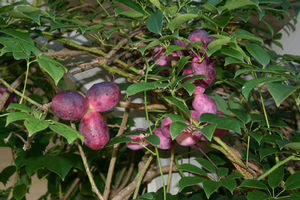
Holboellia coriacea is an evergreen twining vine from western China, glossy and leathery in the leaf, each one divided into three long leaflets held on a slender stalk so the whole plant hangs in layers rather than making a solid mat. In spring and early summer come clusters of small flowers, greenish white through to pale purple, and the scent is the surprise: intensely sweet and carrying, far out of proportion to flowers that most people walk straight past. Later, if the season and the siting are right, the vine produces the other trick, fat pinkish-purple pods shaped unmistakably like sausages, ripening into early winter.
Our plants were propagated from the Charlotte, North Carolina garden of the late Elizabeth Lawrence, the great Southern gardener and garden writer whose books taught two generations how to garden in this climate rather than pretending to be in England. That connection alone is reason enough to want the plant. Little-known in cultivation on either side of the Atlantic, the species was introduced to Britain by Ernest Wilson in 1907 and has never quite caught on, which is the usual fate of a vine whose best quality is a scent rather than a color.
The genus honors Frederik Ludvig Holbøll, a Danish botanist who ran the botanic garden at Copenhagen, and the epithet coriacea means leathery, for those thick evergreen leaflets. Holboellia sits in Lardizabalaceae, a small and rather exotic family of mostly Asian climbers that includes the chocolate vine, Akebia, and the resemblance is obvious once pointed out. The pods split open in late winter to show the seeds bedded in a mass of white jelly, and that jelly is edible, as Akebia pulp is in Japan. Whether the fruit is worth eating is another matter: accounts run from sweet but insipid to frankly bitter, the rind worse than the pulp, and nobody has ever grown this vine for the table. Treat the pods as a curiosity to try once rather than as a crop.
Male and female flowers are borne separately on the same plant, and fruit set is erratic: a vine in shade will flower and scent perfectly well and may never fruit, while the same vine given sun is far likelier to produce the sausages. Two plants of different origin improve the odds further. Grow the sausage vine on a shady or semi-shady arbor, pergola, or wall in the Southern garden, in moist, well-drained soil with organic matter, and give the twining stems something to wind around, since this plant climbs by twining rather than clinging and will not hold to bare masonry. Reckon on fifteen to twenty feet. Site the vine where people pass close in spring, because the scent is the whole point and is easy to miss from a distance. Hardy through USDA zones 7 to 9. Prune after flowering, and expect a vigorous grower that will want a firm hand on a small structure.
- Hardiness
- USDA Zones 7–9
- Sun
- Part Shade, Full Shade
- Soil
- Well-drained, Moist
- Mature size
- Height 15–20 Feet · Spread 6–10 Feet
- Growth rate
- Fast
- Seasonality
- Evergreen
- Provenance
- Propagated from the Charlotte, North Carolina garden of the late Elizabeth Lawrence, Southern gardener and garden writer. Preserved from the original Woodlanders catalog copy; no Odoo source recorded.
Clusters of small greenish-white to pale purple flowers in spring, intensely and sweetly fragrant
From rooting to shipping, our top priority is ensuring you receive healthy, thriving plants for your garden’s success.
Because most of our plants are grown from rooted cuttings — alongside seed, air layering, and grafting chosen for each variety — you receive a stronger, true-to-type plant that establishes quickly in your garden.
Raised on organic soil blends and eco-friendly pest management — never harsh chemicals — your plant arrives healthy for your garden, your family, and the pollinators they feed.
Every purchase gives back. We donate to the Aiken Arboretum and support local wildlife conservation, so growing your garden helps protect the wider ecosystem too.

All our plant material is carefully propagated, grown, and nurtured at our humble nursery in Aiken, South Carolina.

Your plant arrives carefully packed and ready to settle in. Unpack them promptly, give them a day or two to acclimate, then plant following the notes we include — that’s all it takes. Clear care guidance comes with every order, so success is the easy part.
What to expect upon delivery
All our plants are sold in 1-gallon sizes, though the height of each plant can vary depending on its growth rate and seasonality, typically ranging from 1/2 to 2.5 feet.
Each plant is carefully packaged with its roots enclosed in a secure plastic bag containing moist soil, forming a compact root ball. To ensure safe transport, the box is padded with recycled newspaper, providing both stability and eco-friendly protection from weather during shipping.
What is your return policy?
Review our full return policy information on our SHIPPING AND RETURNS POLICY page.
What payment methods can I use?
We offer 35 different payment methods including major providers like Mastercard, Visa, PayPal, American Express and Diners as well as many different local payment methods including Klarna, iDEAL, AliPay, Sofort, giropay, and many more.
Can I make changes to my order after it’s been placed?
At Woodlanders, we strive to fulfill orders as quickly as possible. Therefore, we can only accommodate changes to your order within the first 24 hours after it has been placed. These changes include adding or removing products and modifying the delivery address. If you need to make any changes or if there has been a mistake with your order information, please reach out to us promptly via our CONTACT page with your order number for the quickest resolution.
Your satisfaction is our priority, and we appreciate your understanding and cooperation.