


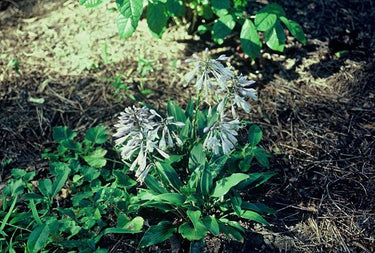

Late-Flowering Plantain Lily
Hosta longipes 'Tardiflora'
Pickup currently unavailable at Aiken Nursery
Hosta 'Tardiflora' announces the best trait in the name itself: tardiflora means late-flowering, and this small Japanese hosta is very nearly the last of the tribe to bloom, lifting lavender flowers in fall when most hostas have already finished and begun to tire. The plant traces back to the wild Hosta longipes, the long-stalked giboshi of Japan's rocky mountain slopes, where the species clings to cliffs and streambanks; 'Tardiflora' is a distinct, late seedling form long grown as a garden plant in its own right.
The plant is a study in neatness. Small, lance-shaped leaves of a deep, glossy green build a tight, low mound barely a foot high, each leaf carried on a petiole flushed with red at the base. Where big blue hostas sprawl and, at the first cold night of autumn, collapse into mush, 'Tardiflora' stays crisp and shapely well into fall, holding form just as the flowers arrive. The glossy leaf surface also sheds water and shrugs off much of the tattering that plagues thinner-leaved hostas.
That combination of late bloom and tidy substance made 'Tardiflora' a prize in the hands of breeders. In England, Eric Smith crossed the plant with the blue-leaved Hosta 'Elegans' to found the celebrated Tardiana group, the source of many of the best small blue hostas in gardens today, including old favorites like 'Halcyon'. For a plant so modest in stature, 'Tardiflora' casts a long shadow across the modern hosta world, standing quietly behind a whole lineage of garden selections.
In Japan, hostas are more than ornament: the tightly furled spring shoots of several species, known as urui, are gathered and eaten as a seasonal vegetable, a reminder that these shade plants have long shared human ground. In the garden, put 'Tardiflora' to work at the front of a shady bed, as edging along a woodland path, or in a tight drift where the fall flowers and glossy leaves close out the season. Ferns, small sedges, and epimediums make easy companions, and the late lavender scapes give bees one more visit before frost. Slugs and deer both admire hostas, so a sharp-draining site and a watchful eye help keep the mound pristine.
- Hardiness
- USDA Zones 5–9
- Sun
- Part Shade, Full Shade
- Soil
- Well-drained, Moist
- Mature size
- Height 10–12 Inches · Spread 10–12 Inches
- Growth rate
- Slow
- Seasonality
- Dies back, depends on zone
Lavender-purple, very late, on red-tinted scapes
From rooting to shipping, our top priority is ensuring you receive healthy, thriving plants for your garden’s success.
Because most of our plants are grown from rooted cuttings — alongside seed, air layering, and grafting chosen for each variety — you receive a stronger, true-to-type plant that establishes quickly in your garden.
Raised on organic soil blends and eco-friendly pest management — never harsh chemicals — your plant arrives healthy for your garden, your family, and the pollinators they feed.
Every purchase gives back. We donate to the Aiken Arboretum and support local wildlife conservation, so growing your garden helps protect the wider ecosystem too.

All our plant material is carefully propagated, grown, and nurtured at our humble nursery in Aiken, South Carolina.

Your plant arrives carefully packed and ready to settle in. Unpack them promptly, give them a day or two to acclimate, then plant following the notes we include — that’s all it takes. Clear care guidance comes with every order, so success is the easy part.
What to expect upon delivery
All our plants are sold in 1-gallon sizes, though the height of each plant can vary depending on its growth rate and seasonality, typically ranging from 1/2 to 2.5 feet.
Each plant is carefully packaged with its roots enclosed in a secure plastic bag containing moist soil, forming a compact root ball. To ensure safe transport, the box is padded with recycled newspaper, providing both stability and eco-friendly protection from weather during shipping.
What is your return policy?
Review our full return policy information on our SHIPPING AND RETURNS POLICY page.
What payment methods can I use?
We offer 35 different payment methods including major providers like Mastercard, Visa, PayPal, American Express and Diners as well as many different local payment methods including Klarna, iDEAL, AliPay, Sofort, giropay, and many more.
Can I make changes to my order after it’s been placed?
At Woodlanders, we strive to fulfill orders as quickly as possible. Therefore, we can only accommodate changes to your order within the first 24 hours after it has been placed. These changes include adding or removing products and modifying the delivery address. If you need to make any changes or if there has been a mistake with your order information, please reach out to us promptly via our CONTACT page with your order number for the quickest resolution.
Your satisfaction is our priority, and we appreciate your understanding and cooperation.