


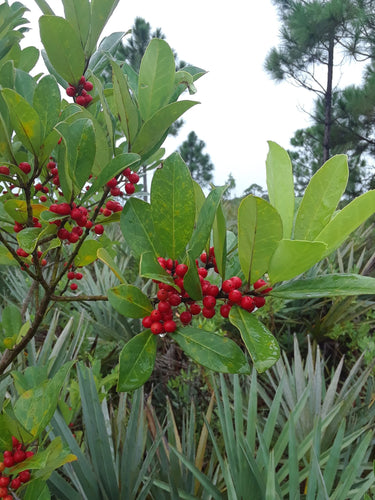


Carolina Holly or Sand Holly
Ilex ambigua
Pickup currently unavailable at Aiken Nursery
Ilex ambigua is the holly almost nobody offers, a medium to large deciduous shrub or small tree of ten to eighteen feet, running open and airy rather than dense. The leaves are small for a holly, thin, often glossy, and finely toothed, turning a soft yellow before falling. Female plants carry berries that are noticeably large for the size of the plant, bright red and handsome in early autumn, though in our experience here they drop rather sooner than the berries of most hollies, so this is a plant for early fall color rather than for a red Christmas. The habit is loose and the bark smooth gray, and the whole effect is closer to a small serviceberry than to the dense evergreen most people picture when they hear holly.
The name carries a small confession. André Michaux described the plant in 1803 as Prinos ambiguus, and Torrey moved the species into Ilex forty years later. Ambigua means doubtful or uncertain, applied here because the species so closely resembles several neighboring hollies that even careful botanists hesitate over herbarium sheets. Ilex itself is borrowed from the classical Latin name of the Mediterranean holm oak, whose leaves the European holly happens to imitate, a piece of botanical name-swapping that has confused people for two thousand years and shows no sign of stopping.
Carolina holly belongs to the sandhills and dry upland woods of the Coastal Plain, from North Carolina and Oklahoma south through Georgia, Alabama, the Gulf states, and into central Florida. This is a plant of poor sand and pine-oak scrub, of exactly the ground that defeats most nursery stock, and that tolerance is the strongest argument for growing it. Deciduous hollies as a group are notably valuable to wildlife: the flowers feed bees in spring and the fruit feeds birds and small mammals through autumn. Unlike the yaupon, Carolina holly carries no caffeine and no ceremonial tradition, which is probably why the species slipped out of the horticultural record almost entirely.
Hollies are dioecious, and this is the fact that matters most before you buy: berries appear only on female plants, and only when a male grows within pollinating distance. Plan for a group rather than a single specimen if fruit is the goal. Site in full sun to light shade on dry, sandy, sharply drained ground; heavy wet soil is the one thing Carolina holly genuinely dislikes. Once established the shrub is drought tolerant and largely self-sufficient. Use at a woodland edge, in a sandhill restoration, or in the transitional zone between garden and pine woods, alongside Vaccinium arboreum, Ilex vomitoria, and Quercus incana. This one is for collectors and native plant gardeners; nobody has ever bought a Carolina holly by accident.
- Hardiness
- USDA Zones 7–9
- Sun
- Full Sun, Part Shade
- Soil
- Well-drained
- Mature size
- Height 10–18 Feet · Spread 8–12 Feet
- Growth rate
- Moderate
- Seasonality
- Deciduous
small greenish white flowers in leaf axils in spring, male and female on separate plants
From rooting to shipping, our top priority is ensuring you receive healthy, thriving plants for your garden’s success.
Because most of our plants are grown from rooted cuttings — alongside seed, air layering, and grafting chosen for each variety — you receive a stronger, true-to-type plant that establishes quickly in your garden.
Raised on organic soil blends and eco-friendly pest management — never harsh chemicals — your plant arrives healthy for your garden, your family, and the pollinators they feed.
Every purchase gives back. We donate to the Aiken Arboretum and support local wildlife conservation, so growing your garden helps protect the wider ecosystem too.

All our plant material is carefully propagated, grown, and nurtured at our humble nursery in Aiken, South Carolina.

Your plant arrives carefully packed and ready to settle in. Unpack them promptly, give them a day or two to acclimate, then plant following the notes we include — that’s all it takes. Clear care guidance comes with every order, so success is the easy part.
What to expect upon delivery
All our plants are sold in 1-gallon sizes, though the height of each plant can vary depending on its growth rate and seasonality, typically ranging from 1/2 to 2.5 feet.
Each plant is carefully packaged with its roots enclosed in a secure plastic bag containing moist soil, forming a compact root ball. To ensure safe transport, the box is padded with recycled newspaper, providing both stability and eco-friendly protection from weather during shipping.
What is your return policy?
Review our full return policy information on our SHIPPING AND RETURNS POLICY page.
What payment methods can I use?
We offer 35 different payment methods including major providers like Mastercard, Visa, PayPal, American Express and Diners as well as many different local payment methods including Klarna, iDEAL, AliPay, Sofort, giropay, and many more.
Can I make changes to my order after it’s been placed?
At Woodlanders, we strive to fulfill orders as quickly as possible. Therefore, we can only accommodate changes to your order within the first 24 hours after it has been placed. These changes include adding or removing products and modifying the delivery address. If you need to make any changes or if there has been a mistake with your order information, please reach out to us promptly via our CONTACT page with your order number for the quickest resolution.
Your satisfaction is our priority, and we appreciate your understanding and cooperation.