


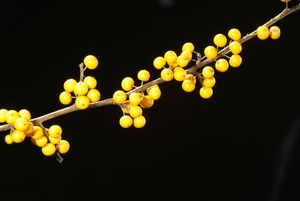

Possumhaw Holly, 'Finch's Golden'
Ilex decidua 'Finch's Golden'
Pickup currently unavailable at Aiken Nursery
Possumhaw is the deciduous holly of southern bottomlands, a shrub or small tree that spends the growing season looking like nothing in particular and then earns the whole year in December. The leaves drop, and what is left is a fine gray branch structure loaded with fruit that holds on bare wood through the winter. On the ordinary wild plant that fruit is red. Ilex decidua 'Finch's Golden' carries bright yellow fruit instead, a selection made by Bill Finch of Mobile, Alabama, and the difference against a gray winter sky is not subtle.
The species is native to bottomlands and moister upland sites across the southeastern United States, and one practical virtue sets possumhaw apart from the better-known winterberry: this holly is far better adapted to high-pH soils than Ilex verticillata, which sulks and yellows on limey ground. The name possumhaw comes from the wildlife that works the fruit over, and haw is the old word for a hedge fruit, the same haw as in hawthorn. The epithet decidua simply records the unholly-like habit of dropping every leaf.
Hollies are dioecious, male and female flowers on separate plants, and this matters commercially rather than as a curiosity. Small white flowers open in spring, and only a female plant will fruit, and only then if a male is within range of the bees. 'Finch's Golden' is a female. A male Ilex decidua planted nearby is the reliable answer; a male Ilex opaca will usually do the job, though the bloom times are a less certain match. Anyone buying this plant for the winter fruit should plan for a pollinator rather than hope for one. The berries are mildly toxic to people and are best left to the mockingbirds, cedar waxwings and robins that strip them by late winter.
Site 'Finch's Golden' where the winter silhouette will be seen from the house, against evergreens or a dark wall that will throw the yellow fruit forward, and reckon on twelve to fifteen feet in time. The plant takes full sun to part shade and a wide range of soils, wet or dry, acid or alkaline, which is a rare tolerance in a holly and makes possumhaw useful where little else fruits well. Limb the plant up as a small multi-stemmed tree to show the pale gray bark, or leave the shrub full to the ground as a screen. Hardy through USDA zones 5 to 9.
- Hardiness
- USDA Zones 5–9
- Sun
- Full Sun, Part Shade
- Soil
- Well-drained, Moist, Clay
- Mature size
- Height 12–15 Feet · Spread 6–10 Feet
- Growth rate
- Medium
- Seasonality
- Deciduous
- Provenance
- A yellow-fruited selection of the native possumhaw made by Bill Finch of Mobile, Alabama. Preserved from the original Woodlanders catalog copy; no Odoo source recorded.
Small white spring flowers, easily missed; the yellow winter fruit on bare branches is the point
From rooting to shipping, our top priority is ensuring you receive healthy, thriving plants for your garden’s success.
Because most of our plants are grown from rooted cuttings — alongside seed, air layering, and grafting chosen for each variety — you receive a stronger, true-to-type plant that establishes quickly in your garden.
Raised on organic soil blends and eco-friendly pest management — never harsh chemicals — your plant arrives healthy for your garden, your family, and the pollinators they feed.
Every purchase gives back. We donate to the Aiken Arboretum and support local wildlife conservation, so growing your garden helps protect the wider ecosystem too.

All our plant material is carefully propagated, grown, and nurtured at our humble nursery in Aiken, South Carolina.

Your plant arrives carefully packed and ready to settle in. Unpack them promptly, give them a day or two to acclimate, then plant following the notes we include — that’s all it takes. Clear care guidance comes with every order, so success is the easy part.
What to expect upon delivery
All our plants are sold in 1-gallon sizes, though the height of each plant can vary depending on its growth rate and seasonality, typically ranging from 1/2 to 2.5 feet.
Each plant is carefully packaged with its roots enclosed in a secure plastic bag containing moist soil, forming a compact root ball. To ensure safe transport, the box is padded with recycled newspaper, providing both stability and eco-friendly protection from weather during shipping.
What is your return policy?
Review our full return policy information on our SHIPPING AND RETURNS POLICY page.
What payment methods can I use?
We offer 35 different payment methods including major providers like Mastercard, Visa, PayPal, American Express and Diners as well as many different local payment methods including Klarna, iDEAL, AliPay, Sofort, giropay, and many more.
Can I make changes to my order after it’s been placed?
At Woodlanders, we strive to fulfill orders as quickly as possible. Therefore, we can only accommodate changes to your order within the first 24 hours after it has been placed. These changes include adding or removing products and modifying the delivery address. If you need to make any changes or if there has been a mistake with your order information, please reach out to us promptly via our CONTACT page with your order number for the quickest resolution.
Your satisfaction is our priority, and we appreciate your understanding and cooperation.