


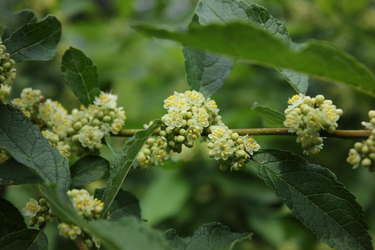


Winterberry Holly 'Southern Gentleman'
Ilex verticillata 'Southern Gentleman'
Pickup available at Aiken Nursery
Usually ready in 2-4 days
Every winterberry covered in red is hiding a secret, and his name is ‘Southern Gentleman’. Winterberry hollies are dioecious, male and female on separate plants, and only the pollinated females set the blazing red fruit the species is grown for. No male nearby, no berries. ‘Southern Gentleman’ is the male who makes the show possible, and asks for none of the credit.
His particular gift is timing. Winterberries only fruit when a male blooms in step with the female he is meant to pollinate, and the late-blooming clones, ‘Winter Red’ chief among them, need a male who flowers late to match. ‘Southern Gentleman’ is exactly that. He carries the pollen for ‘Winter Red’, ‘Winter Gold’, ‘Sparkleberry’, ‘Cacapon’, ‘Shaver’, ‘Sunset’, and the rest of the late crowd, and he is generous about the work: a single plant will service six to ten females within bee range, roughly forty to fifty feet, so one gentleman keeps a whole hedge in fruit. He came out of the nursery of Bob Simpson in Vincennes, Indiana, who first listed him under the unglamorous working name ‘Late Male’ before the better one stuck. Simpson bred him for a purpose: he introduced ‘Winter Red’ in the same era and selected this male expressly to pollinate her.
The distance guidance is a rule of thumb rather than a law. Hollies are pollinated by bees, wasps and ants, not by wind, so what really matters is that an insect can make the trip while both plants are in flower. Isolated female hollies have been recorded fruiting well anyway. Forty to fifty feet is a planning figure, not a fence, and the pairing that matters more is the one between bloom seasons. Match late to late, early to early, and the crop follows.
Do not write him off as merely useful. He makes a vigorous, upright, rounded shrub of glossy dark green that turns soft yellow-green and bronze-purple in fall, six to eight feet each way, and his small spring flowers hum with native bees doing the work he is there for. He will grow in the same wet feet the species loves, full sun to part shade, untroubled by clay or standing water as long as the soil stays acid. Native to the eastern wetlands, Ilex verticillata is one of our finest winter plants, and this is the one you plant so all the others can shine. Buy him for what he does, not for what he shows, and the red will follow.
- Hardiness
- USDA Zones 5–9
- Sun
- Full Sun, Part Shade
- Soil
- Moist, Well-drained, Acid
- Mature size
- Height 6–8 Feet · Spread 6–8 Feet
- Growth rate
- Slow to Moderate
- Seasonality
- Deciduous
Greenish-white, late spring; male, late-blooming pollinizer
From rooting to shipping, our top priority is ensuring you receive healthy, thriving plants for your garden’s success.
Because most of our plants are grown from rooted cuttings — alongside seed, air layering, and grafting chosen for each variety — you receive a stronger, true-to-type plant that establishes quickly in your garden.
Raised on organic soil blends and eco-friendly pest management — never harsh chemicals — your plant arrives healthy for your garden, your family, and the pollinators they feed.
Every purchase gives back. We donate to the Aiken Arboretum and support local wildlife conservation, so growing your garden helps protect the wider ecosystem too.

All our plant material is carefully propagated, grown, and nurtured at our humble nursery in Aiken, South Carolina.

Your plant arrives carefully packed and ready to settle in. Unpack them promptly, give them a day or two to acclimate, then plant following the notes we include — that’s all it takes. Clear care guidance comes with every order, so success is the easy part.
What to expect upon delivery
All our plants are sold in 1-gallon sizes, though the height of each plant can vary depending on its growth rate and seasonality, typically ranging from 1/2 to 2.5 feet.
Each plant is carefully packaged with its roots enclosed in a secure plastic bag containing moist soil, forming a compact root ball. To ensure safe transport, the box is padded with recycled newspaper, providing both stability and eco-friendly protection from weather during shipping.
What is your return policy?
Review our full return policy information on our SHIPPING AND RETURNS POLICY page.
What payment methods can I use?
We offer 35 different payment methods including major providers like Mastercard, Visa, PayPal, American Express and Diners as well as many different local payment methods including Klarna, iDEAL, AliPay, Sofort, giropay, and many more.
Can I make changes to my order after it’s been placed?
At Woodlanders, we strive to fulfill orders as quickly as possible. Therefore, we can only accommodate changes to your order within the first 24 hours after it has been placed. These changes include adding or removing products and modifying the delivery address. If you need to make any changes or if there has been a mistake with your order information, please reach out to us promptly via our CONTACT page with your order number for the quickest resolution.
Your satisfaction is our priority, and we appreciate your understanding and cooperation.