


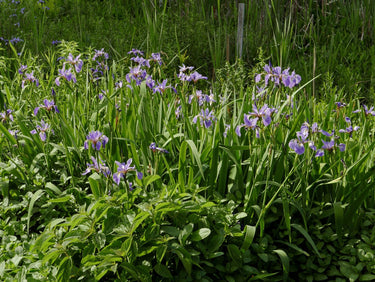


Southern Blue Flag
Iris virginica
Pickup available at Aiken Nursery
Usually ready in 2-4 days
Iris virginica takes the genus name that Linnaeus borrowed from Iris, the Greek goddess who carried messages along the rainbow, a fitting patron for a family that scatters every color through the flower. The species epithet virginica records where botanists first met the plant, in colonial Virginia, though Southern blue flag ranges far beyond, threading wet ground from the Chesapeake down through Florida and west to Texas, and north into the Midwest. In the wild the iris is an obligate wetland plant, at home in marshes, wet meadows, swamps, and the shallow margins of ponds where the roots can sit in standing water for weeks at a time.
From clumps of bright green, sword-shaped leaves, Southern blue flag lifts flowering stalks one to three feet high in late spring and early summer. Each bloom carries the classic iris architecture, three upright standards above three arching falls, painted in blue to deep violet and occasionally a clean white, with a bright yellow signal at the base of each fall that guides bumblebees toward the nectar. Gardeners sometimes confuse this species with the more northern harlequin blue flag, Iris versicolor, but Southern blue flag wears a bolder yellow flash, tolerates real heat, and often carries leaves that stand taller than the flowers.
The blue flags carry a long and cautionary human history. Cherokee and other Southeastern peoples dug the rhizomes in late summer, pounding the rhizome into a skin salve and steeping the root as an infusion for complaints of the liver and kidneys, and nineteenth-century Eclectic physicians later took up blue flag as a so-called blood purifier. All of that came with respect for a genuinely acrid root: the rhizomes hold iridin and volatile oils that irritate the skin and can turn sharply emetic if swallowed, so this is history to read rather than a recipe to try. In the garden the same toxicity is quietly useful, since deer and rabbits leave the foliage alone.
Southern blue flag earns a place wherever water collects. Set the iris along a pond or stream margin, in the wet heart of a rain garden, or in a boggy low spot that defeats most perennials, and give full sun to part shade; the plant will knit into loose colonies by creeping rhizome and stand as a vertical accent among the softer textures of sedges, rushes, and hardy hibiscus. In the Deep South the fans often hold half green through winter, while farther north the plant dies back to the ground and returns in spring. Mass a dozen for a sweep of late-spring violet, or tuck a single clump at the water's edge where the reflection can double the show.
- Hardiness
- USDA Zones 5–9
- Sun
- Full Sun, Part Shade
- Soil
- Moist
- Mature size
- Height 2–3 Feet · Spread 2–3 Feet
- Growth rate
- Medium
- Seasonality
- Dies back, depends on zone
Blue to deep violet flowers with a bright yellow signal on the falls, blooming late spring into early summer; occasional white forms.
These statements have not been evaluated by the Food and Drug Administration. This information is shared for traditional and educational interest only and is not intended to diagnose, treat, cure, or prevent any disease. Please consult a qualified healthcare professional before any medicinal use.
- Fresh rhizome is toxic and a strong irritant
- Ingestion can cause nausea, vomiting, and diarrhea
- Sap may irritate the skin
- Documented for traditional use only, not for self-treatment
- Keep away from children, pets, and livestock
From rooting to shipping, our top priority is ensuring you receive healthy, thriving plants for your garden’s success.
Because most of our plants are grown from rooted cuttings — alongside seed, air layering, and grafting chosen for each variety — you receive a stronger, true-to-type plant that establishes quickly in your garden.
Raised on organic soil blends and eco-friendly pest management — never harsh chemicals — your plant arrives healthy for your garden, your family, and the pollinators they feed.
Every purchase gives back. We donate to the Aiken Arboretum and support local wildlife conservation, so growing your garden helps protect the wider ecosystem too.

All our plant material is carefully propagated, grown, and nurtured at our humble nursery in Aiken, South Carolina.

Your plant arrives carefully packed and ready to settle in. Unpack them promptly, give them a day or two to acclimate, then plant following the notes we include — that’s all it takes. Clear care guidance comes with every order, so success is the easy part.
What to expect upon delivery
All our plants are sold in 1-gallon sizes, though the height of each plant can vary depending on its growth rate and seasonality, typically ranging from 1/2 to 2.5 feet.
Each plant is carefully packaged with its roots enclosed in a secure plastic bag containing moist soil, forming a compact root ball. To ensure safe transport, the box is padded with recycled newspaper, providing both stability and eco-friendly protection from weather during shipping.
What is your return policy?
Review our full return policy information on our SHIPPING AND RETURNS POLICY page.
What payment methods can I use?
We offer 35 different payment methods including major providers like Mastercard, Visa, PayPal, American Express and Diners as well as many different local payment methods including Klarna, iDEAL, AliPay, Sofort, giropay, and many more.
Can I make changes to my order after it’s been placed?
At Woodlanders, we strive to fulfill orders as quickly as possible. Therefore, we can only accommodate changes to your order within the first 24 hours after it has been placed. These changes include adding or removing products and modifying the delivery address. If you need to make any changes or if there has been a mistake with your order information, please reach out to us promptly via our CONTACT page with your order number for the quickest resolution.
Your satisfaction is our priority, and we appreciate your understanding and cooperation.