


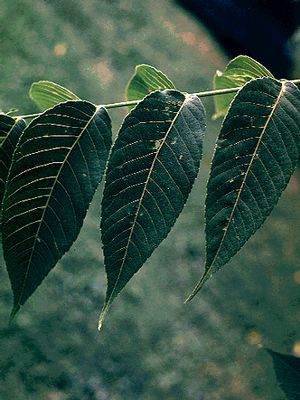

Black Walnut
Juglans nigra
Pickup available at Aiken Nursery
Usually ready in 2-4 days
Juglans nigra, the eastern black walnut, is one of the great trees of eastern North America, a towering, long-lived hardwood native from the Appalachians and Midwest to the Mississippi Valley, most at home in deep, rich, moist but well-drained soils along river bottoms and fertile uplands. Large pinnate leaves cast a broad, airy shade in summer, leaf out late in spring, and drop early in fall to a soft gold, making way for the tree's most famous gift, the crop of hard-shelled nuts.
Those nuts, held in thick green husks, carry rich, oily kernels with a deep, distinctive flavor, a staple of traditional Southern and Appalachian baking and the essential note behind black walnut cake and brownies. The crop feeds wildlife as much as people: squirrels, turkeys, and other woodland creatures depend on the mast. The husks and bark also gave the eastern tribes and later settlers a lasting brown and black dye, and an ink that stains anything it touches.
Black walnut holds a long place in traditional medicine, spanning Native American and European folk practice. The Cherokee chewed the bark for toothache and brewed it as a mild laxative tea, and the green hulls, rich in juglone and tannins, were used as an astringent wash and a folk antifungal and antiparasitic, a use that continues in herbal traditions today. Modern study confirms that juglone has antimicrobial activity, though rigorous clinical evidence is limited. This is traditional-use and early-research information, shared for interest only, and not medical advice.
The dark, fine-grained heartwood is among the most valuable of all American hardwoods, long prized for furniture, cabinetry, gunstocks, and veneer, so that to plant a black walnut is to grow a living heirloom for generations to come. In the landscape the tree is best on large properties, reaching fifty to eighty feet and sometimes more, a majestic shade tree and orchard specimen. Site with care: the roots, leaves, and hulls release juglone, a natural compound that inhibits many plants within the root zone, so keep sensitive species such as tomatoes, azaleas, and rhododendrons well clear.
- Hardiness
- USDA Zones 4–9
- Sun
- Full Sun
- Soil
- Moist, Well-drained
- Mature size
- Height 50–80 Feet · Spread 40–60 Feet
- Growth rate
- Moderate
- Seasonality
- Deciduous
Yellow-green wind-pollinated catkins in spring; large round nuts in thick green husks in fall
These statements have not been evaluated by the Food and Drug Administration. This information is shared for traditional and educational interest only and is not intended to diagnose, treat, cure, or prevent any disease. Please consult a qualified healthcare professional before any medicinal use.
- Juglone is toxic in quantity and stains skin, cloth, and surfaces.
- Folk antiparasitic use is not a substitute for medical treatment.
- Traditional and early-research information only, not medical advice.
From rooting to shipping, our top priority is ensuring you receive healthy, thriving plants for your garden’s success.
Because most of our plants are grown from rooted cuttings — alongside seed, air layering, and grafting chosen for each variety — you receive a stronger, true-to-type plant that establishes quickly in your garden.
Raised on organic soil blends and eco-friendly pest management — never harsh chemicals — your plant arrives healthy for your garden, your family, and the pollinators they feed.
Every purchase gives back. We donate to the Aiken Arboretum and support local wildlife conservation, so growing your garden helps protect the wider ecosystem too.

All our plant material is carefully propagated, grown, and nurtured at our humble nursery in Aiken, South Carolina.

Your plant arrives carefully packed and ready to settle in. Unpack them promptly, give them a day or two to acclimate, then plant following the notes we include — that’s all it takes. Clear care guidance comes with every order, so success is the easy part.
What to expect upon delivery
All our plants are sold in 1-gallon sizes, though the height of each plant can vary depending on its growth rate and seasonality, typically ranging from 1/2 to 2.5 feet.
Each plant is carefully packaged with its roots enclosed in a secure plastic bag containing moist soil, forming a compact root ball. To ensure safe transport, the box is padded with recycled newspaper, providing both stability and eco-friendly protection from weather during shipping.
What is your return policy?
Review our full return policy information on our SHIPPING AND RETURNS POLICY page.
What payment methods can I use?
We offer 35 different payment methods including major providers like Mastercard, Visa, PayPal, American Express and Diners as well as many different local payment methods including Klarna, iDEAL, AliPay, Sofort, giropay, and many more.
Can I make changes to my order after it’s been placed?
At Woodlanders, we strive to fulfill orders as quickly as possible. Therefore, we can only accommodate changes to your order within the first 24 hours after it has been placed. These changes include adding or removing products and modifying the delivery address. If you need to make any changes or if there has been a mistake with your order information, please reach out to us promptly via our CONTACT page with your order number for the quickest resolution.
Your satisfaction is our priority, and we appreciate your understanding and cooperation.