


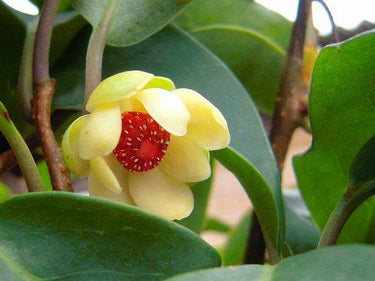


Chinese Kadsura Vine
Kadsura longipedunculata
In propagation
Currently rooting cuttings. Expected Winter 2028.
Add your name with the notify button below, and we will email you the moment this plant is ready to bring home.
Learn how we grow on The Prop House.
Pickup currently unavailable at Aiken Nursery
Kadsura longipedunculata is an evergreen twining vine of the star-anise family, Schisandraceae, native to the moist forests and shaded stream banks of southern and southwestern China. The leaves are narrow, glossy, dark green, and lightly toothed, carried on stems that climb without menace. The genus name comes from kazura, a Japanese word for a twining vine, and the species epithet means long-peduncled, for the slender stalks that let each flower hang clear of the foliage. Chinese gardeners and herbalists know the plant as nan wu wei zi, the southern five-flavor fruit, a nod to the close cousin Schisandra, whose berries are said to carry all five tastes at once. The French botanists Achille Finet and François Gagnepain gave the vine a formal name in 1905.
We obtained this species from Nanjing Botanic Garden in China, and so far as we can tell Woodlanders was the first nursery to offer the plant in this country. Very little of the species has ever made the trip west. What has arrived proves neat, clean, and vigorous in cultivation, hardy through USDA zones 7 to 10, and altogether easier to grow than the rarity would suggest. Your neighbor will likely not have this one.
The flower story here is one of the odder ones in botany. Unlike most of the genus, which keeps male and female plants separate, Kadsura longipedunculata is monoecious, carrying both kinds of flower on the same vine, so a single plant can set fruit alone. The blooms open at night from midsummer into early autumn, cream to pale yellow with some forms flushed red, warming themselves several degrees above the surrounding air and releasing a fruity scent dominated by methyl butyrate across a four or five hour window. The whole performance is aimed at one insect: a female gall midge of the genus Megommata, who arrives to eat pollen. The female flowers offer the same warmth and the same perfume and no reward whatsoever, a small deceit that gets them pollinated all the same. Fruit follows in fall as a rounded scarlet cluster of fleshy carpels, closer to a raspberry than to anything in the grape family, edible raw or cooked and fragrant enough that the oil has been pressed for perfume.
In China the roots and root bark are a long-standing article of the herbal trade, sold as hong mu xiang and zi jin pi, prepared as decoctions and wine infusions to move blood and ease the pain of rheumatism, traumatic injury, and gastric complaint, with the leaves turned to canker sores and menstrual trouble. Modern laboratories have taken an interest as well. Something over three hundred compounds have been catalogued from the plant, chiefly dibenzocyclooctadiene lignans of the kadsulignan and anwulignan sort along with schiartane triterpenoids, and early work has looked at hepatoprotective and sedative activity. All of that is best read as tradition and preliminary research, not as a prescription.
In the garden, treat this kadsura as a woodland-edge plant: rich, moist, well-drained soil, part shade, shelter from harsh afternoon sun and drying wind, and something to twine on. A fence, an arbor, a post at the corner of a shade border, or an old tree will all serve. The vine climbs to roughly eight or ten feet, sometimes twelve, twines rather than smothers, and holds glossy foliage through the winter across most of the range. Ferns, hydrangeas, aucuba, and Danae make good company below. Site the plant near a door or a path if you can, since the flowers do their work after dark and the scent is best met on a summer evening.
- Hardiness
- USDA Zones 7–10
- Sun
- Part Shade, Full Shade
- Soil
- Moist, Well-drained
- Mature size
- Height 8–12 Feet · Spread 3–6 Feet
- Growth rate
- Moderate
- Seasonality
- Evergreen
- Provenance
- Obtained by Woodlanders from Nanjing Botanic Garden, China; probably the first offering of this species in the United States.
Cream to pale yellow flowers, some forms flushed red, opening at night from midsummer to early autumn; rounded scarlet edible fruit in fall
These statements have not been evaluated by the Food and Drug Administration. This information is shared for traditional and educational interest only and is not intended to diagnose, treat, cure, or prevent any disease. Please consult a qualified healthcare professional before any medicinal use.
- Traditional use information only; not a substitute for professional medical care.
- Safety in pregnancy and while nursing has not been established.
- May interact with prescribed medicines; consult a qualified practitioner before use.
- Several Kadsura species are traded under similar Chinese names, so material is easily confused.
From rooting to shipping, our top priority is ensuring you receive healthy, thriving plants for your garden’s success.
Because most of our plants are grown from rooted cuttings — alongside seed, air layering, and grafting chosen for each variety — you receive a stronger, true-to-type plant that establishes quickly in your garden.
Raised on organic soil blends and eco-friendly pest management — never harsh chemicals — your plant arrives healthy for your garden, your family, and the pollinators they feed.
Every purchase gives back. We donate to the Aiken Arboretum and support local wildlife conservation, so growing your garden helps protect the wider ecosystem too.

All our plant material is carefully propagated, grown, and nurtured at our humble nursery in Aiken, South Carolina.

Your plant arrives carefully packed and ready to settle in. Unpack them promptly, give them a day or two to acclimate, then plant following the notes we include — that’s all it takes. Clear care guidance comes with every order, so success is the easy part.
What to expect upon delivery
All our plants are sold in 1-gallon sizes, though the height of each plant can vary depending on its growth rate and seasonality, typically ranging from 1/2 to 2.5 feet.
Each plant is carefully packaged with its roots enclosed in a secure plastic bag containing moist soil, forming a compact root ball. To ensure safe transport, the box is padded with recycled newspaper, providing both stability and eco-friendly protection from weather during shipping.
What is your return policy?
Review our full return policy information on our SHIPPING AND RETURNS POLICY page.
What payment methods can I use?
We offer 35 different payment methods including major providers like Mastercard, Visa, PayPal, American Express and Diners as well as many different local payment methods including Klarna, iDEAL, AliPay, Sofort, giropay, and many more.
Can I make changes to my order after it’s been placed?
At Woodlanders, we strive to fulfill orders as quickly as possible. Therefore, we can only accommodate changes to your order within the first 24 hours after it has been placed. These changes include adding or removing products and modifying the delivery address. If you need to make any changes or if there has been a mistake with your order information, please reach out to us promptly via our CONTACT page with your order number for the quickest resolution.
Your satisfaction is our priority, and we appreciate your understanding and cooperation.