




White Chinese Fringe Flower
Loropetalum chinense
In propagation
Currently growing out 1 Gallon pots. Expected Summer 2027.
Add your name with the notify button below, and we will email you the moment this plant is ready to bring home.
Learn how we grow on The Prop House.
Pickup currently unavailable at Aiken Nursery
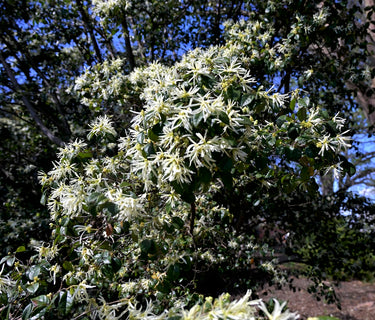
This Chinese evergreen shrub in the witch hazel family can become almost tree-like with age, reaching fifteen to twenty feet on a layered, wide-spreading frame. The leaves are small, dark green, and slightly rough, held densely enough to read as a solid mass from a distance. In early spring the whole shrub covers itself in white flowers built from narrow filamentous petals, four to a flower, giving the fringed effect that runs through the whole witch hazel family and a light sweet fragrance to go with it. That fringe is where the common name Chinese fringe flower comes from, though the name Chinese fringetree is more properly applied to another plant entirely, Chionanthus retusus.
The genus name is a small piece of precision: Loropetalum from the Greek loron, a strap or thong, and petalon, petal, describing exactly what you see. Hamamelidaceae puts this shrub in company with the witch hazels, Fothergilla, Corylopsis, and sweetgum, and the family resemblance is obvious once the flowers open. The wild range runs across southern China, Japan, and northeastern India.
Many purple-leaf and pink-flowered forms of this species have become very popular in recent years, to the point where most gardeners under a certain age have never seen anything else. This is the standard white-flowered form, occasionally seen in southern gardens where it has been grown for many years, and it is a quieter and in our view better plant: the white against dark green is cleaner than the pink against burgundy, the fragrance is stronger, and the mature layered habit is something the compact colored selections never achieve. Our propagation stock was taken from George's yard, off a plant of exactly that old southern kind. In China the species is ji mu, and leaves, flowers, and roots all enter traditional practice, chiefly as a hemostatic. Chewed leaves were a field remedy for staunching a small wound, and the plant carried uses for burns, dysentery, and diarrhea as well. The chemistry behind that is a heavy load of gallic acid tannins and flavonoids.
Plant in sun or semi-shade in soil that is well-drained but not droughty. Acid soil suits best, as it does most of the family. Growth is fast when young, so decide early what you want: left alone the shrub builds into a broad layered small tree worth standing under, and pruned it holds as a dense screen or a large informal hedge. Prune right after flowering, since buds form on growth made later in the season. Good with camellias, Osmanthus fragrans, Illicium, and hellebores beneath, and worth siting where the early bloom can be seen from a window, because it arrives before most of the garden has decided to wake up.
- Hardiness
- USDA Zones 7–9
- Sun
- Full Sun, Part Shade
- Soil
- Well-drained, Moist
- Mature size
- Height 15–20 Feet · Spread 10–15 Feet
- Growth rate
- Fast
- Seasonality
- Evergreen
white flowers of narrow strap-like petals, lightly fragrant, early spring
These statements have not been evaluated by the Food and Drug Administration. This information is shared for traditional and educational interest only and is not intended to diagnose, treat, cure, or prevent any disease. Please consult a qualified healthcare professional before any medicinal use.
- High tannin content can irritate the gastrointestinal tract in quantity
- Not evaluated for safety in pregnancy or while breastfeeding
- Consult a qualified practitioner before use
From rooting to shipping, our top priority is ensuring you receive healthy, thriving plants for your garden’s success.
Because most of our plants are grown from rooted cuttings — alongside seed, air layering, and grafting chosen for each variety — you receive a stronger, true-to-type plant that establishes quickly in your garden.
Raised on organic soil blends and eco-friendly pest management — never harsh chemicals — your plant arrives healthy for your garden, your family, and the pollinators they feed.
Every purchase gives back. We donate to the Aiken Arboretum and support local wildlife conservation, so growing your garden helps protect the wider ecosystem too.

All our plant material is carefully propagated, grown, and nurtured at our humble nursery in Aiken, South Carolina.

Your plant arrives carefully packed and ready to settle in. Unpack them promptly, give them a day or two to acclimate, then plant following the notes we include — that’s all it takes. Clear care guidance comes with every order, so success is the easy part.
What to expect upon delivery
All our plants are sold in 1-gallon sizes, though the height of each plant can vary depending on its growth rate and seasonality, typically ranging from 1/2 to 2.5 feet.
Each plant is carefully packaged with its roots enclosed in a secure plastic bag containing moist soil, forming a compact root ball. To ensure safe transport, the box is padded with recycled newspaper, providing both stability and eco-friendly protection from weather during shipping.
What is your return policy?
Review our full return policy information on our SHIPPING AND RETURNS POLICY page.
What payment methods can I use?
We offer 35 different payment methods including major providers like Mastercard, Visa, PayPal, American Express and Diners as well as many different local payment methods including Klarna, iDEAL, AliPay, Sofort, giropay, and many more.
Can I make changes to my order after it’s been placed?
At Woodlanders, we strive to fulfill orders as quickly as possible. Therefore, we can only accommodate changes to your order within the first 24 hours after it has been placed. These changes include adding or removing products and modifying the delivery address. If you need to make any changes or if there has been a mistake with your order information, please reach out to us promptly via our CONTACT page with your order number for the quickest resolution.
Your satisfaction is our priority, and we appreciate your understanding and cooperation.