


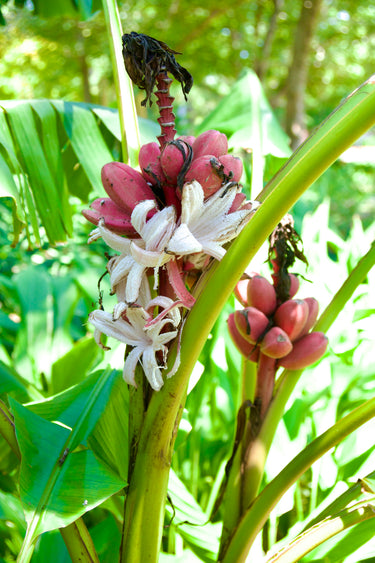


Pink Velvet Banana
Musa velutina
Pickup currently unavailable at Aiken Nursery
Every so often a plant does one strange, particular thing so well that the rest of the description turns into footnotes. Musa velutina is one of those. In late summer, from the top of a pseudostem no taller than a person, comes an upright spike of pink bracts and small tubular flowers, and behind the flowers a cluster of velvety pink bananas about three inches long. Then, when ripe, the fruits peel themselves. The skins split into curling strips and fold back on the stalk, exposing white flesh and a knot of hard black seeds, unprompted, in full view of whoever happens to be standing on the patio.
That habit, and the seeds, come from the wild side of the family. Grocery bananas are sterile triploid clones bred out of Musa acuminata and Musa balbisiana across thousands of years of human selection, and what was selected for above all was the absence of seeds. Musa velutina was never put through that process. The species remains a wild diploid from the eastern Himalaya and Assam, still doing what a banana does in a forest clearing: wrapping a bright, soft, sweet package around a payload of seeds, then opening the package so that something will come and carry them away. What reads on a terrace as a party trick is a dispersal strategy far older than the fruit bowl.
The name arrived twice. Sulpiz Kurz described the plant in 1867 as Musa dasycarpa, on a diagnosis of admirable brevity: fruits hairy. Hermann Wendland and Oscar Drude published Musa velutina in Gartenflora in 1875, with a plate, and that is the name that stuck and was later formally conserved, leaving the older one in the synonymy as a piece of nomenclatural housekeeping. Velutina comes from the medieval Latin velutum, velvet, and the word is exactly right; the fruits carry a soft nap you can feel under a thumb. The genus name is less settled. Some trace Musa to Antonius Musa, physician to the emperor Augustus; others to the Arabic mawz, which simply means banana and is probably the honest answer.
Across monsoon Asia a banana leaf is a working object long before anyone calls the plant ornamental. In Assam and the eastern Himalayan foothills the broad blades go on the table as plates, wrap food set over steam, and serve as an umbrella at short notice. The fruit here is edible and honestly sweet, and one caution comes with that: the seeds are large, hard, and numerous enough that most people try a single banana out of curiosity and never bother with a second. Grow this one for the sight of the fruit rather than for the eating, and count the flowers, which draw bees and hummingbirds through late summer, as part of the return.
Site the plant where low light can come through the leaves rather than only onto them; late sun behind a banana turns the blades into stained glass and lifts the pink midrib from clear across a garden. Full sun and a rich, moist, well-drained soil give the fastest growth and the best flowering, but find some shelter from wind, because a banana leaf in a gale shreds along the veins into a ragged fringe and stays that way until the next leaf unrolls. Four to eight feet tall and three to five wide is the settled size, small enough for a courtyard, a poolside bed, or a large pot that comes under cover for the winter. Pair with cannas, hardy gingers, elephant ears, or anything that answers a paddle leaf with a different shape.
In Aiken the top growth goes down with the first hard freeze, which is normal and not a failure. The rhizome is the hardy part, root hardy to somewhere near zero degrees Fahrenheit, and gardeners as far north as zone 7b carry the plant through winter reliably in full sun under a deep mulch. Cut the frozen stems back, pile on a foot of shredded leaves or straw, and wait. New shoots push up out of the ground in late spring, and the plant flowers again the same year.
- Hardiness
- USDA Zones 7–11
- Sun
- Full Sun, Part Shade
- Soil
- Moist, Well-drained, Rich
- Mature size
- Height 4–8 Feet · Spread 3–5 Feet
- Growth rate
- Fast
- Seasonality
- Dies back, depends on zone
Pink bracts with creamy yellow to orange tubular flowers on an erect spike, late summer into fall
From rooting to shipping, our top priority is ensuring you receive healthy, thriving plants for your garden’s success.
Because most of our plants are grown from rooted cuttings — alongside seed, air layering, and grafting chosen for each variety — you receive a stronger, true-to-type plant that establishes quickly in your garden.
Raised on organic soil blends and eco-friendly pest management — never harsh chemicals — your plant arrives healthy for your garden, your family, and the pollinators they feed.
Every purchase gives back. We donate to the Aiken Arboretum and support local wildlife conservation, so growing your garden helps protect the wider ecosystem too.

All our plant material is carefully propagated, grown, and nurtured at our humble nursery in Aiken, South Carolina.

Your plant arrives carefully packed and ready to settle in. Unpack them promptly, give them a day or two to acclimate, then plant following the notes we include — that’s all it takes. Clear care guidance comes with every order, so success is the easy part.
What to expect upon delivery
All our plants are sold in 1-gallon sizes, though the height of each plant can vary depending on its growth rate and seasonality, typically ranging from 1/2 to 2.5 feet.
Each plant is carefully packaged with its roots enclosed in a secure plastic bag containing moist soil, forming a compact root ball. To ensure safe transport, the box is padded with recycled newspaper, providing both stability and eco-friendly protection from weather during shipping.
What is your return policy?
Review our full return policy information on our SHIPPING AND RETURNS POLICY page.
What payment methods can I use?
We offer 35 different payment methods including major providers like Mastercard, Visa, PayPal, American Express and Diners as well as many different local payment methods including Klarna, iDEAL, AliPay, Sofort, giropay, and many more.
Can I make changes to my order after it’s been placed?
At Woodlanders, we strive to fulfill orders as quickly as possible. Therefore, we can only accommodate changes to your order within the first 24 hours after it has been placed. These changes include adding or removing products and modifying the delivery address. If you need to make any changes or if there has been a mistake with your order information, please reach out to us promptly via our CONTACT page with your order number for the quickest resolution.
Your satisfaction is our priority, and we appreciate your understanding and cooperation.