


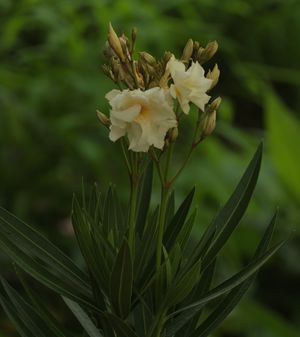

Oleander 'Double Yellow'
Nerium oleander 'Double Yellow'
Pickup currently unavailable at Aiken Nursery
The hardiest yellow oleander in cultivation, and one of the very few oleanders that come in yellow at all. Of the four hundred and more named cultivars of Nerium oleander, the genus runs naturally to white, pink, and red; yellow is the aberration, and a fully double yellow rarer still. 'Double Yellow' is the old French selection that fixed the color.
The cold-hardiness is no idle claim. After the 1984 freeze that drove temperatures to nine below zero Fahrenheit across much of the Southeast, the nursery Plant Delights surveyed which oleanders had come through. Most had not. This selection had, burned hard but back the following spring in full vigor, and the reputation has held ever since. 'Double Yellow' is reliable through zone 8 in the open and root-hardy through zone 7b with shelter, where the top dies back and resprouts to bloom on new wood the same season. Plants at Aiken reach eight feet and stay evergreen.
The flowers are soft primrose to buttery yellow, fully double and rose-like, lightly fragrant, borne in clusters at the branch tips from late June through September, over glossy dark green leathery leaves in whorls of three. Heat-tolerant, drought-tolerant, salt-tolerant, deer- and rabbit-proof, and indifferent to lean soil, this is the classic Mediterranean coastal plant doing exactly what a Mediterranean coastal plant does.
A toxicity note belongs in every oleander listing: all parts contain cardiac glycosides and are poisonous if eaten. The practical garden risk is low, since the bitterness keeps animals off and human cases are rare, and as the old Woodlanders catalog has always put it, oleander is poisonous but not likely to be ingested except by beach goers who choose oleander sticks to cook wieners. In short, do not grill on an oleander stick.
One for the southern coastal gardener, the heat-and-drought designer, the container gardener north of zone 8 willing to overwinter a tub indoors, or anyone who has ever been told that yellow oleanders do not really exist. Give full sun and sharp drainage, cut back hard in late winter to renew, and site away from where children or livestock might nibble.
- Hardiness
- USDA Zones 7–11
- Sun
- Full Sun
- Soil
- Well-drained
- Mature size
- Height 10–15 Feet · Spread 8–12 Feet
- Growth rate
- Fast
- Seasonality
- Evergreen
Double primrose-yellow, lightly fragrant, June to September
From rooting to shipping, our top priority is ensuring you receive healthy, thriving plants for your garden’s success.
Because most of our plants are grown from rooted cuttings — alongside seed, air layering, and grafting chosen for each variety — you receive a stronger, true-to-type plant that establishes quickly in your garden.
Raised on organic soil blends and eco-friendly pest management — never harsh chemicals — your plant arrives healthy for your garden, your family, and the pollinators they feed.
Every purchase gives back. We donate to the Aiken Arboretum and support local wildlife conservation, so growing your garden helps protect the wider ecosystem too.

All our plant material is carefully propagated, grown, and nurtured at our humble nursery in Aiken, South Carolina.

Your plant arrives carefully packed and ready to settle in. Unpack them promptly, give them a day or two to acclimate, then plant following the notes we include — that’s all it takes. Clear care guidance comes with every order, so success is the easy part.
What to expect upon delivery
All our plants are sold in 1-gallon sizes, though the height of each plant can vary depending on its growth rate and seasonality, typically ranging from 1/2 to 2.5 feet.
Each plant is carefully packaged with its roots enclosed in a secure plastic bag containing moist soil, forming a compact root ball. To ensure safe transport, the box is padded with recycled newspaper, providing both stability and eco-friendly protection from weather during shipping.
What is your return policy?
Review our full return policy information on our SHIPPING AND RETURNS POLICY page.
What payment methods can I use?
We offer 35 different payment methods including major providers like Mastercard, Visa, PayPal, American Express and Diners as well as many different local payment methods including Klarna, iDEAL, AliPay, Sofort, giropay, and many more.
Can I make changes to my order after it’s been placed?
At Woodlanders, we strive to fulfill orders as quickly as possible. Therefore, we can only accommodate changes to your order within the first 24 hours after it has been placed. These changes include adding or removing products and modifying the delivery address. If you need to make any changes or if there has been a mistake with your order information, please reach out to us promptly via our CONTACT page with your order number for the quickest resolution.
Your satisfaction is our priority, and we appreciate your understanding and cooperation.