


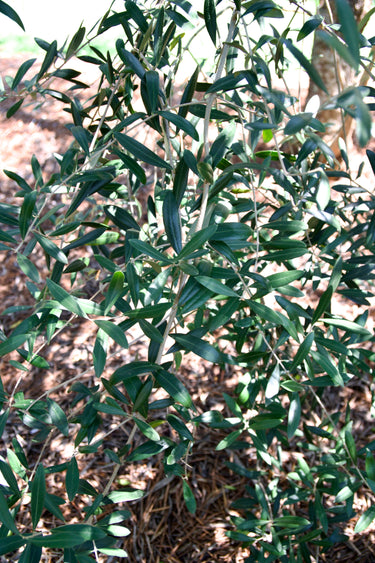

Farga Olive
Olea europaea 'Farga'
In propagation
Currently rooting cuttings. Expected Winter 2028.
Add your name with the notify button below, and we will email you the moment this plant is ready to bring home.
Learn how we grow on The Prop House.
Pickup currently unavailable at Aiken Nursery
The olive is an evergreen Mediterranean tree, sometimes a very large shrub, with narrow leathery leaves gray-green above and silver beneath, and small fragrant white flowers carried in axillary racemes in late summer. Fruit ripened in dry climates is the source of commercial olives and olive oil. In the humid Southeast the olive has never been a dependable fruit producer, whatever the winter hardiness, and the honest advice is to grow one here for the silver evergreen structure and treat any crop as a bonus. There is now a commercial grove in south Georgia, so perhaps a suitable variety has been found, though the University of Georgia's own assessment of adaptability and productiveness in the state remains carefully undecided.
Farga is the heirloom olive of the Baix Maestrat, the coastal country where Castellón meets southern Catalonia, and the variety carries a claim no other olive can make. That corner of Spain holds the largest concentration of millenary olive trees in the world, several thousand of them, with enormous hollow, fluted, gnarled trunks, and the great majority are Farga. Researchers at the Technical University of Madrid dated one, the Farga de l'Arión, at roughly seventeen hundred years, which puts that tree in contention for the oldest olive alive. The oil pressed from the ancient groves now carries a Slow Food Presidium of the Maestrat millenary trees.
Farga yields less than the modern workhorse varieties, and has been returning to favor for the very reasons that once counted against the variety: extreme longevity, real toughness on poor ground, and an unusual genetic makeup including a rare chlorotype that makes the population valuable to anyone studying olive resilience. Two practical notes follow from the biology. Farga is recorded as male sterile, so a second olive of a different variety needs to stand within pollen range for any fruit at all. And when a crop does come, the oil is picked early and tastes of that choice: medium bitterness, a definite peppery finish, and a green aroma of cut grass and unripe almond.
Grow as a multi-stemmed small tree at a terrace corner, along a drive, or against warm masonry where afternoon light can find the silver leaf undersides. Full sun without compromise, and sharp drainage above all else. Olives forgive poor rocky ground and do not forgive standing water, and Phytophthora root rot is the usual killer in this part of the world. Humidity brings peacock spot and anthracnose, both manageable with airflow pruning that opens the center of the canopy and with drip rather than overhead irrigation. Old trees go hollow and characterful, so choose a position worth keeping for decades.
This is a very old Spanish variety that we propagated originally from a tree at what was then Armstrong Atlantic State University in Savannah, Georgia. The current batch was struck from cuttings taken on the Armstrong Campus again in August of 2026.
- Hardiness
- USDA Zones 8–10
- Sun
- Full Sun
- Soil
- Well-drained
- Mature size
- Height 25–30 Feet · Spread 25–30 Feet
- Growth rate
- Slow
- Seasonality
- Evergreen
- Provenance
- Originally propagated by Woodlanders from a tree at what was then Armstrong Atlantic State University, Savannah, Georgia. This batch struck from cuttings taken on the Armstrong Campus again in August 2026.
Small fragrant white flowers in axillary racemes, late summer
From rooting to shipping, our top priority is ensuring you receive healthy, thriving plants for your garden’s success.
Because most of our plants are grown from rooted cuttings — alongside seed, air layering, and grafting chosen for each variety — you receive a stronger, true-to-type plant that establishes quickly in your garden.
Raised on organic soil blends and eco-friendly pest management — never harsh chemicals — your plant arrives healthy for your garden, your family, and the pollinators they feed.
Every purchase gives back. We donate to the Aiken Arboretum and support local wildlife conservation, so growing your garden helps protect the wider ecosystem too.

All our plant material is carefully propagated, grown, and nurtured at our humble nursery in Aiken, South Carolina.

Your plant arrives carefully packed and ready to settle in. Unpack them promptly, give them a day or two to acclimate, then plant following the notes we include — that’s all it takes. Clear care guidance comes with every order, so success is the easy part.
What to expect upon delivery
All our plants are sold in 1-gallon sizes, though the height of each plant can vary depending on its growth rate and seasonality, typically ranging from 1/2 to 2.5 feet.
Each plant is carefully packaged with its roots enclosed in a secure plastic bag containing moist soil, forming a compact root ball. To ensure safe transport, the box is padded with recycled newspaper, providing both stability and eco-friendly protection from weather during shipping.
What is your return policy?
Review our full return policy information on our SHIPPING AND RETURNS POLICY page.
What payment methods can I use?
We offer 35 different payment methods including major providers like Mastercard, Visa, PayPal, American Express and Diners as well as many different local payment methods including Klarna, iDEAL, AliPay, Sofort, giropay, and many more.
Can I make changes to my order after it’s been placed?
At Woodlanders, we strive to fulfill orders as quickly as possible. Therefore, we can only accommodate changes to your order within the first 24 hours after it has been placed. These changes include adding or removing products and modifying the delivery address. If you need to make any changes or if there has been a mistake with your order information, please reach out to us promptly via our CONTACT page with your order number for the quickest resolution.
Your satisfaction is our priority, and we appreciate your understanding and cooperation.