


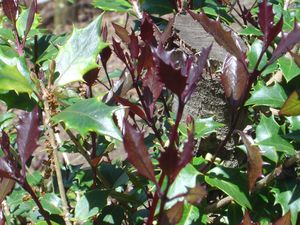

Holly Osmanthus
Osmanthus heterophyllus 'Purpureus'
In propagation
Currently growing out 1 Gallon pots. Expected Summer 2027.
Add your name with the notify button below, and we will email you the moment this plant is ready to bring home.
Learn how we grow on The Prop House.
Pickup currently unavailable at Aiken Nursery
Holly osmanthus is a large evergreen Asian shrub whose leaves do a convincing impression of holly, spined, glossy and hard, so convincing that people reach for the plant expecting berries and are surprised twice: first by the fragrance, and then by the fact that the leaves are set in opposite pairs, which no holly ever manages. 'Purpureus' adds one thing to that reliable frame. New growth breaks a deep purple-black, holds the color for weeks, and settles into dark green still tinged with purple, so the shrub flushes dark twice a year rather than green.
This clone was raised at Kew Gardens in England in 1880 and has been passed hand to hand ever since, and among growers 'Purpureus' carries a reputation as the most cold-hardy form of Osmanthus heterophyllus, which is why the plant turns up in gardens well north of where the species is usually attempted. The genus name is a plain description built from the Greek osme, fragrance, and anthos, flower. The epithet heterophyllus means variable-leaved, and the plant earns it: juvenile growth low on the shrub is fiercely spined, while the upper and older growth often loses the teeth entirely and goes smooth-edged. Osmanthus sits in Oleaceae, the olive family, alongside lilac, forsythia and jasmine.
The flowering is the reason to plant one where people walk. In autumn, small waxy white flowers open in tight clusters in the leaf axils, easy to miss on the branch and impossible to miss on the air, throwing a sweet apricot-and-jasmine scent that carries across a garden on a still October evening. This is a shrub sited by the nose rather than the eye. In Japan the related Osmanthus fragrans scents tea and sweets; holly osmanthus has no such culinary tradition and is grown for the perfume where it stands.
Use 'Purpureus' as a hedge, a screen, a barrier planting where the spined lower growth does real work, or as a slow specimen at ten to twelve feet, in sun or semi-shade in fertile, moist, well-drained soil. Set the shrub beside a path, a gate, or a door so the autumn scent is walked through rather than admired from a distance, and let the purple new growth read against something plain. Deer leave the plant alone, which the spines explain. Growth is slow, so buy the size you can wait for. Hardy through USDA zones 6 to 9. One honest caution: those spines are genuinely sharp, so keep the shrub back from where bare arms brush past.
- Hardiness
- USDA Zones 6–9
- Sun
- Full Sun, Part Shade
- Soil
- Well-drained, Moist
- Mature size
- Height 10–12 Feet · Spread 10–12 Feet
- Growth rate
- Slow
- Seasonality
- Evergreen
- Provenance
- A clone raised at the Royal Botanic Gardens, Kew, England in 1880. Preserved from the original Woodlanders catalog copy; no Odoo source recorded.
Tiny waxy white flowers in the leaf axils in autumn, powerfully fragrant of apricot and jasmine
From rooting to shipping, our top priority is ensuring you receive healthy, thriving plants for your garden’s success.
Because most of our plants are grown from rooted cuttings — alongside seed, air layering, and grafting chosen for each variety — you receive a stronger, true-to-type plant that establishes quickly in your garden.
Raised on organic soil blends and eco-friendly pest management — never harsh chemicals — your plant arrives healthy for your garden, your family, and the pollinators they feed.
Every purchase gives back. We donate to the Aiken Arboretum and support local wildlife conservation, so growing your garden helps protect the wider ecosystem too.

All our plant material is carefully propagated, grown, and nurtured at our humble nursery in Aiken, South Carolina.

Your plant arrives carefully packed and ready to settle in. Unpack them promptly, give them a day or two to acclimate, then plant following the notes we include — that’s all it takes. Clear care guidance comes with every order, so success is the easy part.
What to expect upon delivery
All our plants are sold in 1-gallon sizes, though the height of each plant can vary depending on its growth rate and seasonality, typically ranging from 1/2 to 2.5 feet.
Each plant is carefully packaged with its roots enclosed in a secure plastic bag containing moist soil, forming a compact root ball. To ensure safe transport, the box is padded with recycled newspaper, providing both stability and eco-friendly protection from weather during shipping.
What is your return policy?
Review our full return policy information on our SHIPPING AND RETURNS POLICY page.
What payment methods can I use?
We offer 35 different payment methods including major providers like Mastercard, Visa, PayPal, American Express and Diners as well as many different local payment methods including Klarna, iDEAL, AliPay, Sofort, giropay, and many more.
Can I make changes to my order after it’s been placed?
At Woodlanders, we strive to fulfill orders as quickly as possible. Therefore, we can only accommodate changes to your order within the first 24 hours after it has been placed. These changes include adding or removing products and modifying the delivery address. If you need to make any changes or if there has been a mistake with your order information, please reach out to us promptly via our CONTACT page with your order number for the quickest resolution.
Your satisfaction is our priority, and we appreciate your understanding and cooperation.