




White Patrinia
Patrinia villosa
In propagation
Currently growing out 1 Gallon pots. Expected Winter 2027.
Add your name with the notify button below, and we will email you the moment this plant is ready to bring home.
Learn how we grow on The Prop House.
Pickup currently unavailable at Aiken Nursery
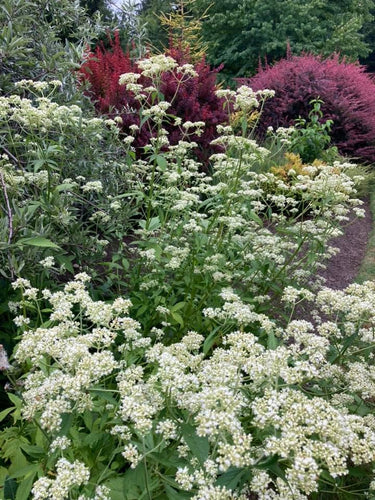
Patrinia villosa is a good perennial for warm climates, introduced to American gardens by Heronswood Nursery, and the appeal is easy to miss in a catalog photograph and obvious in a border. Broad flat clusters of small white flowers are held well clear of the foliage on wiry stems through summer, giving the effect of a white lace-cap floating above the planting rather than sitting in it. The basal leaves are coarsely toothed, ovate to rhomboid, and covered in the short white hairs that give the species its epithet. Plants run gently at the root, so a single crown widens into a colony over a few seasons without ever becoming a nuisance.
Patrinia honors Eugène Louis Melchior Patrin, a French naturalist who spent years travelling and collecting in Siberia in the late eighteenth century, and villosa simply means hairy, for those softly furred stems and leaves. The genus has moved house botanically: the old family Valerianaceae has been folded into Caprifoliaceae, so this plant is now formally a relative of honeysuckle and valerian alike. The wild range covers China, Japan, Korea, and Taiwan, on grassy slopes, forest margins, and thickets from four hundred to fifteen hundred meters.
In China the plant is bai jiang cao, and the name is a piece of blunt honesty: bai jiang means something close to spoiled fermented sauce, for the distinctly sour smell of the dried root. Patrinia villosa is one of two species accepted in the Chinese Pharmacopoeia under that name, the other being Patrinia scabiosifolia, and the herb goes back to the Shen Nong Ben Cao Jing, the foundational Chinese materia medica, where it is listed among the middle-grade medicines. Traditional use centers on clearing heat and resolving toxicity, and above all on internal abscesses, particularly of the intestines. Modern laboratory work has looked at anti-inflammatory and hepatoprotective activity in the extracts.
Grow in full sun to light shade in ordinary garden soil with reasonable moisture; nothing here is fussy. The airy flower heads are made for weaving through a sunny border, softening stiffer neighbors and reading as a haze rather than a block of color, which is exactly the job that Ammi and Selinum do in cooler gardens and that neither will do reliably in the Southeast. Good with Rudbeckia, Echinacea, Amsonia, ornamental grasses, and late asters. Deer generally leave the plants alone. Cut the whole clump to the ground in late winter and expect fresh growth well before spring is finished. One practical note: the flowering stems last well when cut, though the faint sour scent that gave the plant its Chinese name is more noticeable indoors than out.
- Hardiness
- USDA Zones 5–8
- Sun
- Full Sun, Part Shade
- Soil
- Moist, Well-drained
- Mature size
- Height 2–3 Feet · Spread 2–3 Feet
- Growth rate
- Moderate
- Seasonality
- Dies back, depends on zone
broad flat clusters of small white flowers held well above the foliage, through summer
These statements have not been evaluated by the Food and Drug Administration. This information is shared for traditional and educational interest only and is not intended to diagnose, treat, cure, or prevent any disease. Please consult a qualified healthcare professional before any medicinal use.
- Not evaluated for safety in pregnancy or while breastfeeding
- Traditionally regarded as a cooling herb and unsuitable for those with cold or deficient constitutions
- Consult a qualified practitioner before use
From rooting to shipping, our top priority is ensuring you receive healthy, thriving plants for your garden’s success.
Because most of our plants are grown from rooted cuttings — alongside seed, air layering, and grafting chosen for each variety — you receive a stronger, true-to-type plant that establishes quickly in your garden.
Raised on organic soil blends and eco-friendly pest management — never harsh chemicals — your plant arrives healthy for your garden, your family, and the pollinators they feed.
Every purchase gives back. We donate to the Aiken Arboretum and support local wildlife conservation, so growing your garden helps protect the wider ecosystem too.

All our plant material is carefully propagated, grown, and nurtured at our humble nursery in Aiken, South Carolina.

Your plant arrives carefully packed and ready to settle in. Unpack them promptly, give them a day or two to acclimate, then plant following the notes we include — that’s all it takes. Clear care guidance comes with every order, so success is the easy part.
What to expect upon delivery
All our plants are sold in 1-gallon sizes, though the height of each plant can vary depending on its growth rate and seasonality, typically ranging from 1/2 to 2.5 feet.
Each plant is carefully packaged with its roots enclosed in a secure plastic bag containing moist soil, forming a compact root ball. To ensure safe transport, the box is padded with recycled newspaper, providing both stability and eco-friendly protection from weather during shipping.
What is your return policy?
Review our full return policy information on our SHIPPING AND RETURNS POLICY page.
What payment methods can I use?
We offer 35 different payment methods including major providers like Mastercard, Visa, PayPal, American Express and Diners as well as many different local payment methods including Klarna, iDEAL, AliPay, Sofort, giropay, and many more.
Can I make changes to my order after it’s been placed?
At Woodlanders, we strive to fulfill orders as quickly as possible. Therefore, we can only accommodate changes to your order within the first 24 hours after it has been placed. These changes include adding or removing products and modifying the delivery address. If you need to make any changes or if there has been a mistake with your order information, please reach out to us promptly via our CONTACT page with your order number for the quickest resolution.
Your satisfaction is our priority, and we appreciate your understanding and cooperation.