


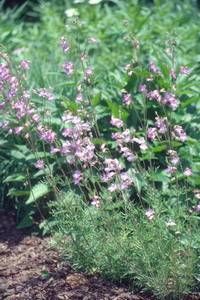

Dissected Beardtongue
Penstemon dissectus
In propagation
Currently growing out 1 Quart pots. Expected Winter 2027.
Add your name with the notify button below, and we will email you the moment this plant is ready to bring home.
Learn how we grow on The Prop House.
Pickup currently unavailable at Aiken Nursery
This rare Penstemon is a very attractive perennial with deeply cut, fern-like leaves and tall spikes of pinkish-violet flowers, each two-lipped tube carrying the yellow-bearded sterile stamen that gives the genus the name beardtongue. The dissected foliage is not merely a nice feature; it is unique in the entire genus, and no other Penstemon anywhere in the world has leaves like these. Bloom comes in late spring on stems of a foot to two, held well above a low basal clump.
The range is about as small as a range gets. Penstemon dissectus occurs only in Georgia, and only around the sandstone outcrops of the Altamaha Grit, a formation on the coastal plain that surfaces in scattered patches through longleaf pine and scrub oak woodland and supports a whole suite of plants found nowhere else. The habitat is exactly what the old catalog description says: sunny situations on shallow soil over rock, often with water seeping across it in winter and spring and baking dry by summer. That combination, wet feet in the cool season and hard drought in the hot one, is unusual and explains a good deal about how the plant behaves in a garden.
Being an endemic on a rare and shrinking habitat, this species carries real conservation weight. The outcrops are threatened by trash dumping and off-road vehicle damage, and there are not many of them. Nursery-propagated stock matters here in a way it does not for a common plant: growing it well in gardens takes pressure off wild populations and keeps material in circulation. Probably first made available to gardeners by Woodlanders, and still offered by almost nobody else. The stock behind our current plants was collected by Jonas Meyer.
The good news for gardeners is that it does well in ordinary garden soil, provided that soil drains. Full sun, lean ground, and no standing water in summer; a raised bed, a rock garden, a gravel garden, or the top of a wall all suit. Like most penstemons the enemy is winter wet on a heavy soil, not cold. Cut the spent flower stems after bloom and leave the basal rosette alone. Plants are relatively short-lived, as the genus tends to be, so let some seed ripen and drop if you want a colony to persist. Good with Coreopsis, Liatris, Phemeranthus teretifolius, and little bluestem, which is close to the company it keeps in the wild.
- Hardiness
- USDA Zones 6–9
- Sun
- Full Sun
- Soil
- Well-drained
- Mature size
- Height 1–2 Feet · Spread 1–2 Feet
- Growth rate
- Moderate
- Seasonality
- Dies back, depends on zone
spikes of pinkish-violet two-lipped tubular flowers with a yellow-bearded staminode, late spring
From rooting to shipping, our top priority is ensuring you receive healthy, thriving plants for your garden’s success.
Because most of our plants are grown from rooted cuttings — alongside seed, air layering, and grafting chosen for each variety — you receive a stronger, true-to-type plant that establishes quickly in your garden.
Raised on organic soil blends and eco-friendly pest management — never harsh chemicals — your plant arrives healthy for your garden, your family, and the pollinators they feed.
Every purchase gives back. We donate to the Aiken Arboretum and support local wildlife conservation, so growing your garden helps protect the wider ecosystem too.

All our plant material is carefully propagated, grown, and nurtured at our humble nursery in Aiken, South Carolina.

Your plant arrives carefully packed and ready to settle in. Unpack them promptly, give them a day or two to acclimate, then plant following the notes we include — that’s all it takes. Clear care guidance comes with every order, so success is the easy part.
What to expect upon delivery
All our plants are sold in 1-gallon sizes, though the height of each plant can vary depending on its growth rate and seasonality, typically ranging from 1/2 to 2.5 feet.
Each plant is carefully packaged with its roots enclosed in a secure plastic bag containing moist soil, forming a compact root ball. To ensure safe transport, the box is padded with recycled newspaper, providing both stability and eco-friendly protection from weather during shipping.
What is your return policy?
Review our full return policy information on our SHIPPING AND RETURNS POLICY page.
What payment methods can I use?
We offer 35 different payment methods including major providers like Mastercard, Visa, PayPal, American Express and Diners as well as many different local payment methods including Klarna, iDEAL, AliPay, Sofort, giropay, and many more.
Can I make changes to my order after it’s been placed?
At Woodlanders, we strive to fulfill orders as quickly as possible. Therefore, we can only accommodate changes to your order within the first 24 hours after it has been placed. These changes include adding or removing products and modifying the delivery address. If you need to make any changes or if there has been a mistake with your order information, please reach out to us promptly via our CONTACT page with your order number for the quickest resolution.
Your satisfaction is our priority, and we appreciate your understanding and cooperation.