




Fever Tree, Georgia Bark
Pinckneya bracteata (pubens)
In propagation
Currently rooting cuttings. Expected Winter 2028.
Add your name with the notify button below, and we will email you the moment this plant is ready to bring home.
Learn how we grow on The Prop House.
Pickup currently unavailable at Aiken Nursery
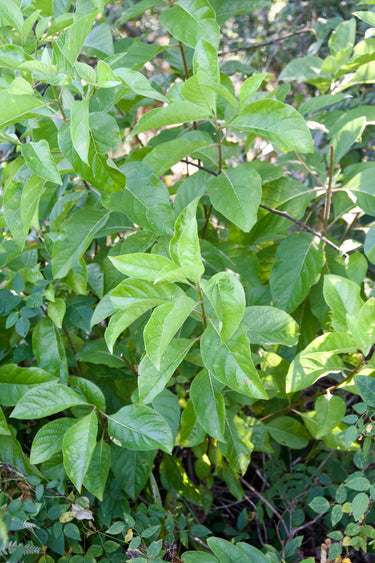
Pinckneya is a large shrub or small deciduous tree with showy pink flowers that are not flowers at all. What carries the colour is a single enlarged sepal on some of the blooms, expanded into a soft rose-pink blade three or four inches long, so a tree in full display looks convincingly like a poinsettia that has escaped into a Georgia bog. The true flowers are smaller, greenish-yellow, tubular, and easy to overlook beside the bracts. The leaves are oval and four to five inches long, and the whole plant is loose and open rather than dense.
The range is small and particular: scattered locations from southeastern South Carolina through Georgia into Florida, always in moist, acid ground that is not subject to standing water. In the wild you find the tree along the edges of bayheads, in pitcher-plant bogs, at the margins of swamp forest, and in moist pine and cypress savanna. That habitat description is also the growing instruction, and it explains the plant's reputation. Pinckneya is not an easy plant to grow, but the tree grows well where the tree is happy, and is striking when in flower. Plant in sun or part shade, in acid soil that stays moist without ever going stagnant, and do not fight the plant on drainage.
The common name Feverbark alludes to the tree having once been used as a substitute for quinine to treat malaria, and the claim has better foundations than most folk remedies. Pinckneya sits in the Rubiaceae, the coffee and madder family, in close company with Cinchona, the South American genus that is the actual source of quinine. The inner bark is bitter and was collected in Georgia and Florida for intermittent fevers through the eighteenth and nineteenth centuries, with nineteenth-century medical writers rating the bark as nearly equal to the official Peruvian article. The genus commemorates Charles Cotesworth Pinckney, the South Carolina soldier and statesman, and the species was described from William Bartram's collections, which puts this tree in the same historical company as Franklinia.
A connoisseur plant, rare and not readily available, and worth the trouble for anyone with the right ground. Site the tree at a pond edge, in a rain garden, or in the moist low corner most gardens have and few know what to do with, where the bracts can be seen against dark evergreen. Nursery-propagated plants also keep a scarce Southeastern native in cultivation, which matters for a species this narrowly distributed. Our cuttings came from Screven County, Georgia, in August 2026, on the same collecting trip that produced the Armstrong campus material.
- Hardiness
- USDA Zones 7–9
- Sun
- Full Sun, Part Shade
- Soil
- Moist
- Mature size
- Height 10–25 Feet · Spread 8–15 Feet
- Growth rate
- Medium
- Seasonality
- Deciduous
- Provenance
- Cuttings taken in Screven County, Georgia, August 2026, on the same collecting trip as the Armstrong Campus material.
Showy rose-pink bracts 3 to 4 inches long over small greenish-yellow tubular flowers, late spring into summer
From rooting to shipping, our top priority is ensuring you receive healthy, thriving plants for your garden’s success.
Because most of our plants are grown from rooted cuttings — alongside seed, air layering, and grafting chosen for each variety — you receive a stronger, true-to-type plant that establishes quickly in your garden.
Raised on organic soil blends and eco-friendly pest management — never harsh chemicals — your plant arrives healthy for your garden, your family, and the pollinators they feed.
Every purchase gives back. We donate to the Aiken Arboretum and support local wildlife conservation, so growing your garden helps protect the wider ecosystem too.

All our plant material is carefully propagated, grown, and nurtured at our humble nursery in Aiken, South Carolina.

Your plant arrives carefully packed and ready to settle in. Unpack them promptly, give them a day or two to acclimate, then plant following the notes we include — that’s all it takes. Clear care guidance comes with every order, so success is the easy part.
What to expect upon delivery
All our plants are sold in 1-gallon sizes, though the height of each plant can vary depending on its growth rate and seasonality, typically ranging from 1/2 to 2.5 feet.
Each plant is carefully packaged with its roots enclosed in a secure plastic bag containing moist soil, forming a compact root ball. To ensure safe transport, the box is padded with recycled newspaper, providing both stability and eco-friendly protection from weather during shipping.
What is your return policy?
Review our full return policy information on our SHIPPING AND RETURNS POLICY page.
What payment methods can I use?
We offer 35 different payment methods including major providers like Mastercard, Visa, PayPal, American Express and Diners as well as many different local payment methods including Klarna, iDEAL, AliPay, Sofort, giropay, and many more.
Can I make changes to my order after it’s been placed?
At Woodlanders, we strive to fulfill orders as quickly as possible. Therefore, we can only accommodate changes to your order within the first 24 hours after it has been placed. These changes include adding or removing products and modifying the delivery address. If you need to make any changes or if there has been a mistake with your order information, please reach out to us promptly via our CONTACT page with your order number for the quickest resolution.
Your satisfaction is our priority, and we appreciate your understanding and cooperation.