


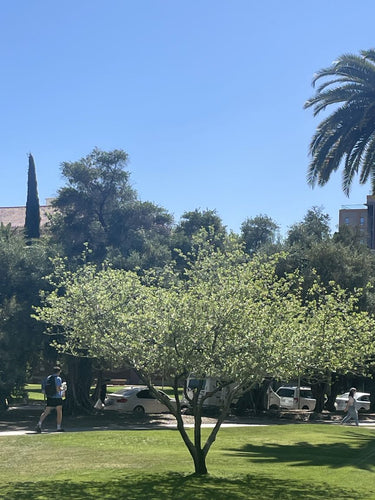


Arizona White Oak
Quercus arizonica
Pickup currently unavailable at Aiken Nursery
Quercus arizonica is the heavy, pale-barked white oak of the Madrean Sky Islands, the ranges that lift out of the desert in southeastern Arizona, southwestern New Mexico, west Texas, and northern Mexico. Growth is slow and the frame is broad: stout limbs, an irregularly spreading crown, and in time a trunk three feet through on a tree capable of sixty feet where the site allows, though garden specimens usually settle nearer thirty. The leaves give the species away, thick and stiff as harness leather, blue-green above and conspicuously pale and felted beneath, holding through most winters and dropping only as new growth pushes in spring. Old bark goes ashy white and deeply furrowed, which is where the common name comes from.
Arizonica is straightforward, though the range runs well past Arizona, through New Mexico and the Trans-Pecos into Chihuahua, Coahuila, Durango, and Sonora, mostly between five and seven thousand feet on rocky slopes and canyon sides. Quercus is the classical Latin name, and this species sits in the white oak group, the lineage whose acorns are comparatively sweet and ripen in a single season rather than two. Hybridizing runs rampant among the Madrean oaks, and Arizona white oak crosses freely with several neighbors, which is a good part of why field identification in that country remains a running argument among botanists.
Acorns from the white oak group carry far less tannin than those of the red oaks, and the peoples of the Southwest ground them into meal after leaching, though where there was a choice the acorns of several neighboring oaks were preferred. The wood is dense and burns hot, and Arizona white oak has been cut for fuel and fence posts for as long as anyone has kept records. In the Sky Island woodlands the species is a keystone: acorns feed black bear, javelina, deer, wild turkey, and the Mexican jay, and the broad crowns hold up the canopy of an ecosystem that exists nowhere else on earth.
In cultivation this is a tree for gardeners who want something nobody else on the street has and who can offer a hot, open, sharply drained site. Full sun, lean soil, and restraint with the hose once established; the roots resent the steady moisture that suits an eastern oak perfectly well. Hardy through zone 7 and untroubled by heat, drought, or alkaline ground. Expect slow growth and low branching unless you prune for clearance early. One practical note: leaf retention shifts with the winter, so in mild years the foliage holds right through and in hard ones the leaves brown and drop, which is worth knowing before siting the tree where you want dependable winter screening.
- Hardiness
- USDA Zones 7–10
- Sun
- Full Sun
- Soil
- Well-drained
- Mature size
- Height 20–50 Feet · Spread 20–30 Feet
- Growth rate
- Slow
- Seasonality
- Semi-Evergreen
pendulous yellow-green male catkins in spring, inconspicuous female flowers, acorns ripening in a single season
From rooting to shipping, our top priority is ensuring you receive healthy, thriving plants for your garden’s success.
Because most of our plants are grown from rooted cuttings — alongside seed, air layering, and grafting chosen for each variety — you receive a stronger, true-to-type plant that establishes quickly in your garden.
Raised on organic soil blends and eco-friendly pest management — never harsh chemicals — your plant arrives healthy for your garden, your family, and the pollinators they feed.
Every purchase gives back. We donate to the Aiken Arboretum and support local wildlife conservation, so growing your garden helps protect the wider ecosystem too.

All our plant material is carefully propagated, grown, and nurtured at our humble nursery in Aiken, South Carolina.

Your plant arrives carefully packed and ready to settle in. Unpack them promptly, give them a day or two to acclimate, then plant following the notes we include — that’s all it takes. Clear care guidance comes with every order, so success is the easy part.
What to expect upon delivery
All our plants are sold in 1-gallon sizes, though the height of each plant can vary depending on its growth rate and seasonality, typically ranging from 1/2 to 2.5 feet.
Each plant is carefully packaged with its roots enclosed in a secure plastic bag containing moist soil, forming a compact root ball. To ensure safe transport, the box is padded with recycled newspaper, providing both stability and eco-friendly protection from weather during shipping.
What is your return policy?
Review our full return policy information on our SHIPPING AND RETURNS POLICY page.
What payment methods can I use?
We offer 35 different payment methods including major providers like Mastercard, Visa, PayPal, American Express and Diners as well as many different local payment methods including Klarna, iDEAL, AliPay, Sofort, giropay, and many more.
Can I make changes to my order after it’s been placed?
At Woodlanders, we strive to fulfill orders as quickly as possible. Therefore, we can only accommodate changes to your order within the first 24 hours after it has been placed. These changes include adding or removing products and modifying the delivery address. If you need to make any changes or if there has been a mistake with your order information, please reach out to us promptly via our CONTACT page with your order number for the quickest resolution.
Your satisfaction is our priority, and we appreciate your understanding and cooperation.