


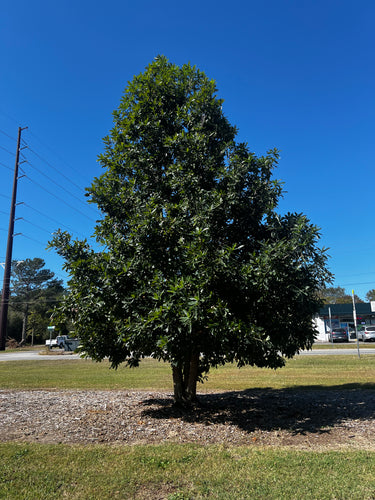


Mexican Royal Oak
Quercus germana
Pickup available at Aiken Nursery
Usually ready in 2-4 days
Schlechtendal and Chamisso published this oak in 1830 from material gathered around Jalapa, in Veracruz, and the epithet they settled on, germana, is the Latin word for genuine, true, of the same stock. Neither botanist left a note explaining the choice. The common names have been more generous since: royal oak, encino roble, and best of all avocado-leaf oak, for foliage so long, leathery, and lustrous that the leaves could pass for those of a Persea. In the cloud forests where both trees grow, the resemblance is more than a coincidence of shape; the two share the same wet, mild, dripping world.
Woodlanders has a particular stake in this tree. Roughly fifteen years ago Bob McCartney planted a royal oak on Park Avenue in Aiken, along the mile-long median that runs beside the railroad tracks, as part of the Aiken Citywide Arboretum. That arboretum is an odd and wonderful thing, not a fenced parcel but every public and private tree within four miles of downtown, grown out of the experimental street plantings Woodlanders began along Colleton Avenue in the 1980s, and now holding well over a hundred and seventy oak species, the largest gathering of Quercus anywhere in America. In November of 2013, when the International Oak Society brought oak people from nine states and two foreign countries to walk that trail, the royal oak was the second tree on the tour, described by one of the visitors as small, nice, and complete with exactly one acorn. Every plant offered here was grown from the acorns of that tree, which has run on through South Carolina winters since, taking foliage and tip burn in the hardest of them and flushing back each spring. These are seedlings rather than clones, with all the small variation seed brings, but raised from a parent that has already made the case in zone 8.
In the wild the species keeps to a narrow world. Quercus germana belongs to eastern Mexico and nowhere else, threading the Sierra Madre Oriental from Tamaulipas and San Luis Potosí south through Querétaro, Hidalgo, and Puebla into Veracruz, then reappearing in the Sierra Madre de Oaxaca, always in montane cloud forest between roughly 2,600 and 5,900 feet. A white oak by section, this is a tree that wants real heat in summer despite the cool mountain address, and growers in the American Southeast have had far better luck than gardeners in Britain, where the species has failed repeatedly at the Hillier Gardens and was cut to the ground at Thenford in the winter of 2005 to 2006. The one consolation of that freeze was the flush of shoots that followed, described by the people who saw them as an astonishing beetroot red.
Rare in American gardens even now, the royal oak has moved through the trade largely on the generosity of a few people. Dave Creech and the SFA Gardens in Nacogdoches have grown a pair of trees for well over a decade and handed out acorns to any nurseryman who asked, and the old Yucca Do Nursery at Hempstead, Texas reported a tree surviving five degrees Fahrenheit. The acorns are the headline: large, up to two inches long, subglobose and rusty-felted, sitting three-quarters buried in a warty cup, and given to germinating while still hanging on the branch. Weevils find them within days on the ground, which is why growers pick them straight from the tree. In the wild, those same cloud forests are coffee country, and the oaks have been cleared steadily for plantations; published assessments of the species range from Least Concern to Vulnerable, and the fair summary is that the habitat is disappearing faster than the tree.
In the garden, plant the royal oak where hot summers and sharp drainage can be guaranteed, USDA zones 8 and 9, and the reward is a semi-evergreen canopy of glossy, blue-backed leaves that hold through most Southern winters before the spring flush replaces them in bright pinkish purple. That flush is the event of the year, worth siting the tree where morning light can come through the new growth. Expect twenty-five to forty feet in cultivation rather than the eighty feet the species can reach in the wild, which makes this a workable shade tree for a courtyard, a lawn, or the edge of a collector's woodland. Underplant with the other treasures of the Mexican cloud forest, Magnolia tamaulipana, Cornus florida subsp. urbiniana, and the Mexican Illicium, and let the oak build the ceiling. One warning is worth repeating: young plants resent wet feet badly and damp off with very little provocation, so grow them lean and dry until the taproot takes hold.
- Hardiness
- USDA Zones 8–9
- Sun
- Full Sun, Part Shade
- Soil
- Well-drained
- Mature size
- Height 25–40 Feet · Spread 20–30 Feet
- Growth rate
- Moderate
- Seasonality
- Semi-Evergreen
- Provenance
- Seed-grown from the specimen Bob McCartney planted on Park Avenue in the Aiken Citywide Arboretum around 2011, recorded by International Oak Society visitors in November 2013 bearing a single first acorn.
Yellow-green catkins in spring; large acorns ripening in a single season
From rooting to shipping, our top priority is ensuring you receive healthy, thriving plants for your garden’s success.
Because most of our plants are grown from rooted cuttings — alongside seed, air layering, and grafting chosen for each variety — you receive a stronger, true-to-type plant that establishes quickly in your garden.
Raised on organic soil blends and eco-friendly pest management — never harsh chemicals — your plant arrives healthy for your garden, your family, and the pollinators they feed.
Every purchase gives back. We donate to the Aiken Arboretum and support local wildlife conservation, so growing your garden helps protect the wider ecosystem too.

All our plant material is carefully propagated, grown, and nurtured at our humble nursery in Aiken, South Carolina.

Your plant arrives carefully packed and ready to settle in. Unpack them promptly, give them a day or two to acclimate, then plant following the notes we include — that’s all it takes. Clear care guidance comes with every order, so success is the easy part.
What to expect upon delivery
All our plants are sold in 1-gallon sizes, though the height of each plant can vary depending on its growth rate and seasonality, typically ranging from 1/2 to 2.5 feet.
Each plant is carefully packaged with its roots enclosed in a secure plastic bag containing moist soil, forming a compact root ball. To ensure safe transport, the box is padded with recycled newspaper, providing both stability and eco-friendly protection from weather during shipping.
What is your return policy?
Review our full return policy information on our SHIPPING AND RETURNS POLICY page.
What payment methods can I use?
We offer 35 different payment methods including major providers like Mastercard, Visa, PayPal, American Express and Diners as well as many different local payment methods including Klarna, iDEAL, AliPay, Sofort, giropay, and many more.
Can I make changes to my order after it’s been placed?
At Woodlanders, we strive to fulfill orders as quickly as possible. Therefore, we can only accommodate changes to your order within the first 24 hours after it has been placed. These changes include adding or removing products and modifying the delivery address. If you need to make any changes or if there has been a mistake with your order information, please reach out to us promptly via our CONTACT page with your order number for the quickest resolution.
Your satisfaction is our priority, and we appreciate your understanding and cooperation.