


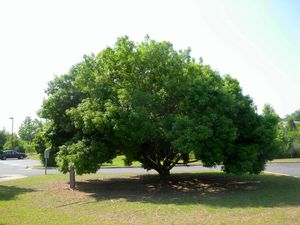

Japanese Willowleaf Oak
Quercus salicina
Pickup currently unavailable at Aiken Nursery
A small-to-medium evergreen oak unlike anything in the North American flora. Quercus salicina belongs to section Cyclobalanopsis of the oak genus, the ring-cupped oaks, an entirely Asian group of evergreen oaks distinguished from every American oak by the concentric rings on the acorn cup, rather than the overlapping scales of the red and white oak groups. Some taxonomists treat Cyclobalanopsis as a genus of its own. To grow this oak in a Southeastern garden is to bring in a fundamentally different evolutionary lineage, one that has been evolving in isolation in the temperate forests of Japan and Korea for tens of millions of years, in parallel with the separate American radiation. The result reads as recognizably Quercus in habit and presence, yet is architecturally distinct in nearly every detail.
The species is native to the temperate mountain forests of Japan, chiefly Honshu, Shikoku, and Kyushu, with disjunct populations in southern Korea. The Japanese common name urajirogashi translates as white-backed oak, a reference to the most distinctive feature of the foliage: the waxy silver-white coating on the underside of every leaf. Look up at a mature specimen on a breezy day and the canopy flashes silver as the leaves turn in the wind. The white is not down or hairs but a fine waxy powder, which can even be rubbed off by heat, so a leaf held over a flame will green, though most gardeners decline the experiment. The other Japanese name, hosobagashi, means narrow-leaf oak, and the Latin epithet salicina, chosen by the Dutch botanist Karl Ludwig Blume in 1851, means willow-like, both names describing the elegant, elongated, lance-shaped leaves, genuinely more reminiscent of a Salix than of any American oak.
Among the arborists and oak collectors who know the tree, the praise is unusual. Barry Yinger called this probably the most beautiful of the temperate zone's evergreen oaks (1990); Tom Hohn described an exceptionally handsome small specimen or patio tree (1993); and Béatrice Chassé, who has written extensively on cultivated oaks, called the tree simply a perfect, graceful tree (2017). The unanimity is rare in the oak world, where most species have their detractors.
In the garden, this oak forms a low-branching, rounded-to-vase-shaped evergreen tree, eventually reaching thirty to sixty feet in ideal native conditions but typically settling to a more refined fifteen to twenty-five feet in cultivation, often shrubby in youth before developing a single trunk and broader crown over decades. The leaves are three to five inches long, narrow and lance-shaped, toothed on the upper half of the blade, glossy dark green above and silver-white below, and the new growth emerges in remarkable copper-bronze, purple, and rose tones, holding for two to three weeks in spring before maturing to green, a moment few gardeners expect from an oak. The bark is smooth, finely fissured, and grayish-black, with white lenticels on the young branchlets, and the acorns mature over two seasons in the banded Cyclobalanopsis cup. The plants offered here have done very well at Woodlanders in Aiken, a meaningful local record for a tree that remains genuinely rare in American cultivation.
This is a tree for the oak collector building a serious Quercus collection, especially one that reaches into the Asian evergreens; for the gardener wanting a refined, small-scale evergreen specimen; for the Southeastern designer after a non-native alternative to live oak at residential scale; and for anyone who has been looking for an evergreen oak with the texture of a willow and the shimmer of silver leaves in the wind. Give full sun to part shade, well-drained soil, and a sheltered spot in zones 8 and 9, and site the tree where the silver undersides and the copper spring flush can be seen up close.
- Hardiness
- USDA Zones 8–9
- Sun
- Full Sun, Part Shade
- Soil
- Well-drained
- Mature size
- Height 20–30 Feet · Spread 20–30 Feet
- Growth rate
- Slow
- Seasonality
- Evergreen
From rooting to shipping, our top priority is ensuring you receive healthy, thriving plants for your garden’s success.
Because most of our plants are grown from rooted cuttings — alongside seed, air layering, and grafting chosen for each variety — you receive a stronger, true-to-type plant that establishes quickly in your garden.
Raised on organic soil blends and eco-friendly pest management — never harsh chemicals — your plant arrives healthy for your garden, your family, and the pollinators they feed.
Every purchase gives back. We donate to the Aiken Arboretum and support local wildlife conservation, so growing your garden helps protect the wider ecosystem too.

All our plant material is carefully propagated, grown, and nurtured at our humble nursery in Aiken, South Carolina.

Your plant arrives carefully packed and ready to settle in. Unpack them promptly, give them a day or two to acclimate, then plant following the notes we include — that’s all it takes. Clear care guidance comes with every order, so success is the easy part.
What to expect upon delivery
All our plants are sold in 1-gallon sizes, though the height of each plant can vary depending on its growth rate and seasonality, typically ranging from 1/2 to 2.5 feet.
Each plant is carefully packaged with its roots enclosed in a secure plastic bag containing moist soil, forming a compact root ball. To ensure safe transport, the box is padded with recycled newspaper, providing both stability and eco-friendly protection from weather during shipping.
What is your return policy?
Review our full return policy information on our SHIPPING AND RETURNS POLICY page.
What payment methods can I use?
We offer 35 different payment methods including major providers like Mastercard, Visa, PayPal, American Express and Diners as well as many different local payment methods including Klarna, iDEAL, AliPay, Sofort, giropay, and many more.
Can I make changes to my order after it’s been placed?
At Woodlanders, we strive to fulfill orders as quickly as possible. Therefore, we can only accommodate changes to your order within the first 24 hours after it has been placed. These changes include adding or removing products and modifying the delivery address. If you need to make any changes or if there has been a mistake with your order information, please reach out to us promptly via our CONTACT page with your order number for the quickest resolution.
Your satisfaction is our priority, and we appreciate your understanding and cooperation.