


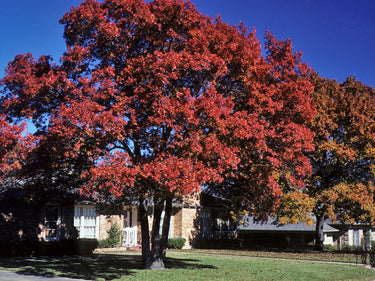


Shumard's Scarlet Oak
Quercus shumardii
Pickup available at Aiken Nursery
Usually ready in 2-4 days
There is a small drama in this oak's name. It honors Benjamin Franklin Shumard, a physician turned geologist who became the first State Geologist of Texas and who, decades before the oil boom, noted petroleum seeping up at several spots across the state. The man who named the tree for him in 1860 was his own assistant, Samuel Buckley, who would later turn on Shumard in print, call him incompetent, and take the state geologist's post for himself, all of which makes the enduring courtesy of the name faintly delicious. The tree has outlasted the quarrel.
Quercus shumardii belongs to the red oak group, with the deeply lobed, bristle-tipped leaves that mark a red oak and a fall color that runs from russet through red to deep scarlet, arriving late and holding well. What sets the tree apart is temperament. Shumard oak came up out of the river bottoms but has proven almost indifferent to the site, shrugging off heavy clay, drought, road salt, and city air, and thriving in the alkaline, limestone-laced ground where pin oaks yellow and sulk.
Shumard oak grows faster than the white oaks into a broad and dignified canopy that clears sixty feet and keeps going. For a tree this adaptable, and one feeding the hundreds of moth and butterfly species that an oak supports, it is far less common in the trade than such a tree deserves.
Shumard oak is the oak to reach for when you want red-oak color and a tree that will forgive almost anything: a fast shade or street tree for a lawn, a park, a campus, a parking island, or a difficult urban or alkaline site where fussier oaks decline. Give full sun and room for a broad, sixty- to seventy-five-foot crown, and pair with other tough natives. The late scarlet fall color, the strong branching, and the wildlife-feeding acorns round out one of the most adaptable and underused of the red oaks.
- Hardiness
- USDA Zones 5–9
- Sun
- Full Sun
- Soil
- Well-drained, Moist
- Mature size
- Height 50–75 Feet · Spread 40–50 Feet
- Growth rate
- Fast
- Seasonality
- Deciduous
From rooting to shipping, our top priority is ensuring you receive healthy, thriving plants for your garden’s success.
Because most of our plants are grown from rooted cuttings — alongside seed, air layering, and grafting chosen for each variety — you receive a stronger, true-to-type plant that establishes quickly in your garden.
Raised on organic soil blends and eco-friendly pest management — never harsh chemicals — your plant arrives healthy for your garden, your family, and the pollinators they feed.
Every purchase gives back. We donate to the Aiken Arboretum and support local wildlife conservation, so growing your garden helps protect the wider ecosystem too.

All our plant material is carefully propagated, grown, and nurtured at our humble nursery in Aiken, South Carolina.

Your plant arrives carefully packed and ready to settle in. Unpack them promptly, give them a day or two to acclimate, then plant following the notes we include — that’s all it takes. Clear care guidance comes with every order, so success is the easy part.
What to expect upon delivery
All our plants are sold in 1-gallon sizes, though the height of each plant can vary depending on its growth rate and seasonality, typically ranging from 1/2 to 2.5 feet.
Each plant is carefully packaged with its roots enclosed in a secure plastic bag containing moist soil, forming a compact root ball. To ensure safe transport, the box is padded with recycled newspaper, providing both stability and eco-friendly protection from weather during shipping.
What is your return policy?
Review our full return policy information on our SHIPPING AND RETURNS POLICY page.
What payment methods can I use?
We offer 35 different payment methods including major providers like Mastercard, Visa, PayPal, American Express and Diners as well as many different local payment methods including Klarna, iDEAL, AliPay, Sofort, giropay, and many more.
Can I make changes to my order after it’s been placed?
At Woodlanders, we strive to fulfill orders as quickly as possible. Therefore, we can only accommodate changes to your order within the first 24 hours after it has been placed. These changes include adding or removing products and modifying the delivery address. If you need to make any changes or if there has been a mistake with your order information, please reach out to us promptly via our CONTACT page with your order number for the quickest resolution.
Your satisfaction is our priority, and we appreciate your understanding and cooperation.