


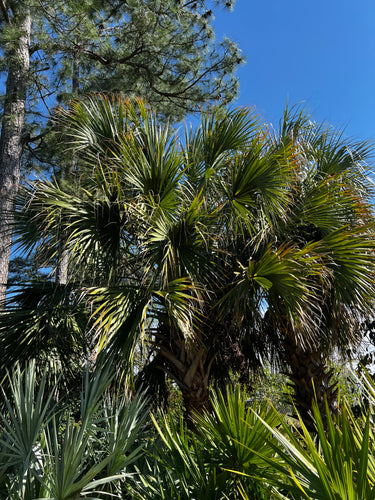


Puerto Rican Hat Palm
Sabal causiarum
In propagation
Currently growing out 1 Gallon pots. Expected Summer 2027.
Add your name with the notify button below, and we will email you the moment this plant is ready to bring home.
Learn how we grow on The Prop House.
Pickup currently unavailable at Aiken Nursery
Sabal causiarum, the Puerto Rican Hat Palm, is the heavyweight of the palmetto family. A single smooth gray trunk swells to as much as four feet through, the thickest of any Sabal, and rises forty or fifty feet beneath a crown of enormous costapalmate fans six feet across, stiff and deeply divided, each with a conspicuous tan ligule at the base of the stalk. Cream flowers on branched stalks longer than the leaves give way to round black fruit. Where the native palmettos read as graceful, this one reads as monumental.
The palm grows wild in Puerto Rico, on Hispaniola, and on a few of the British Virgin Islands, in open country near sea level. The name is a hat. Causia was the broad-brimmed sun hat of ancient Macedonia, and causiarum, of hats, records the industry that grew up around the palm: by 1901 the village of Joyuda on the west coast of Puerto Rico was turning the fans into hats in quantity, and the common name has followed the palm ever since. The leaves also served for thatch, brooms, and baskets, in the long tradition of the genus.
What makes the Hat Palm interesting to a Southern gardener is that a palm from the Caribbean has no business being as cold hardy as this one is. Established specimens shrug off the low twenties without leaf damage, the palm is rated to Zone 8b, and growers have raised the species as far afield as Houston and the coastal Pacific Northwest. Among the big trunked Sabal, only the Texas Palmetto comes close for cold tolerance, and the Hat Palm grows faster, which for a palmetto is saying something. Our plants came from Joe LeVert of Aquinas High School in Augusta, Georgia, whose palm collection has sent more than one rarity down the road to Aiken, and Woodlanders is growing a small first batch on in one-gallon pots. This is one of the rarest palms we have ever listed.
Give the Hat Palm what any monument needs: room. Full sun, sharp drainage, and a site where a four-foot trunk and a thirty-foot crown will not be an argument in twenty years. The palm tolerates drought and salt once established and asks for little else beyond patience and an occasional feed, since the big fans show potassium hunger on lean ground. Plant as a specimen on a lawn or a wide avenue, where the trunk can be read whole, and underplant with sun-loving, salt-tolerant companions once the canopy lifts. A palm for the gardener who wants the largest palmetto that can be grown this far north, and a story about hats to go with it.
- Hardiness
- USDA Zones 8–11
- Sun
- Full Sun
- Soil
- Well-drained
- Mature size
- Height 30–50 Feet · Spread 15–20 Feet
- Growth rate
- Moderate
- Seasonality
- Evergreen
- Provenance
- From Joe LeVert of Aquinas High School, Augusta, Georgia; first batch potted July 2026
Cream flowers on branched stalks that exceed the leaves in summer, followed by round black fruit about a third of an inch across.
From rooting to shipping, our top priority is ensuring you receive healthy, thriving plants for your garden’s success.
Because most of our plants are grown from rooted cuttings — alongside seed, air layering, and grafting chosen for each variety — you receive a stronger, true-to-type plant that establishes quickly in your garden.
Raised on organic soil blends and eco-friendly pest management — never harsh chemicals — your plant arrives healthy for your garden, your family, and the pollinators they feed.
Every purchase gives back. We donate to the Aiken Arboretum and support local wildlife conservation, so growing your garden helps protect the wider ecosystem too.

All our plant material is carefully propagated, grown, and nurtured at our humble nursery in Aiken, South Carolina.

Your plant arrives carefully packed and ready to settle in. Unpack them promptly, give them a day or two to acclimate, then plant following the notes we include — that’s all it takes. Clear care guidance comes with every order, so success is the easy part.
What to expect upon delivery
All our plants are sold in 1-gallon sizes, though the height of each plant can vary depending on its growth rate and seasonality, typically ranging from 1/2 to 2.5 feet.
Each plant is carefully packaged with its roots enclosed in a secure plastic bag containing moist soil, forming a compact root ball. To ensure safe transport, the box is padded with recycled newspaper, providing both stability and eco-friendly protection from weather during shipping.
What is your return policy?
Review our full return policy information on our SHIPPING AND RETURNS POLICY page.
What payment methods can I use?
We offer 35 different payment methods including major providers like Mastercard, Visa, PayPal, American Express and Diners as well as many different local payment methods including Klarna, iDEAL, AliPay, Sofort, giropay, and many more.
Can I make changes to my order after it’s been placed?
At Woodlanders, we strive to fulfill orders as quickly as possible. Therefore, we can only accommodate changes to your order within the first 24 hours after it has been placed. These changes include adding or removing products and modifying the delivery address. If you need to make any changes or if there has been a mistake with your order information, please reach out to us promptly via our CONTACT page with your order number for the quickest resolution.
Your satisfaction is our priority, and we appreciate your understanding and cooperation.