




Blue Brazilian Sage
Salvia guaranitica
Pickup currently unavailable at Aiken Nursery
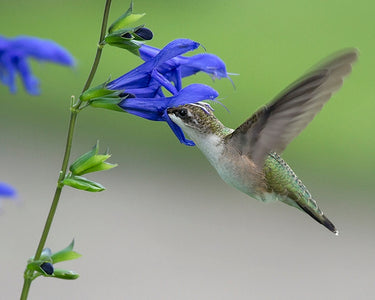
Salvia guaranitica is the blue that gardeners keep looking for and rarely find. From midsummer through to frost the plant sends up long spikes of tubular flowers in a deep, saturated blue, each one held in a calyx of darker purple-blue so the whole spike reads richer than the petals alone would manage. The leaves are heart-shaped, soft green, and release a clean anise scent when brushed, which is where the common name comes from. Hummingbirds find this sage and then keep the address.
The species is a tender perennial or subshrub from a wide swathe of South America, native to Brazil, Paraguay, Uruguay and northern Argentina, and the epithet guaranitica honors the Guarani people of that region. Salvia is the great genus of the mint family, Lamiaceae, and the name comes from the Latin salvere, to heal or be well, for the medicinal reputation of common sage. That reputation belongs to Salvia officinalis and not to this one; blue anise sage is grown for the flowers and the scent, and we make no medicinal claim for the plant.
Growth is upright and bushy on square dark green stems, three to four feet in a season and taller in a long one, and the plant tolerates the heat and humidity that flatten so many salvias, which makes this a genuinely good sage for Southern gardens. Blue anise sage takes full sun to part shade and is one of the few salvias that will flower respectably with some afternoon shade. Below the ground it runs on swollen tuberous roots, and one honest caution comes with the vigor: in mild climates and good soil the plant will spread from those tubers and fill more space than expected. Site accordingly, or lift and divide every few years.
Place blue anise sage in a mixed border, a pollinator planting, or a large container, where the deep blue can sit against silver, chartreuse or hot orange rather than competing with other blues. Pair with agastache, salvias of other colors, warm-season grasses, and rudbeckia. Hardy through USDA zones 8 to 10, and worth trying in zone 7 in a sheltered, sharply drained spot under a deep winter mulch, where the plant dies to the ground and returns from the tubers in spring. Cut the old stems back in late winter, and treat the sage as a fast annual anywhere colder.
Photo courtesy of BudOhio
- Hardiness
- USDA Zones 7–10
- Sun
- Full Sun, Part Shade
- Soil
- Well-drained, Moist
- Mature size
- Height 3–4 Feet · Spread 3–4 Feet
- Growth rate
- Fast
- Seasonality
- Dies back, depends on zone
Deep blue tubular flowers in long spikes, set in darker purple-blue calyxes, from midsummer through to frost
From rooting to shipping, our top priority is ensuring you receive healthy, thriving plants for your garden’s success.
Because most of our plants are grown from rooted cuttings — alongside seed, air layering, and grafting chosen for each variety — you receive a stronger, true-to-type plant that establishes quickly in your garden.
Raised on organic soil blends and eco-friendly pest management — never harsh chemicals — your plant arrives healthy for your garden, your family, and the pollinators they feed.
Every purchase gives back. We donate to the Aiken Arboretum and support local wildlife conservation, so growing your garden helps protect the wider ecosystem too.

All our plant material is carefully propagated, grown, and nurtured at our humble nursery in Aiken, South Carolina.

Your plant arrives carefully packed and ready to settle in. Unpack them promptly, give them a day or two to acclimate, then plant following the notes we include — that’s all it takes. Clear care guidance comes with every order, so success is the easy part.
What to expect upon delivery
All our plants are sold in 1-gallon sizes, though the height of each plant can vary depending on its growth rate and seasonality, typically ranging from 1/2 to 2.5 feet.
Each plant is carefully packaged with its roots enclosed in a secure plastic bag containing moist soil, forming a compact root ball. To ensure safe transport, the box is padded with recycled newspaper, providing both stability and eco-friendly protection from weather during shipping.
What is your return policy?
Review our full return policy information on our SHIPPING AND RETURNS POLICY page.
What payment methods can I use?
We offer 35 different payment methods including major providers like Mastercard, Visa, PayPal, American Express and Diners as well as many different local payment methods including Klarna, iDEAL, AliPay, Sofort, giropay, and many more.
Can I make changes to my order after it’s been placed?
At Woodlanders, we strive to fulfill orders as quickly as possible. Therefore, we can only accommodate changes to your order within the first 24 hours after it has been placed. These changes include adding or removing products and modifying the delivery address. If you need to make any changes or if there has been a mistake with your order information, please reach out to us promptly via our CONTACT page with your order number for the quickest resolution.
Your satisfaction is our priority, and we appreciate your understanding and cooperation.