


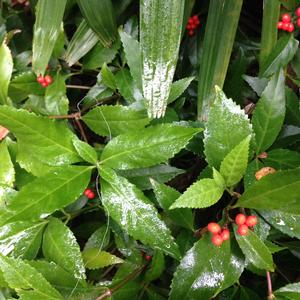


Grass Coral
Sarcandra glabra
Pickup currently unavailable at Aiken Nursery
This plant is a botanical time machine. Sarcandra glabra belongs to the Chloranthaceae, a flowering-plant family with only four surviving genera worldwide and a fossil record reaching back into the Early Cretaceous, more than a hundred million years ago. Pollen and floral fossils of the Chloranthaceae are among the earliest evidence of flowering plants anywhere on Earth, and the family was already abundant when the dinosaurs were only in their middle age. Today Sarcandra is one of just four genera left from a lineage that once spread across what is now Portugal, Spain, and eastern North America, and most of that Cretaceous diversity is gone. The little plant in the garden is a quiet survivor of a family that mostly did not make it.
The plant is genuinely beautiful, too. Sarcandra forms a slow-spreading mound one to two feet tall, with elliptical, leathery, deeply serrated evergreen leaves that carry a hint of nandina without the legginess. The Chinese name Cao Shan Hu, grass coral, catches the point exactly: the small, bright orange-red drupes that ripen in autumn and hold through winter into spring, glossy and tightly clustered like miniature branches of coral against the leaves. Small yellowish flowers come in late spring, but the fruit is the show. Another Chinese name, Zhong Jie Feng, and the old Western name nine-knotted flower both come from the segmented, jointed stems.
The native range runs across the eastern half of Asia, from China, Japan, Korea, and Taiwan through Vietnam, Cambodia, and Malaysia to Sri Lanka, India, and the Philippines, wherever there are wet, shaded slopes and humid valley floors. In China the plant has served in traditional medicine for a thousand years, above all for bruises, bone fractures, arthritis, and injury, a tradition set out in the fields below. In Japan the branches are one of the plants used for chabana, the spare flower arrangement of the tea ceremony, especially at New Year, paired with winter jasmine.
In a Southeastern garden Sarcandra glabra makes a refined evergreen groundcover for moist, deeply shaded ground, lovely with hellebores, hostas, hakone grass, ferns, wild ginger, and the smaller woodland camellias. Reliably hardy through zone 8, the plant pushes into zone 7 with shelter, though hard freezes can cut it to the ground, from which it usually returns in spring. Give the rich, moist, organic floor of a woodland understory, keep it out of drying full sun, and the plant rewards the effort with year-round structure and a coral-bright fruit display that runs for months.
For the gardener building a serious shade garden, the collector with a taste for evolutionary depth, or anyone who would like to grow something whose lineage has, in one form or another, come through every mass extinction since flowering plants began.
- Hardiness
- USDA Zones 8–9
- Sun
- Part Shade, Full Shade
- Soil
- Moist, Well-drained
- Mature size
- Height 1–2 Feet · Spread 1–2 Feet
- Growth rate
- Slow
- Seasonality
- Evergreen
Small, petalless, yellowish-green flowers in short terminal spikes in late spring, followed by glossy orange-red berries from autumn through spring.
These statements have not been evaluated by the Food and Drug Administration. This information is shared for traditional and educational interest only and is not intended to diagnose, treat, cure, or prevent any disease. Please consult a qualified healthcare professional before any medicinal use.
- Not medical advice
- Consult a qualified practitioner before use
From rooting to shipping, our top priority is ensuring you receive healthy, thriving plants for your garden’s success.
Because most of our plants are grown from rooted cuttings — alongside seed, air layering, and grafting chosen for each variety — you receive a stronger, true-to-type plant that establishes quickly in your garden.
Raised on organic soil blends and eco-friendly pest management — never harsh chemicals — your plant arrives healthy for your garden, your family, and the pollinators they feed.
Every purchase gives back. We donate to the Aiken Arboretum and support local wildlife conservation, so growing your garden helps protect the wider ecosystem too.

All our plant material is carefully propagated, grown, and nurtured at our humble nursery in Aiken, South Carolina.

Your plant arrives carefully packed and ready to settle in. Unpack them promptly, give them a day or two to acclimate, then plant following the notes we include — that’s all it takes. Clear care guidance comes with every order, so success is the easy part.
What to expect upon delivery
All our plants are sold in 1-gallon sizes, though the height of each plant can vary depending on its growth rate and seasonality, typically ranging from 1/2 to 2.5 feet.
Each plant is carefully packaged with its roots enclosed in a secure plastic bag containing moist soil, forming a compact root ball. To ensure safe transport, the box is padded with recycled newspaper, providing both stability and eco-friendly protection from weather during shipping.
What is your return policy?
Review our full return policy information on our SHIPPING AND RETURNS POLICY page.
What payment methods can I use?
We offer 35 different payment methods including major providers like Mastercard, Visa, PayPal, American Express and Diners as well as many different local payment methods including Klarna, iDEAL, AliPay, Sofort, giropay, and many more.
Can I make changes to my order after it’s been placed?
At Woodlanders, we strive to fulfill orders as quickly as possible. Therefore, we can only accommodate changes to your order within the first 24 hours after it has been placed. These changes include adding or removing products and modifying the delivery address. If you need to make any changes or if there has been a mistake with your order information, please reach out to us promptly via our CONTACT page with your order number for the quickest resolution.
Your satisfaction is our priority, and we appreciate your understanding and cooperation.