




Himalayan Sweet Box
Sarcococca hookeriana
In propagation
Growing On. Expected Fall 2026.
Add your name with the notify button below, and we will email you the moment this plant is ready to bring home.
Learn how we grow on The Prop House.
Pickup currently unavailable at Aiken Nursery
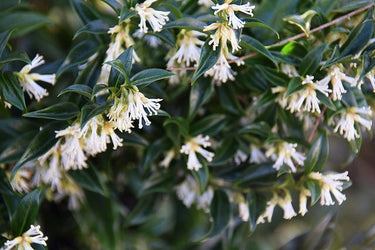
Of all the sweet boxes, Sarcococca hookeriana is the one most gardeners mean when they say the name, the Himalayan sweet box proper, a dense, glossy, suckering evergreen of the boxwood family, Buxaceae, that saves the whole of the year's drama for the dead of winter. The French botanist Henri Baillon described the species in 1859 in his monograph of the box family, and the epithet honors the Hookers of Kew. Most accounts give the credit to Joseph Dalton Hooker, Darwin's close friend, who collected in the Sikkim Himalaya in the late 1840s and later directed the Royal Botanic Gardens, though the name was published while his father William was still at the helm, so the family may fairly share the compliment. The genus name is Greek, sarx for flesh and kokkos for berry, a plain description of the fleshy black fruits that follow the flowers.
The Himalayan sweet box ranges along the central and eastern Himalaya, from Nepal and Bhutan through northeastern India into southeastern Tibet and the mountains of southwestern China, growing in the cool, humid understory of broadleaf and conifer forest where the light is broken and the soil never fully dries. In that company the shrub makes a rounded thicket of arching stems, three to five feet high and slowly wider, clothed in narrow, tapering, deep green leaves with a lacquered shine. From January into March, tiny petal-less flowers open in the leaf axils, creamy white with a tuft of pale stamens, so small they are easily overlooked until the scent arrives: a sweet, honeyed, faintly vanilla perfume that carries yards on a still mild day and stops people on the path. Glossy black berries ripen behind the flowers and hang on well into spring.
Woodlanders has grown the sweet boxes for decades, the dwarf variety humilis, the narrow-leaved digyna, and an unnamed Yunnan collection among them, but the straight species has been oddly hard to find in American nurseries, where the compact selections crowd the catalogs. This is the true species, taller and looser than the dwarfs, with a fuller arching habit and the same extravagant winter perfume. The plants have proven tough, tidy, and reliably fragrant here in the lower South, where some of the hardier dwarf forms can sulk through a long hot summer.
Across the Himalaya and southwestern China, the sweet boxes carry a long folk-medicine history. In Chinese and ethnic-minority traditions of Guizhou and Yunnan, the roots and stems of Sarcococca have been prepared for stomach pain, rheumatism, swollen sore throat, and the bruises and strains of injury, and Nepalese practice draws on the same genus for fevers and aches. Modern phytochemists have found the reason for the reputation in a remarkable family of pregnane-type steroidal alkaloids. Teams in Karachi and Bielefeld working with Nepalese-collected material isolated hookerianamides that inhibit cholinesterase enzymes and show activity against Leishmania and malaria parasites in the laboratory, and researchers in Guiyang have since described hookerianines and sarchookloides from the roots with cytotoxic activity against cancer cell lines. None of this makes the shrub a home remedy; those same alkaloids are the reason the plant should be admired rather than consumed. Deer leave the leathery leaves alone, and once established the plant shrugs off a dry summer with little complaint.
- Hardiness
- USDA Zones 6–9
- Sun
- Part Shade, Full Shade
- Soil
- Well-drained, Moist
- Mature size
- Height 3–5 Feet · Spread 3–6 Feet
- Growth rate
- Slow
- Seasonality
- Evergreen
- Provenance
- Grown on at Woodlanders from liners of the straight species
Tiny, creamy-white, intensely fragrant, January to March
From rooting to shipping, our top priority is ensuring you receive healthy, thriving plants for your garden’s success.
Because most of our plants are grown from rooted cuttings — alongside seed, air layering, and grafting chosen for each variety — you receive a stronger, true-to-type plant that establishes quickly in your garden.
Raised on organic soil blends and eco-friendly pest management — never harsh chemicals — your plant arrives healthy for your garden, your family, and the pollinators they feed.
Every purchase gives back. We donate to the Aiken Arboretum and support local wildlife conservation, so growing your garden helps protect the wider ecosystem too.

All our plant material is carefully propagated, grown, and nurtured at our humble nursery in Aiken, South Carolina.

Your plant arrives carefully packed and ready to settle in. Unpack them promptly, give them a day or two to acclimate, then plant following the notes we include — that’s all it takes. Clear care guidance comes with every order, so success is the easy part.
What to expect upon delivery
All our plants are sold in 1-gallon sizes, though the height of each plant can vary depending on its growth rate and seasonality, typically ranging from 1/2 to 2.5 feet.
Each plant is carefully packaged with its roots enclosed in a secure plastic bag containing moist soil, forming a compact root ball. To ensure safe transport, the box is padded with recycled newspaper, providing both stability and eco-friendly protection from weather during shipping.
What is your return policy?
Review our full return policy information on our SHIPPING AND RETURNS POLICY page.
What payment methods can I use?
We offer 35 different payment methods including major providers like Mastercard, Visa, PayPal, American Express and Diners as well as many different local payment methods including Klarna, iDEAL, AliPay, Sofort, giropay, and many more.
Can I make changes to my order after it’s been placed?
At Woodlanders, we strive to fulfill orders as quickly as possible. Therefore, we can only accommodate changes to your order within the first 24 hours after it has been placed. These changes include adding or removing products and modifying the delivery address. If you need to make any changes or if there has been a mistake with your order information, please reach out to us promptly via our CONTACT page with your order number for the quickest resolution.
Your satisfaction is our priority, and we appreciate your understanding and cooperation.