


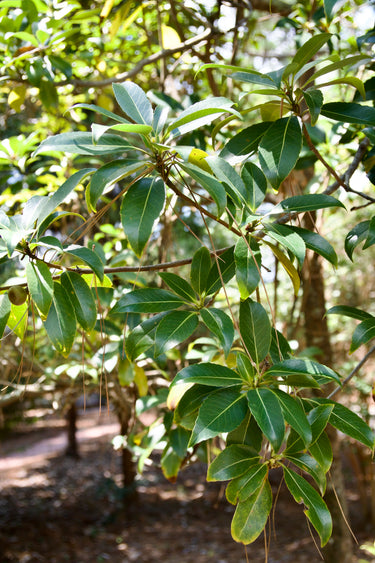


Chinese Needlewood
Schima remotiserrata
In propagation
Currently rooting cuttings. Expected Winter 2028.
Add your name with the notify button below, and we will email you the moment this plant is ready to bring home.
Learn how we grow on The Prop House.
Pickup currently unavailable at Aiken Nursery
If you already grow a camellia, a stewartia, or a Franklinia, you know most of what a Schima is trying to be. The genus sits in the tea family, evergreen where the American members are deciduous, and carries the family flower in the purest form the family manages: five white petals cupped around a dense boss of gold stamens, two inches or so across, fragrant, and scattered through the crown in summer rather than delivered all at once. Schima remotiserrata is a southeast Chinese species, native to Fujian, Guangdong, eastern Guangxi, southern Hunan, and Jiangxi, and almost unknown in American gardens; the epithet refers to the leaf margin, toothed at intervals rather than continuously, which is the field character that separates this species from a shelf full of near relatives.
The genus name is a piece of quiet observation. Schima derives from the Greek skiasma, a shadow, for the dense shade a mature crown throws. That is not marketing; these are forest trees, and in the wild parts of the genus exceed a hundred feet. In cultivation on this side of the Pacific expect something far more reasonable, an upright evergreen of thirty to fifty feet over a long life, with handsome leathery foliage flushing bronze-red on new growth and holding good colour through winter.
The family connections are the interesting part, and Woodlanders has a stake in them. Schima is closest of the Asian tea-family genera to Franklinia alatamaha, the tree John and William Bartram found on the Altamaha River in Georgia in 1765 and which has not been seen in the wild since about 1803. That relationship is close enough to cross: the intergeneric hybrid ×Schimlinia floribunda, Franklinia crossed with Schima argentea, is a plant we grow and sell here, as is S. argentea itself and S. superba. Adding a fourth species to the bench is how a nursery finds out what else the genus will do, and anyone building a Theaceae collection now has another piece to place beside the stewartias and the gordonias.
Site the tree in full sun to light high shade, in acid, humus-rich, well-drained soil, and give real room; a shade tree that throws the shade the Greek name promises is not a courtyard plant. Water through establishment and in droughts, and mulch to keep the roots cool. One honest caution: Schima is subtropical to warm-temperate, and while young plants of the genus have taken temperatures as low as about eighteen degrees Fahrenheit, frost protection through the first winters is sensible and this species is untested across most of the country. Call the tree zone 8b to 10 for now, plant with a warm wall or an evergreen windbreak behind, and understand that you are helping find out where the limit actually is. That is a fair description of most of the interesting plants we sell.
- Hardiness
- USDA Zones 8–10
- Sun
- Full Sun, Part Shade
- Soil
- Well-drained, Moist
- Mature size
- Height 30–50 Feet · Spread 20–30 Feet
- Growth rate
- Medium
- Seasonality
- Evergreen
- Provenance
- Cuttings taken on the Armstrong Campus, Savannah, Georgia, August 2026.
Fragrant white flowers about 2 inches across with a boss of gold stamens, summer
From rooting to shipping, our top priority is ensuring you receive healthy, thriving plants for your garden’s success.
Because most of our plants are grown from rooted cuttings — alongside seed, air layering, and grafting chosen for each variety — you receive a stronger, true-to-type plant that establishes quickly in your garden.
Raised on organic soil blends and eco-friendly pest management — never harsh chemicals — your plant arrives healthy for your garden, your family, and the pollinators they feed.
Every purchase gives back. We donate to the Aiken Arboretum and support local wildlife conservation, so growing your garden helps protect the wider ecosystem too.

All our plant material is carefully propagated, grown, and nurtured at our humble nursery in Aiken, South Carolina.

Your plant arrives carefully packed and ready to settle in. Unpack them promptly, give them a day or two to acclimate, then plant following the notes we include — that’s all it takes. Clear care guidance comes with every order, so success is the easy part.
What to expect upon delivery
All our plants are sold in 1-gallon sizes, though the height of each plant can vary depending on its growth rate and seasonality, typically ranging from 1/2 to 2.5 feet.
Each plant is carefully packaged with its roots enclosed in a secure plastic bag containing moist soil, forming a compact root ball. To ensure safe transport, the box is padded with recycled newspaper, providing both stability and eco-friendly protection from weather during shipping.
What is your return policy?
Review our full return policy information on our SHIPPING AND RETURNS POLICY page.
What payment methods can I use?
We offer 35 different payment methods including major providers like Mastercard, Visa, PayPal, American Express and Diners as well as many different local payment methods including Klarna, iDEAL, AliPay, Sofort, giropay, and many more.
Can I make changes to my order after it’s been placed?
At Woodlanders, we strive to fulfill orders as quickly as possible. Therefore, we can only accommodate changes to your order within the first 24 hours after it has been placed. These changes include adding or removing products and modifying the delivery address. If you need to make any changes or if there has been a mistake with your order information, please reach out to us promptly via our CONTACT page with your order number for the quickest resolution.
Your satisfaction is our priority, and we appreciate your understanding and cooperation.