


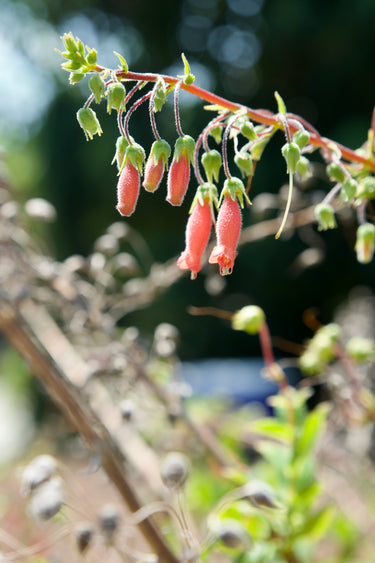


Hardy Red Gloxinia
Sinningia sellovii
In propagation
Currently rooting cuttings. Expected Spring 2027.
Add your name with the notify button below, and we will email you the moment this plant is ready to bring home.
Learn how we grow on The Prop House.
Pickup currently unavailable at Aiken Nursery
Gesneriads are supposed to be houseplants. Somebody should tell Sinningia sellovii, which comes out of a hard woody tuber the size of a fist, throws arching stems three or four feet long, hangs them with scarlet tubular flowers from early summer until frost, and then dies back to the ground and does the whole thing again the following year in USDA zone 7b. Gardeners who know the family only through florist gloxinias tend to find this genuinely disorienting, which is a good reason to grow the plant near the front gate.
The species is Brazilian, from the drier southern grasslands and rocky ground, and the tuber is the key to everything else. Water is stored underground, the top growth is expendable, and the plant treats winter dormancy as an ordinary annual event rather than a crisis. That combination gives you something unusual: a plant with the flowers of the tropics and the habits of a prairie perennial. The flowers themselves are narrow scarlet trumpets, freckled darker inside, dangling in a long procession down each arching stem, and they are shaped for exactly one visitor. Hummingbirds work the stems steadily from June onward, and in a good year the traffic is the point of the planting.
Both halves of the name are commemorations. Sinningia honors Wilhelm Sinning, head gardener at the Bonn botanic garden in the early nineteenth century, who grew and distributed much of what Europe first knew of the family. Sellovii remembers Friedrich Sellow, the German botanist who spent nearly two decades collecting across Brazil and Uruguay, sent tens of thousands of specimens back to Berlin, and drowned in the Rio Doce in 1831 with most of the work still unpublished. A great many South American plants carry that name; this is one of the better ones to have it.
Give the plant full sun to part shade in gritty, well-drained ground, and site where people walk, because the flowers hang and want to be seen from below rather than looked down on. A raised bed, a wall top, a slope, or a large container all suit. Water moderately in growth and keep the tuber dry in dormancy; wet winter soil is what kills, not cold. Cut the spent stems to the ground after frost blackens them and mark the spot, since the tuber is slow to wake and easy to dig up by accident in spring. Pair with agaves, gaura, muhly grass, and the drier salvias for a hummingbird corner that carries through the hottest weeks of the year, and expect the whole performance to improve as the tuber thickens with age.
- Hardiness
- USDA Zones 7–11
- Sun
- Full Sun, Part Shade
- Soil
- Well-drained
- Mature size
- Height 3–4 Feet · Spread 2–3 Feet
- Growth rate
- Fast
- Seasonality
- Dies back, depends on zone
- Provenance
- Cuttings taken on the Armstrong Campus, Savannah, Georgia, August 2026.
Hanging scarlet tubular flowers freckled darker inside, early summer to frost
From rooting to shipping, our top priority is ensuring you receive healthy, thriving plants for your garden’s success.
Because most of our plants are grown from rooted cuttings — alongside seed, air layering, and grafting chosen for each variety — you receive a stronger, true-to-type plant that establishes quickly in your garden.
Raised on organic soil blends and eco-friendly pest management — never harsh chemicals — your plant arrives healthy for your garden, your family, and the pollinators they feed.
Every purchase gives back. We donate to the Aiken Arboretum and support local wildlife conservation, so growing your garden helps protect the wider ecosystem too.

All our plant material is carefully propagated, grown, and nurtured at our humble nursery in Aiken, South Carolina.

Your plant arrives carefully packed and ready to settle in. Unpack them promptly, give them a day or two to acclimate, then plant following the notes we include — that’s all it takes. Clear care guidance comes with every order, so success is the easy part.
What to expect upon delivery
All our plants are sold in 1-gallon sizes, though the height of each plant can vary depending on its growth rate and seasonality, typically ranging from 1/2 to 2.5 feet.
Each plant is carefully packaged with its roots enclosed in a secure plastic bag containing moist soil, forming a compact root ball. To ensure safe transport, the box is padded with recycled newspaper, providing both stability and eco-friendly protection from weather during shipping.
What is your return policy?
Review our full return policy information on our SHIPPING AND RETURNS POLICY page.
What payment methods can I use?
We offer 35 different payment methods including major providers like Mastercard, Visa, PayPal, American Express and Diners as well as many different local payment methods including Klarna, iDEAL, AliPay, Sofort, giropay, and many more.
Can I make changes to my order after it’s been placed?
At Woodlanders, we strive to fulfill orders as quickly as possible. Therefore, we can only accommodate changes to your order within the first 24 hours after it has been placed. These changes include adding or removing products and modifying the delivery address. If you need to make any changes or if there has been a mistake with your order information, please reach out to us promptly via our CONTACT page with your order number for the quickest resolution.
Your satisfaction is our priority, and we appreciate your understanding and cooperation.