


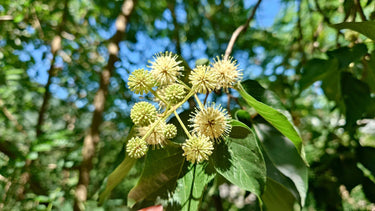

Chinese Adina
Sinoadina racemosa
In propagation
Currently rooting cuttings. Expected Winter 2028.
Add your name with the notify button below, and we will email you the moment this plant is ready to bring home.
Learn how we grow on The Prop House.
Pickup currently unavailable at Aiken Nursery
Here is a tree almost nobody in American horticulture has grown, and the reason is not that the plant is difficult. Sinoadina racemosa is simply obscure: a deciduous member of the madder family ranging from northern Myanmar and Thailand through southern China, Taiwan, the Ryukyu Islands, and into Japan, running fifteen to forty feet tall with grey trunk bark and smooth young branches. In summer the tree carries small flowers packed tight into spherical heads, the heads themselves gathered into open terminal panicles, which is exactly what the epithet racemosa is pointing at.
Anyone who grows a buttonbush will recognise that flower head immediately, and the resemblance is real family resemblance rather than coincidence. Rubiaceae is the coffee and gardenia family, and within it this tree sits in the same tribe as our own Cephalanthus occidentalis, the buttonbush of Southern pond margins with the little sputnik flowers. The connection reaches further than that: Pinckneya bracteata, the fever tree of Georgia and Carolina bays, is another Rubiaceae cousin, and we collected cuttings of both plants in the same week. Growing them within sight of one another is a good way to see how far one plant family can travel and still keep the same habits.
The naming has been unsettled for two centuries. Siebold and Zuccarini described the plant from Japanese material in the nineteenth century; the species then spent decades filed under Adina or Nauclea before Ridsdale erected Sinoadina for the tree in 1978, and some authorities still fold the genus straight back into Adina. Adina comes from the Greek adinos, crowded, for those tight-packed heads, and Sino- is simply the Chinese half of the range. You may see either name on a label; both point at the same tree.
An honest note, and we would rather lead with it than bury it. The horticultural literature on this species is close to nonexistent, so what follows is our best reading rather than settled fact. Our cuttings came from a plant growing in the UGA Trial Garden in Athens, Georgia, which is practical evidence of hardiness in the middle of zone 8a and encouraging for the piedmont generally; we would call the tree zone 7b to 9 provisionally and revise as we learn. Site in full sun to light shade in decent, evenly moist, well-drained ground, give room for a small shade tree, and treat the whole exercise as a collaboration. Growing an obscure tree well is how the record gets written in the first place, and there are very few American gardens where you can go and look at a mature one.
- Hardiness
- USDA Zones 7–9
- Sun
- Full Sun, Part Shade
- Soil
- Well-drained, Moist
- Mature size
- Height 15–40 Feet · Spread 12–25 Feet
- Growth rate
- Medium
- Seasonality
- Deciduous
- Provenance
- Cuttings taken from the UGA Trial Garden, Athens, Georgia, August 2026, on the same collecting trip as the Armstrong Campus material.
Small yellowish-white flowers in crowded spherical heads, carried in terminal panicles in summer
From rooting to shipping, our top priority is ensuring you receive healthy, thriving plants for your garden’s success.
Because most of our plants are grown from rooted cuttings — alongside seed, air layering, and grafting chosen for each variety — you receive a stronger, true-to-type plant that establishes quickly in your garden.
Raised on organic soil blends and eco-friendly pest management — never harsh chemicals — your plant arrives healthy for your garden, your family, and the pollinators they feed.
Every purchase gives back. We donate to the Aiken Arboretum and support local wildlife conservation, so growing your garden helps protect the wider ecosystem too.

All our plant material is carefully propagated, grown, and nurtured at our humble nursery in Aiken, South Carolina.

Your plant arrives carefully packed and ready to settle in. Unpack them promptly, give them a day or two to acclimate, then plant following the notes we include — that’s all it takes. Clear care guidance comes with every order, so success is the easy part.
What to expect upon delivery
All our plants are sold in 1-gallon sizes, though the height of each plant can vary depending on its growth rate and seasonality, typically ranging from 1/2 to 2.5 feet.
Each plant is carefully packaged with its roots enclosed in a secure plastic bag containing moist soil, forming a compact root ball. To ensure safe transport, the box is padded with recycled newspaper, providing both stability and eco-friendly protection from weather during shipping.
What is your return policy?
Review our full return policy information on our SHIPPING AND RETURNS POLICY page.
What payment methods can I use?
We offer 35 different payment methods including major providers like Mastercard, Visa, PayPal, American Express and Diners as well as many different local payment methods including Klarna, iDEAL, AliPay, Sofort, giropay, and many more.
Can I make changes to my order after it’s been placed?
At Woodlanders, we strive to fulfill orders as quickly as possible. Therefore, we can only accommodate changes to your order within the first 24 hours after it has been placed. These changes include adding or removing products and modifying the delivery address. If you need to make any changes or if there has been a mistake with your order information, please reach out to us promptly via our CONTACT page with your order number for the quickest resolution.
Your satisfaction is our priority, and we appreciate your understanding and cooperation.