


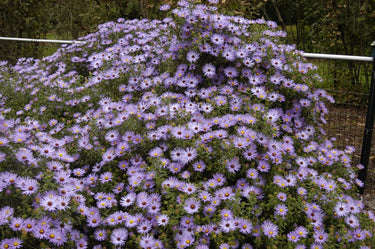


Aromatic Aster
Symphyotrichum oblongifolium
Pickup available at Aiken Nursery
Usually ready in 2-4 days
Symphyotrichum oblongifolium, the aromatic aster, saves the best of the season for last. Long after most perennials have folded, this tough native throws up a low, spreading mound of stiff, well-branched stems and buries the whole clump under small violet-blue daisies, each lit with a bright gold eye, from early fall well into November. The show arrives just as the garden goes quiet, and the flowers hum with the last bees and butterflies of the year.
A plant of dry prairies, glades, bluffs, and rocky roadside banks, the aromatic aster ranges across the central plains and eastward through the Southeast, thriving on the lean, sun-baked ground where softer plants give up. The common name comes from the foliage, not the flower, for the small, oblong, grey-green leaves give off a clean balsam scent when crushed or brushed in passing. Botanists once filed the plant under Aster, though the New World asters now carry the tongue-twisting name Symphyotrichum, from the Greek for a coming-together of hairs.
In the garden, Symphyotrichum oblongifolium earns a place at the front or middle of a sunny border, along a dry bank, through a meadow, or spilling over the edge of a wall or path, where the mounding habit softens hard lines. The late bloom makes the aromatic aster one of the most valuable of all fall nectar plants, feeding migrating monarchs and native bees when little else remains. Pair the aster with little bluestem, goldenrod, and the seed heads of coneflower and rudbeckia for a rich, late-season, prairie-style picture.
Give the plant full sun and a lean, dry to average, well-drained soil, and the aromatic aster asks for nothing more, shrugging off drought, heat, and poor ground once the roots take hold. A pinch or shear in early summer keeps the mound tight and heavy with bloom, and the plant needs no staking in an open, sunny spot. Cut the old stems to the ground in late winter, and leave the fall seed heads for the birds. A tough, fragrant, gloriously late native aster for the hardest, driest corners of the garden.
- Hardiness
- USDA Zones 3–8
- Sun
- Full Sun, Part Shade
- Soil
- Dry, Average, Well-drained
- Mature size
- Height 2–3 Feet · Spread 2–3 Feet
- Growth rate
- Moderate
- Seasonality
- Dies back
Violet-blue daisies with gold centers, mid to late fall
From rooting to shipping, our top priority is ensuring you receive healthy, thriving plants for your garden’s success.
Because most of our plants are grown from rooted cuttings — alongside seed, air layering, and grafting chosen for each variety — you receive a stronger, true-to-type plant that establishes quickly in your garden.
Raised on organic soil blends and eco-friendly pest management — never harsh chemicals — your plant arrives healthy for your garden, your family, and the pollinators they feed.
Every purchase gives back. We donate to the Aiken Arboretum and support local wildlife conservation, so growing your garden helps protect the wider ecosystem too.

All our plant material is carefully propagated, grown, and nurtured at our humble nursery in Aiken, South Carolina.

Your plant arrives carefully packed and ready to settle in. Unpack them promptly, give them a day or two to acclimate, then plant following the notes we include — that’s all it takes. Clear care guidance comes with every order, so success is the easy part.
What to expect upon delivery
All our plants are sold in 1-gallon sizes, though the height of each plant can vary depending on its growth rate and seasonality, typically ranging from 1/2 to 2.5 feet.
Each plant is carefully packaged with its roots enclosed in a secure plastic bag containing moist soil, forming a compact root ball. To ensure safe transport, the box is padded with recycled newspaper, providing both stability and eco-friendly protection from weather during shipping.
What is your return policy?
Review our full return policy information on our SHIPPING AND RETURNS POLICY page.
What payment methods can I use?
We offer 35 different payment methods including major providers like Mastercard, Visa, PayPal, American Express and Diners as well as many different local payment methods including Klarna, iDEAL, AliPay, Sofort, giropay, and many more.
Can I make changes to my order after it’s been placed?
At Woodlanders, we strive to fulfill orders as quickly as possible. Therefore, we can only accommodate changes to your order within the first 24 hours after it has been placed. These changes include adding or removing products and modifying the delivery address. If you need to make any changes or if there has been a mistake with your order information, please reach out to us promptly via our CONTACT page with your order number for the quickest resolution.
Your satisfaction is our priority, and we appreciate your understanding and cooperation.