


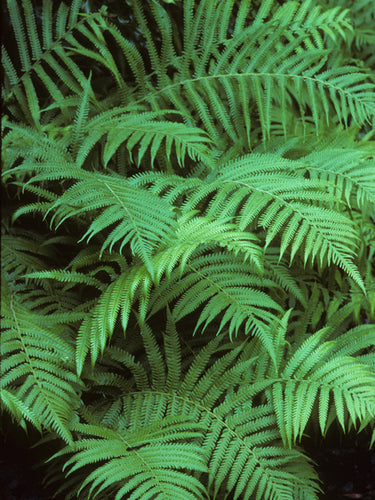


Southern Shield Fern
Thelypteris kunthii
Pickup available at Aiken Nursery
Usually ready in 2-4 days
The southern shield fern carries a longer pedigree than most ferns in cultivation. The type specimen was collected by Alexander von Humboldt and Aimé Bonpland near Cumanacoa, in the cloud-shrouded country around Caripe in northeastern Venezuela, during their five-year expedition through the equinoctial Americas. Decades later the German botanist Carl Sigismund Kunth, Humboldt's assistant in Paris and the man who would spend years describing the ten thousand and more specimens the explorers shipped home, became the namesake when Nicaise Auguste Desvaux formally described the species in 1827 as Nephrodium kunthii. C.V. Morton moved the fern into Thelypteris in 1967, and recent molecular work (Fawcett and Smith, 2021) has shifted the name again into Pelazoneuron, though the older binomial remains the one in common horticultural use.
This is also one of the most adaptable native ferns in the American South. The range runs from the fall line in the Carolinas across the Gulf Coast to east Texas, and on through the Caribbean and Mesoamerica into northern South America, essentially tracking the warm, humid, summer-rich half of the New World. In the wild the fern turns up on shaded streambanks, in rocky woodland, along sinkhole walls, and in the soft alluvial soils of bottomland forest. The fronds are pale, almost sea-green as they emerge in spring, finely cut, slightly triangular in outline, and rise in upright, arching clumps to three feet, occasionally four in rich ground. They are deciduous in the Upper South, going bronze at first frost and disappearing by mid-winter, then unfurling fresh in April.
The southern shield fern travels by both short and long creeping rhizomes, so that a single plant will, given a few seasons, become a colony. This is the rare fern that genuinely earns the word groundcover, soft, continuous, and self-knitting, yet not aggressive enough to overrun a planting. The Southern Living article that first sent gardeners looking for the fern in the 1990s suggested the plant could take full sun, which holds in the deeper South, provided the soil stays consistently moist.
Woodlanders plants ours in shade or semi-shade with rich, humusy soil and steady water through the first season, and recommends the same. Deer pass the fronds by, and the fern holds slopes near water exceptionally well. Pair the southern shield fern with hosta, heuchera, woodland phlox, trillium, and native azaleas, or let the colony run beneath high-pruned hardwoods as a clean green floor.
- Hardiness
- USDA Zones 7–10
- Sun
- Part Shade, Full Shade
- Soil
- Moist, Well-drained
- Mature size
- Height 2–3 Feet · Spread 2–3 Feet
- Growth rate
- Fast
- Seasonality
- Deciduous
From rooting to shipping, our top priority is ensuring you receive healthy, thriving plants for your garden’s success.
Because most of our plants are grown from rooted cuttings — alongside seed, air layering, and grafting chosen for each variety — you receive a stronger, true-to-type plant that establishes quickly in your garden.
Raised on organic soil blends and eco-friendly pest management — never harsh chemicals — your plant arrives healthy for your garden, your family, and the pollinators they feed.
Every purchase gives back. We donate to the Aiken Arboretum and support local wildlife conservation, so growing your garden helps protect the wider ecosystem too.

All our plant material is carefully propagated, grown, and nurtured at our humble nursery in Aiken, South Carolina.

Your plant arrives carefully packed and ready to settle in. Unpack them promptly, give them a day or two to acclimate, then plant following the notes we include — that’s all it takes. Clear care guidance comes with every order, so success is the easy part.
What to expect upon delivery
All our plants are sold in 1-gallon sizes, though the height of each plant can vary depending on its growth rate and seasonality, typically ranging from 1/2 to 2.5 feet.
Each plant is carefully packaged with its roots enclosed in a secure plastic bag containing moist soil, forming a compact root ball. To ensure safe transport, the box is padded with recycled newspaper, providing both stability and eco-friendly protection from weather during shipping.
What is your return policy?
Review our full return policy information on our SHIPPING AND RETURNS POLICY page.
What payment methods can I use?
We offer 35 different payment methods including major providers like Mastercard, Visa, PayPal, American Express and Diners as well as many different local payment methods including Klarna, iDEAL, AliPay, Sofort, giropay, and many more.
Can I make changes to my order after it’s been placed?
At Woodlanders, we strive to fulfill orders as quickly as possible. Therefore, we can only accommodate changes to your order within the first 24 hours after it has been placed. These changes include adding or removing products and modifying the delivery address. If you need to make any changes or if there has been a mistake with your order information, please reach out to us promptly via our CONTACT page with your order number for the quickest resolution.
Your satisfaction is our priority, and we appreciate your understanding and cooperation.