


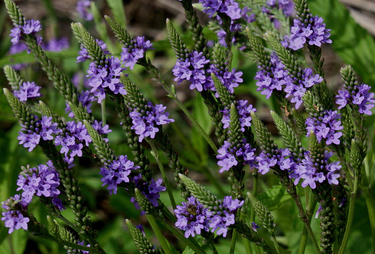


Blue Vervain
Verbena hastata
Pickup available at Aiken Nursery
Usually ready in 2-4 days
Blue vervain rises in summer as a candelabra of slender, pencil-thin spikes, each one lit from the base upward with tiny, five-lobed flowers in a saturated purplish blue that few native perennials can match. Verbena hastata is a clump-forming perennial of eastern North America, reaching two to four feet in good ground and occasionally stretching to six, on stiff, square, hairy stems that branch toward the top. The lance-shaped leaves are sharply toothed and rough to the touch, a coarse green foil for the refined flower spikes above. Bloom comes slowly and deliberately from July into September, only a few florets open on each spike at any moment, so the plant seems to smolder for weeks rather than flare all at once.
The names carry their own small histories. Verbena was a Latin word for the leafy branches and sacred herbs laid on altars and used in both ceremony and medicine, a lineage that marks this genus as one of the old holy plants. The epithet hastata means spear-shaped, a nod to the pointed leaves. English folk names lean into the same mix of reverence and use: simpler's joy, after the simplers who once gathered healing herbs from the countryside, and herb of grace, a name blue vervain shares with a long European tradition of vervain as a charm against ill will.
That reputation as a healing and protective herb runs deep in North America too. The Dakota and Omaha-Ponca names for the plant translate simply as medicine. The Iroquois are recorded using a cold infusion of the mashed leaves as a protective medicine, meant, memorably, to make obnoxious persons go away, while the Cherokee turned to the leaves, seeds, and roots for colds and coughs. Later Eclectic physicians and folk herbalists reached for blue vervain to settle frayed nerves and low spirits, and modern herbalists still regard the plant as a calming, bitter tonic. These are traditions worth knowing rather than prescriptions to follow, and the plant is potent enough that large doses upset the stomach; none of this is medical advice.
In the garden, blue vervain belongs wherever the ground stays damp: the low, wet middle of a rain garden, the margin of a pond, a moist meadow, or the soggy corner that defeats tidier plants. Give the plant full sun and medium to wet soil and they will form loose colonies by rhizome and self-sown seed, an asset in naturalistic plantings and something to edit in a formal bed. The vertical spikes read beautifully against the round umbels of Joe-Pye weed and swamp milkweed, the rusty spires of ironweed, and the airy white of Culver's root, and the flowers draw bees, butterflies, and the occasional hummingbird all summer. Leave the seedheads standing into winter and goldfinches, juncos, and sparrows will work them over on cold afternoons.
Photos courtesy of RW Smith and Sally & Andy Wasowski
- Hardiness
- USDA Zones 3–9
- Sun
- Full Sun, Part Shade
- Soil
- Moist
- Mature size
- Height 2–6 Feet · Spread 1–3 Feet
- Growth rate
- Fast
- Seasonality
- Dies back, depends on zone
Purplish-blue tubular florets on slender spikes, July to September
These statements have not been evaluated by the Food and Drug Administration. This information is shared for traditional and educational interest only and is not intended to diagnose, treat, cure, or prevent any disease. Please consult a qualified healthcare professional before any medicinal use.
- May interfere with blood pressure medication
- May interfere with hormone therapy
- Large doses cause vomiting and diarrhea
- Avoid during pregnancy
From rooting to shipping, our top priority is ensuring you receive healthy, thriving plants for your garden’s success.
Because most of our plants are grown from rooted cuttings — alongside seed, air layering, and grafting chosen for each variety — you receive a stronger, true-to-type plant that establishes quickly in your garden.
Raised on organic soil blends and eco-friendly pest management — never harsh chemicals — your plant arrives healthy for your garden, your family, and the pollinators they feed.
Every purchase gives back. We donate to the Aiken Arboretum and support local wildlife conservation, so growing your garden helps protect the wider ecosystem too.

All our plant material is carefully propagated, grown, and nurtured at our humble nursery in Aiken, South Carolina.

Your plant arrives carefully packed and ready to settle in. Unpack them promptly, give them a day or two to acclimate, then plant following the notes we include — that’s all it takes. Clear care guidance comes with every order, so success is the easy part.
What to expect upon delivery
All our plants are sold in 1-gallon sizes, though the height of each plant can vary depending on its growth rate and seasonality, typically ranging from 1/2 to 2.5 feet.
Each plant is carefully packaged with its roots enclosed in a secure plastic bag containing moist soil, forming a compact root ball. To ensure safe transport, the box is padded with recycled newspaper, providing both stability and eco-friendly protection from weather during shipping.
What is your return policy?
Review our full return policy information on our SHIPPING AND RETURNS POLICY page.
What payment methods can I use?
We offer 35 different payment methods including major providers like Mastercard, Visa, PayPal, American Express and Diners as well as many different local payment methods including Klarna, iDEAL, AliPay, Sofort, giropay, and many more.
Can I make changes to my order after it’s been placed?
At Woodlanders, we strive to fulfill orders as quickly as possible. Therefore, we can only accommodate changes to your order within the first 24 hours after it has been placed. These changes include adding or removing products and modifying the delivery address. If you need to make any changes or if there has been a mistake with your order information, please reach out to us promptly via our CONTACT page with your order number for the quickest resolution.
Your satisfaction is our priority, and we appreciate your understanding and cooperation.