


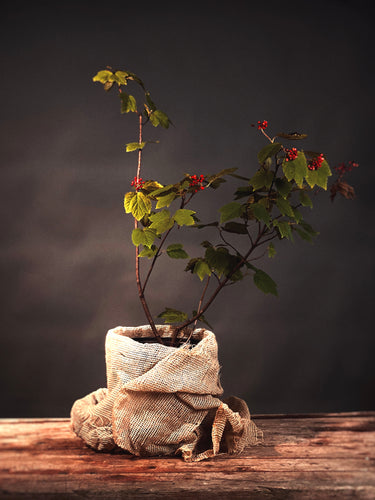


Viburnum, Mapleleaf
Viburnum acerifolium
Pickup currently unavailable at Aiken Nursery
Mapleleaf viburnum does what almost no other native shrub will do: thrive in dry shade. Most of the eastern American natives that gardeners reach for, serviceberry, red buckeye, sweetshrub, oakleaf hydrangea, want steady moisture and at least a few hours of sun. Viburnum acerifolium is the one that walks into the dry, root-tangled, low-light pocket beneath an established oak or beech and simply gets on with the job. The native range is genuinely vast, from New Brunswick south to Florida and west to Texas and the Upper Peninsula of Michigan, in upland forests, rocky slopes, and the edges of bluffs, making this one of the most widespread and most underused native shrubs of eastern North America.
The leaves are the calling card. Three-lobed, coarsely toothed, and opposite, they read instantly as the foliage of a small red maple, so much so that in the woods mapleleaf viburnum is most often mistaken for seedlings of Acer rubrum, and the species name acerifolium makes the comparison official: leaves like Acer, the maples. From spring through summer the foliage holds a clean medium green, and then in autumn the shrub does something almost no other native does. Where most shrubs turn red, orange, or yellow, mapleleaf viburnum turns pink: fluorescent rose-pink, lavender, dusty mauve, sometimes deep grape-juice purple, and often three or four of those shades on the same plant at once. Michael Dirr describes the display as shades of fluorescent pink and rose-red to grape-juice purple-red, a genuinely distinctive note in a season that otherwise leans hot.
Flat-topped white flower clusters open in late spring and early summer and draw a wide cross-section of native pollinators, among them the Cetonia scarab beetles that carry branched body hairs almost identical to the pollen-collecting hairs of bees, one of the small, strange, beautiful pieces of evolutionary parallelism. The drupes that follow ripen through several stages, green to red to deep blue to nearly black, and hang in tight clusters into winter for ruffed grouse, woodland songbirds, white-footed mice, and chipmunks. Mapleleaf viburnum is also the larval host plant for the Spring Azure butterfly, Celastrina ladon, a small native blue that emerges with the first warm days and times its life cycle to the new spring foliage.
The shrub grows four to six feet tall and slowly forms loose colonies by rhizomatous suckering, a virtue rather than a fault in the woodland borders, shade gardens, and restoration plantings where the plant belongs, and easily curbed by occasional pruning where a tighter shape is wanted. One point matters for fruit: mapleleaf viburnum needs more than one genetic strain nearby to set a heavy crop, so a lone plant will flower beautifully but fruit lightly, while two or more from different sources, or planted alongside another viburnum, will carry the dense berry display the wildlife depends on.
This is the shrub for the gardener with too much shade, the native-plant collector after something useful rather than merely showy, and the woodland gardener building a four-season bird and butterfly garden under a canopy of oaks. Voted the Georgia Native Plant Society's Plant of the Year in 2011, mapleleaf viburnum has been quietly earning that regard across its range for a very long time.
- Hardiness
- USDA Zones 3–9
- Sun
- Part Shade, Full Shade
- Soil
- Well-drained
- Mature size
- Height 4–6 Feet · Spread 3–4 Feet
- Growth rate
- Moderate
- Seasonality
- Deciduous
Creamy white flat cymes, late spring to early summer; pink to purple fall foliage
From rooting to shipping, our top priority is ensuring you receive healthy, thriving plants for your garden’s success.
Because most of our plants are grown from rooted cuttings — alongside seed, air layering, and grafting chosen for each variety — you receive a stronger, true-to-type plant that establishes quickly in your garden.
Raised on organic soil blends and eco-friendly pest management — never harsh chemicals — your plant arrives healthy for your garden, your family, and the pollinators they feed.
Every purchase gives back. We donate to the Aiken Arboretum and support local wildlife conservation, so growing your garden helps protect the wider ecosystem too.

All our plant material is carefully propagated, grown, and nurtured at our humble nursery in Aiken, South Carolina.

Your plant arrives carefully packed and ready to settle in. Unpack them promptly, give them a day or two to acclimate, then plant following the notes we include — that’s all it takes. Clear care guidance comes with every order, so success is the easy part.
What to expect upon delivery
All our plants are sold in 1-gallon sizes, though the height of each plant can vary depending on its growth rate and seasonality, typically ranging from 1/2 to 2.5 feet.
Each plant is carefully packaged with its roots enclosed in a secure plastic bag containing moist soil, forming a compact root ball. To ensure safe transport, the box is padded with recycled newspaper, providing both stability and eco-friendly protection from weather during shipping.
What is your return policy?
Review our full return policy information on our SHIPPING AND RETURNS POLICY page.
What payment methods can I use?
We offer 35 different payment methods including major providers like Mastercard, Visa, PayPal, American Express and Diners as well as many different local payment methods including Klarna, iDEAL, AliPay, Sofort, giropay, and many more.
Can I make changes to my order after it’s been placed?
At Woodlanders, we strive to fulfill orders as quickly as possible. Therefore, we can only accommodate changes to your order within the first 24 hours after it has been placed. These changes include adding or removing products and modifying the delivery address. If you need to make any changes or if there has been a mistake with your order information, please reach out to us promptly via our CONTACT page with your order number for the quickest resolution.
Your satisfaction is our priority, and we appreciate your understanding and cooperation.