

Landscape Design · Tea Olives · Southeast
A tea olive in bloom can be smelled before the shrub is seen. Where to plant one so the scent finds you, which species fits which job, and how to live with the spines.
In this piece
I.A flower you find with your nose
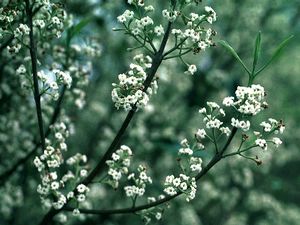
The flowers of a tea olive are not the point. They are small, white or cream or, in a few forms, apricot, and tucked so deep in the leaves that a visitor can stand beside a shrub in full bloom and ask what smells so good. The fragrance has been compared to ripe apricots, and on a still October evening the scent carries across a garden. In China the dried flowers go into tea and the extracts into perfume. Our story of the Osmanthus and the Moon Palace tells how a flower became a legend.
In a Southern garden the shrub offers something more practical. The leaves are evergreen, glossy and dark. The plant tolerates drought once settled, shrugs off deer, and is rarely troubled by pests. And the bloom lands in autumn, when the rest of the garden has gone quiet, which is the strongest argument for planting one near where you walk. We made the case for scent as a design principle in Sited by the Nose. This piece is the practical sequel: which tea olive, and where.
The best seat for a tea olive is wherever you will walk past them on a cool evening, not where you will look at them.
II.Four tea olives, four jobs
Gardeners lump the whole genus together as sweet olives or tea olives, and the genus is large enough to deserve better. Four groups cover most of what a Southern garden needs.
Fragrant tea olive, Osmanthus fragrans
The classic, and the most fragrant. The shrub grows ten to twenty feet tall and ten to fourteen wide, rated USDA zones 8 to 11, with some forms reaching into zone 7. The main bloom comes in October and November, with scattered flowers in other seasons, and the flowers range from white to cream, butter yellow and orange. The var. aurantiacus, the orange-flowered form, is hardier than the species. Afternoon shade helps in the hottest climates, and a hard frost can reduce the following fall's bloom, so shelter from cold wind pays.
Fortune's tea olive, Osmanthus × fortunei
A hybrid believed to be fragrant tea olive crossed with false holly, which arose in Japan before the middle of the nineteenth century and was carried to Europe by Philipp Franz von Siebold. The cross keeps much of the scent and borrows the cold tolerance, rated zones 7 to 9. The leaves are holly-like with a few teeth. Growth is slow but the plant is big in the end, fifteen to twenty feet by six to ten wide, though the shrub can be pruned to a third of that height. Fruit is rare. 'San Jose', which came out of California in 1934 and was introduced in 1941, is narrower in the leaf, with finer teeth.
False holly, Osmanthus heterophyllus
The cold-hardy one, rated zones 6 to 9, flowering late in fall into winter, with a scent that is rich only up close. Young plants carry spiny, holly-like leaves, and older growth turns smooth-edged: a shrub in two moods. The plant builds a dense hedge or a screen, or stands as a specimen, and the variegated and compact cultivars are garden plants in their own right. 'Goshiki', with new growth in pink, cream, yellow and orange, stays near five feet, and 'Purpureus' with the dark purple juvenile leaves is the hardiest of the forms.
The others
Osmanthus armatus, the toothed sweet olive, is considered the hardiest of the fragrant fall bloomers, with long narrow leaves. Spring-blooming relatives like Osmanthus × burkwoodii carry a lighter, sweeter scent and suit colder gardens. And the native devilwood, Cartrema americanum (formerly Osmanthus americanus), brings a smooth-leaved evergreen from our own woods. We have few of these this fall, so watch the tea olives collection as they return.
| Tea olive | Zones | Size | Bloom | Best job |
|---|---|---|---|---|
| O. fragrans | 8 to 11 (some forms 7) | 10 to 20 ft, 10 to 14 ft wide | Heaviest in Oct and Nov | Specimen by a door or path |
| O. × fortunei | 7 to 9 | 15 to 20 ft, 6 to 10 ft wide | Late summer into fall | Tall screen or narrow evergreen |
| O. heterophyllus | 6 to 9 | 8 to 20 ft; dwarf forms 4 to 5 ft | Late fall into winter | Hedge, barrier, variegated accent |
| O. armatus | 6 to 9 | Long, narrow leaves | Fall | Scent for colder gardens |
III.Where to put one
By the door or the path
The oldest advice is the best: site a tea olive within a few steps of where you come and go. The scent is strongest at the shrub, and wanders downwind. A plant by the back door, at the end of a patio, or beside the walk from the car will earn a place in the garden every October. Leave room, because the mature size is real. Place the shrub at least six feet from the house wall for the larger forms.
The evergreen screen
Tea olives make a handsome dense hedge, and a less dull one than the usual. Our piece on screens that are a thicket, not a wall argues for mixing species, and a few tea olives in the line give the hedge a fragrant month. 'San Jose' is the tall, narrow choice. Space the plants wider than the nursery tag suggests so the lower branches keep their leaves.
The sand and the drought
Tea olives are drought tolerant once established and accept sand, loam and clay as long as the drainage is decent. They are a natural fit for the dry, lean soil described in Gardening in Sand. The one real enemy is wet feet: in soil that stays soggy, mushroom root rot can set in, so skip the low corner. (That is a sweetspire's job, not a tea olive's.)
Field Note
Sources disagree on whether the next season's bloom forms on the new growth or on the previous year's wood, so prune lightly and judge the plant yourself. A gentle trim just after the main bloom is a safe bet. Heavy cutting can cost a year of flowers.

IV.Living with the spines
One honest caution comes with the beauty. The false holly and the hybrids carry spiny leaves, and the lower branches of a young plant are not friendly to bare arms. Site these away from a path where children run or where you brush past in summer clothes, and plant the smooth-leaved O. fragrans where touch matters. The spines are an asset in another setting: as a barrier planting under a window, a tea olive hedge makes a polite but effective fence.
The other fuss is scale, the main pest, which can defoliate a heavily infested shrub. Healthy, unstressed plants rarely have trouble; check the undersides of the leaves each summer and act early if the scale appears.
Osmanthus x fortunei 'San Jose'
San Jose Fortune's tea olive
- 15 to 20 ft
- Narrow, upright
- Fall fragrance
- Zones 7 to 9
- Sun to part shade
Narrower leaves with finer teeth than the species, a shrub for the corner where a tall green exclamation point is wanted.
Osmanthus heterophyllus 'Rotundifolius'
Round-leaved false holly
- Slow-growing dwarf
- Blunt-bumped leaf margins
- Less cold hardy
A dwarf form with blunt, rounded leaf margins in place of the spines, so a gentler choice for a spot near the path.
Osmanthus heterophyllus 'Variegatus'
Variegated false holly
- Cream-edged leaves
- Spiny
- Evergreen
Green leaves with creamy white margins, bright in winter shade. Our stock is down to a single plant.
V.Planting this fall
Fall is the right moment for planting shrubs in the Southeast, and the tea olive blooms while you do it, so you can plant the scent where it is strongest. Our longer argument for planting in the cooling is in Plant It in the Cooling. Water deeply at planting and through the first summer, and mulch to keep the roots cool.
Light and soil
Full sun to part shade. In the hottest parts of the South, afternoon shade is kind to O. fragrans. Moist, well-drained soil is ideal; heavy clay is tolerated, standing water is not.
Spacing
Give a specimen ten feet of width. For a hedge, set the plants six to eight feet apart for the taller forms, closer for the dwarf selections.
Companions
Camellias for the winter bloom, a Japanese maple or a fragrant viburnum for the middle, and an edge of ferns beneath. A tea olive and a witch hazel in the same view make a good argument for the shoulder seasons.
Deer
Tea olives are considered deer and rabbit resistant, and slightly salt tolerant.
From the Nursery
Our tea olives are gathered in one collection, from fragrant fall bloomers to the spiny and the variegated. The collection changes as plants sell through and return.
References
- North Carolina Extension Gardener Plant Toolbox: Osmanthus fragrans, Osmanthus × fortunei, Osmanthus heterophyllus. plants.ces.ncsu.edu
- University of Florida IFAS Extension, Osmanthus × fortunei 'Variegatus' (ST427). edis.ifas.ufl.edu
- Fine Gardening, "Tea Olive Shrubs for the Southeast." finegardening.com