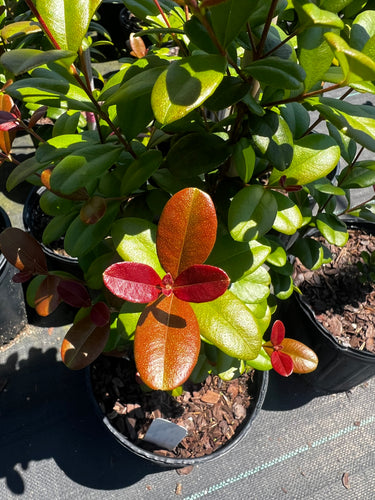
Plant Highlight · Myrcianthes fragrans · Florida and the Caribbean
The Shrub That Comes in Twos
Twin berries on a forked stalk, two common names that disagree about the plant entirely, and a nutmeg scent hiding in a leaf you have to bruise to find.
IA man, a hedge, and a case of dysentery
Few plants carry a common name that argues with itself as productively as this one. Simpson's stopper honors Charles Torrey Simpson, the self-taught naturalist, shell collector, and author who settled on Biscayne Bay in the 1880s and spent forty years writing down what grew in the lower Florida wilds before most of it was drained. Simpson was the sort of man who described a hammock the way other people describe a cathedral, and the plant named for him is a fair likeness: dense, aromatic, unshowy, and much better at close range than at a distance.
The other half of the name is less flattering and considerably older. Stopper, in the Florida woods, is what you called any of a handful of small myrtaceous trees whose bark and leaves were brewed to stop dysentery. That is the plain etymology, and there is a second folk reading that runs alongside: the shrubs branch so low and so thickly that a stopper hedge simply stops you, and anyone else who tries to walk through. Both meanings have been in use for a century and neither has won.
Then there is twinberry, which is the name the plant would probably choose. Flowers and fruits are borne two at a time on a short forked stalk, a little Y with a red bead at each tip. Once you have seen the arrangement you cannot unsee it, and it is the fastest field mark in the group.
Three common names, three completely different observations, and all three of them are right about the same shrub.
IIWhat the plant actually does

Myrcianthes fragrans sits in the Myrtaceae, the same family as guava, allspice, clove, and the eucalypts, and the family character comes through in the only way that matters to a gardener: the foliage is loaded with aromatic oil. Crush a leaf between finger and thumb and the scent is immediate and specific, nutmeg with a citrus edge, clean and slightly resinous. This is not a background fragrance. The plant is one of the few evergreen shrubs that rewards being handled.
The leaves themselves are small, glossy, dark, and elliptical, with new growth that flushes anywhere from pale chartreuse to deep wine depending on the season and the plant. Flowering peaks in spring, generally April and May in the native range, and continues sporadically through warm weather. The flowers are small, white, and spidery with prominent stamens, fragrant enough to notice from a few feet away, and thoroughly worked over by butterflies and native bees.
Fruit follows from late summer into fall: bright orange to red berries in those characteristic pairs, ripening exactly as the migrating birds arrive. Mockingbirds, cardinals, blue jays, buntings, and cedar waxwings all take them, usually faster than a gardener would prefer. The fruit is edible for people too, sweet and mild, though nobody has ever built a preserve tradition on the fruit, and the seeds are best left alone.
Field Note
The shrub grows about a foot a year until maturity, which is slow enough to plan around and fast enough not to despair. That patience buys density: a hedge grown from Simpson's stopper is genuinely impenetrable in a way a fast shrub never manages. Space plants three to five feet apart for a hedge, and accept that pruning hard and often will cost you the flowers and the berries.
IIIThe bark nobody photographs
Here is the case for planting this shrub in partial shade rather than full sun, which runs against most advice. In full sun the plant builds a tight, dense canopy that makes a superb hedge and hides the trunk completely. In part shade the foliage opens a little, and what becomes visible underneath is one of the more distinguished barks in Southern gardens: smooth reddish-brown, exfoliating in irregular plates, closer to a crape myrtle than to anything else you might have planted for the purpose.
Nobody puts this on a plant tag because bark does not photograph from ten feet. But if you have room for a multi-stemmed small tree rather than a clipped hedge, limbing up a mature Simpson's stopper is one of the quietly great moves available in a zone 8b garden. The sparkleberry earns a place in Southern gardens for the same reason, and the two make an unexpectedly good pairing on the strength of their trunks alone.
IV'Geode', and why a cultivar earns a place here
Myrcianthes fragrans 'Geode'
- Zones 8b to 11
- Evergreen
- Fragrant foliage
- Drought tolerant
- Bird fruit
- Salt tolerant
Seedling Simpson's stoppers vary considerably in habit, in how reliably they fruit, and in how well they take a dry spell. 'Geode' is an improved selection out of AgriStarts in Apopka, Florida, chosen for enhanced drought tolerance, consistent fruiting, and a compact habit that stays where you put the plant. The name is a nod to the jewel-like look of the paired red berries against dark foliage, which is a better cultivar name than most.
For a garden rather than a restoration, the selection is worth it. A hedge of seedlings will be a hedge of individuals, some full, some leggy, some fruiting well and some not at all. 'Geode' gives you the same plant twelve times, which is what a hedge actually wants.
VGrowing a Florida hammock plant in South Carolina
Now the honest part, because this is where most articles about Simpson's stopper go vague.
The species is native to seaside hammocks and coastal scrub in Florida, and beyond our borders through the Caribbean, Mexico, Central America, and south into Colombia and Venezuela. Recommended hardiness runs zones 8b to 11, with cold tolerance generally given as down to about 25 degrees Fahrenheit and possibly a little lower on an established plant. Extension guidance puts the northern limit along the East Coast at roughly Charleston.
Aiken is not Charleston. We sit inland at the 8a and 8b line, and a hard advective freeze here will take a young Simpson's stopper to the ground. So the plant is a microclimate proposition in the upper Coastal Plain and the Midlands, and a straightforwardly reliable one from the coastal counties south. That is not a reason to skip the shrub. It is a reason to site the shrub deliberately: against a south or east wall, under high pine canopy, out of the open north wind, or in a large container that can spend February on a porch.
| Condition | What the plant wants |
|---|---|
| Hardiness | Zones 8b to 11; roughly 25°F on an established plant, less on a young one |
| Light | Full sun for a dense hedge, part shade for visible bark and a looser form |
| Soil | Wide tolerance, including alkaline and sandy; handles poor drainage better than most evergreens |
| Water | Watch for drought stress the first four years, then very little needed |
| Salt | Good tolerance; a genuine coastal plant |
| Size | Commonly 10 to 20 ft; the Florida champion in Okeechobee County stands 38 ft |
| Pruning | Tolerates severe cutting back; also takes to topiary, bonsai, and containers |
| Problems | Very few; guava rust turns up occasionally on stressed plants |
If you garden below Charleston or Savannah
Plant with confidence and in numbers. This is a foundation evergreen for coastal Southeastern gardens, salt-tolerant, drought-tolerant once settled, and one of the better bird plants available to you.
If you garden in the Midlands, the Sandhills, or the upper Coastal Plain
Treat the shrub as a favored-position plant. A protected corner, a wall that holds afternoon heat, or high pine shade will usually carry a plant through. Mulch well the first two winters and expect occasional tip damage in a hard year.
If you garden in the Piedmont or above
A container is the honest answer. Simpson's stopper takes to pot culture and hard pruning better than nearly any other evergreen in the family, which is why the plant appears so often as bonsai. Winter the pot in an unheated garage or a bright cold room.
VIWhere to put the shrub
Site this plant where people pass close enough to touch the foliage. That is the whole argument, and it is the same argument we make for the sweetshrubs and the tea olives: a fragrance held inside a leaf is worth nothing at the back of a border. Along a path, at a gate, beside the steps, near a door that gets used. Our piece on a garden written in scent works through the placement logic at length.
As a hedge, the shrub gives you an evergreen screen that flowers, fruits, feeds birds, and asks for almost nothing once established, which is a short list of plants. As a specimen, limbed up over a low groundcover, the bark carries the winter. In a mixed dry planting the drought tolerance makes Simpson's stopper a useful evergreen anchor among the perennials we recommended in the xeriscape field guide, where the woody structure is usually the missing piece.
A fragrance held inside a leaf is worth nothing at the back of a border. Plant the shrub where a sleeve will brush the leaves.

VIIA quiet conservation note
Myrcianthes fragrans is listed as threatened by the Florida Department of Agriculture and Consumer Services. The pressure is habitat, not horticulture: coastal hammock and scrub are among the most thoroughly developed plant communities in the Southeast, and the shrub has gone with them.
The practical consequence is simple. Buy nursery-propagated plants, never wild-collected ones, and ask if you cannot tell. A threatened plant that becomes a common garden hedge is a threatened plant with a future, and that is a genuinely cheerful way for this story to end.
Field Note
Woodlanders has grown the straight species and the odd selection 'Spineless Hedgehog' over the years, both from cutting-grown stock. Everything we ship of this species is propagated, never collected.
VIIIReferences
- UF/IFAS Extension Gardening Solutions, Simpson's Stopper (Myrcianthes fragrans).
- Florida Native Plant Society, species profile for Myrcianthes fragrans.
- Florida Wildflower Foundation, Flower Friday: Simpson's stopper.
- Naples Botanical Garden, A Native Tree of Many Names (and Roles).
- McVaugh, R., taxonomic treatment of Myrcianthes (Myrtaceae).
- Simpson, Charles Torrey. 1920. In Lower Florida Wilds. G. P. Putnam's Sons.
- Florida Department of Agriculture and Consumer Services, Regulated Plant Index.
Before you go
We grow Myrcianthes fragrans 'Geode' in one-gallon containers, cutting-grown and ready to plant this fall, which is the right season to settle an evergreen in the Southeast.
Grown in Aiken, South Carolina, and shipped young enough to establish properly.