

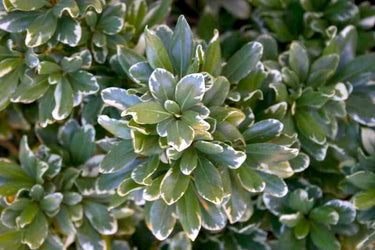
Variegated Japanese Pittosporum

Pittosporum tobira 'Variegata'

$23.00
Low Stock

1 Gallon | Hardiness Zones 8-11

In Japan they call it tobira, short for tobira no ki, the door tree, because the cut branches were hung in the doorway at Setsubun to turn back demons at the threshold of spring. The broken wood smells rank, which was rather the point: bad spirits, like most of us, would rather not walk through a bad smell. The genus name is kinder and more exact, pitta and sporos, pitch and seed, for the resin that coats the black seeds and glues them to whatever bird carries them off.

You meet none of that at the doorstep. What you meet is the scent of the flowers, pure orange blossom, carried on creamy five-petaled stars clustered at the branch tips through late spring. This is the variegated form, and the foliage is the reason to reach for it: oval, leathery, gray-green leaves rimmed in irregular cream, their edges rolled softly under, holding the two-tone all year. By autumn the spent flowers have become small woody capsules that split into three and show a lining of bright orange-red seeds set in that same resinous gloss.

Tough in the way coastal plants are tough, unbothered by salt wind, heat, or a hard shearing, asking only for sharp drainage and a little sun. A hedge that perfumes the whole garden for a fortnight in spring and stays composed the other fifty weeks of the year. It belongs where you pass close by, beside a gate or a door, where the scent can ambush you on the way in.

Standing on: Pittosporum tobira is a broadleaf evergreen native to central and southern Japan (also Korea, Taiwan, southern China), known there as tobera; its white-to-cream late-spring flowers smell of orange blossom (hence "mock orange"), and its three-valved green capsules ripen brown and split to reveal showy orange-red seeds; the genus name means "pitch seed" for the sticky seeds. The Japanese name comes from tobira no ki, "door tree," tied to the custom of hanging the cut branches (which smell when cut) at the doorway to drive off bad spirits. It is hardy to about zone 8 and tolerates drought, heat, and salt spray but needs good drainage.

Pickup available at Aiken Nursery

Usually ready in 2-4 days

Schedule Delayed Shipping in your Cart

Hardiness Zones USDA Zones 8-11
Sun Full Sun and Part Shade
Soil Well-drained
Mature size Height: 4-6 Feet / Spread: 4-6 Feet
Growth Rate Moderate
Seasonality Evergreen

Flower, Fruit and Foliage

Flower. Tight terminal clusters of five-petaled stars open white and age to soft cream, modest to look at and immodest to smell: a heavy, true orange-blossom scent that carries clear across a garden through late spring. On the variegated form they come a touch more sparingly, which somehow only makes catching them sweeter.

Fruit. By autumn the flowers have set small woody capsules, hairy and green, ripening brown and dividing into three. When they split they show the trick, a lining packed with seeds in vivid orange-red, held in the sticky resin that gives the whole genus its name.

Foliage. The reason to choose this form over the plain green. Oval, leathery, glossy leaves to about four inches, gray-green at the center and rimmed in irregular creamy white, the edges rolled gently under, whorled toward the branch tips and held all year. Evergreen, salt-proof, and unbothered by shearing into whatever shape you ask of it.

Read full care instruction manual here.

Planting Requirements

  • Light: Thrives in full sun to partial shade. In warmer climates, partial shade during the hottest part of the day can help prevent leaf scorch.
  • Soil: Prefers well-draining soil, but is adaptable to sandy, loamy, or slightly clayey soils. A neutral to slightly alkaline pH is ideal.
  • Planting Time: Plant in spring or fall for best establishment.

Watering

  • Water regularly during the first growing season to establish a strong root system.
  • Once established, Pittosporum tobira 'Variegata' is drought-tolerant but benefits from occasional deep watering during extended dry periods. Avoid overwatering, as it dislikes waterlogged soils.

Fertilization

  • Feed with a balanced, slow-release fertilizer in spring to promote healthy growth and vibrant foliage.
  • Avoid over-fertilizing, which may encourage excessive growth at the expense of its compact shape.

Pruning

  • Prune in late winter or early spring to shape and maintain a compact form.
  • Light trimming after flowering can encourage new growth and prevent the plant from becoming leggy.

Growth Habit and Size

  • Grows as a dense, rounded shrub with a slow to moderate growth rate.
  • Reaches a height and spread of 4–6 feet, though it can be pruned smaller or allowed to grow slightly larger in ideal conditions.

Pests and Diseases

  • Generally pest-free but may occasionally encounter issues with aphids or scale insects. Treat infestations promptly with horticultural oil or insecticidal soap.
  • Rarely affected by diseases, but proper spacing and good airflow help prevent fungal issues.

Special Features

  • Foliage: Leaves are oval-shaped, leathery, and glossy, with creamy white margins surrounding a rich green center. The variegation adds visual interest year-round.
  • Flowers: Clusters of small, white, star-shaped flowers bloom in late spring to early summer. They are fragrant, emitting a sweet, citrus-like scent reminiscent of orange blossoms.
  • Evergreen Habit: Retains its attractive variegated foliage throughout the year.

Winter Care

  • Hardy in USDA zones 8–11. Protect from harsh winter winds and extreme cold in marginal zones by applying a layer of mulch around the base and covering with frost cloth if necessary.

Landscape Uses

  • Ideal for borders, hedges, foundation plantings, or container gardening. Its compact size and year-round appeal make it versatile in both formal and informal landscapes.

Additional Tips

  • Tolerant of coastal conditions, including salty air and sandy soils, making it a good choice for seaside gardens.
  • Can be grown indoors as a houseplant in bright, indirect light.

With its striking variegated foliage, fragrant flowers, and easy-care nature, Pittosporum tobira 'Variegata' is an excellent choice for adding elegance and structure to any garden or landscape.

Here’s a closer look at how we produce our plants:

From rooting to shipping, our top priority is ensuring you receive healthy, thriving plants for your garden’s success.

The majority of our plants are carefully cultivated from rooted cuttings, while we also utilize propagation methods such as seed, air layering, and grafting, thoughtfully chosen to suit each plant’s unique needs.

Our plants are cultivated using sustainable practices, including organic soil blends and eco-friendly pest management, ensuring they thrive while minimizing environmental impact.

We are proud to contribute to local biodiversity through ongoing donations to the Aiken Arboretum and support for local wildlife conservation efforts, helping to preserve and enhance our community’s natural ecosystems.

Grown in Aiken, South Carolina

At Woodlanders, we are committed to quality.

All our plant material is carefully propagated, grown, and nurtured at our humble nursery in Aiken, South Carolina.

Learn more about Woodlanders here.

Plant Success Tip #1

Unpack Promptly

Carefully unpack your plant as soon as it arrives. Check the roots and soil to ensure they are still moist. If the roots feel dry, lightly mist or water them before proceeding with planting or temporary storage.

Plant Success Tip #2

Acclimate Your Plant

Allow your plant to adjust to its new environment by placing it in a sheltered spot for a day or two before planting, especially if it has traveled a long distance. Avoid exposing it to extreme temperatures right away.

Plant Success Tip #3

Follow Planting and Care Instructions

Plant your new arrival as soon as possible, following the specific care guidelines provided. If planting outdoors isn’t immediately possible, temporarily pot it in well-draining soil to maintain health until conditions are suitable.

Frequently Asked Questions

What to expect upon delivery

All our plants are sold in 1-gallon sizes, though the height of each plant can vary depending on its growth rate and seasonality, typically ranging from 1/2 to 2.5 feet.

Each plant is carefully packaged with its roots enclosed in a secure plastic bag containing moist soil, forming a compact root ball. To ensure safe transport, the box is padded with recycled newspaper, providing both stability and eco-friendly protection from weather during shipping.

What is your return policy?

Review our full return policy information on our SHIPPING AND RETURNS POLICY page.

What payment methods can I use?

We offer 35 different payment methods including major providers like Mastercard, Visa, PayPal, American Express and Diners as well as many different local payment methods including Klarna, iDEAL, AliPay, Sofort, giropay, and many more.

Can I make changes to my order after it’s been placed?

At Woodlanders, we strive to fulfill orders as quickly as possible. Therefore, we can only accommodate changes to your order within the first 24 hours after it has been placed. These changes include adding or removing products and modifying the delivery address. If you need to make any changes or if there has been a mistake with your order information, please reach out to us promptly via our CONTACT page with your order number for the quickest resolution.

Your satisfaction is our priority, and we appreciate your understanding and cooperation.