


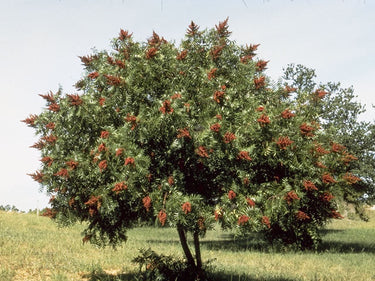


Smooth Sumac
Rhus glabra
Pickup available at Aiken Nursery
Usually ready in 2-4 days
Smooth sumac is a bold, colony-forming native shrub of the eastern and central United States, in time reaching the scale of a small tree, and one of the finest plants going for a hot, dry, sunny site where little else will thrive. The long, pinnately compound leaves give an almost tropical texture through summer, and the plant spreads by root suckers into broad, picturesque colonies, or can be held to a single tree-like specimen where the suckers are controlled.
Panicles of greenish-yellow flowers open in June and July, feeding bees and other pollinators, and female plants follow with erect, cone-shaped panicles of fuzzy crimson fruit that persist through winter and blaze against the snow. In autumn the foliage turns a brilliant scarlet, as fiery as any native shrub, so smooth sumac earns a place for both the fall color and the long-held fruit. The smooth, waxy stems, free of the velvety hairs of staghorn sumac, give the plant the name glabra.
Few native shrubs carry a richer human history. The tart red berries, high in vitamin C, steep in cool water into a red, lemonade-like drink long enjoyed across the plant's range, and Indigenous peoples across the continent drew on the astringent, tannin-rich roots, bark, leaves, and berries for a wide range of traditional remedies, from teas for digestive complaints and sore throats to dressings for the skin. The inner bark and berries also yielded yellow and red dyes. Modern interest in the genus Rhus centers on the tannins and gallic acid behind that astringent chemistry.
Give smooth sumac a large, sunny, dry site with room to run: a hot bank, a wild border, a naturalized edge, or a mass planting for erosion control, where the suckering colony is welcome. For a tidier effect, plant where mowing or edging can hold the spread, or grow a single specimen and remove the suckers. Pair with little bluestem, asters, and other tough sun-lovers, set a female plant for the fruit, and let the scarlet fall color and crimson winter panicles carry the season. Deer tend to pass the plant by, and drought only makes the colony tougher.
Additional photos courtesy of the Loughmillers and David Northington
- Hardiness
- USDA Zones 4–8
- Sun
- Full Sun
- Soil
- Well-drained, Dry
- Mature size
- Height 9–15 Feet · Spread 10–15 Feet
- Growth rate
- Fast
- Seasonality
- Deciduous
Greenish-yellow panicles, June to July
These statements have not been evaluated by the Food and Drug Administration. This information is shared for traditional and educational interest only and is not intended to diagnose, treat, cure, or prevent any disease. Please consult a qualified healthcare professional before any medicinal use.
- Not a substitute for professional medical care
- Astringent and high in tannins; large amounts may upset the stomach
- Confirm identification; do not confuse with poison sumac, Toxicodendron vernix
From rooting to shipping, our top priority is ensuring you receive healthy, thriving plants for your garden’s success.
Because most of our plants are grown from rooted cuttings — alongside seed, air layering, and grafting chosen for each variety — you receive a stronger, true-to-type plant that establishes quickly in your garden.
Raised on organic soil blends and eco-friendly pest management — never harsh chemicals — your plant arrives healthy for your garden, your family, and the pollinators they feed.
Every purchase gives back. We donate to the Aiken Arboretum and support local wildlife conservation, so growing your garden helps protect the wider ecosystem too.

All our plant material is carefully propagated, grown, and nurtured at our humble nursery in Aiken, South Carolina.

Your plant arrives carefully packed and ready to settle in. Unpack them promptly, give them a day or two to acclimate, then plant following the notes we include — that’s all it takes. Clear care guidance comes with every order, so success is the easy part.
What to expect upon delivery
All our plants are sold in 1-gallon sizes, though the height of each plant can vary depending on its growth rate and seasonality, typically ranging from 1/2 to 2.5 feet.
Each plant is carefully packaged with its roots enclosed in a secure plastic bag containing moist soil, forming a compact root ball. To ensure safe transport, the box is padded with recycled newspaper, providing both stability and eco-friendly protection from weather during shipping.
What is your return policy?
Review our full return policy information on our SHIPPING AND RETURNS POLICY page.
What payment methods can I use?
We offer 35 different payment methods including major providers like Mastercard, Visa, PayPal, American Express and Diners as well as many different local payment methods including Klarna, iDEAL, AliPay, Sofort, giropay, and many more.
Can I make changes to my order after it’s been placed?
At Woodlanders, we strive to fulfill orders as quickly as possible. Therefore, we can only accommodate changes to your order within the first 24 hours after it has been placed. These changes include adding or removing products and modifying the delivery address. If you need to make any changes or if there has been a mistake with your order information, please reach out to us promptly via our CONTACT page with your order number for the quickest resolution.
Your satisfaction is our priority, and we appreciate your understanding and cooperation.