




Cumberland Rosemary
Conradina verticillata
Pickup available at Aiken Nursery
Usually ready in 2-4 days
Federally listed as threatened since 1991, which means this plant cannot be sold across state lines. South Carolina and in-person purchase only.
A small shrub of the Cumberland Plateau, found only on the flood-scoured cobble and sand bars of three river systems in eastern Tennessee and a sliver of Kentucky: the Big South Fork of the Cumberland, the Caney Fork, and the Obed. The rest of the Conradina clan keeps to the sand scrub of Florida and the Gulf Coast of Alabama, sun-baked and semitropical. This species took a different path, north into the cooler uplands, and is the only member of the genus that never reached Florida at all. The cold-hardiness that came with the move is the gift to gardens farther north.
Cumberland rosemary lives by disturbance. The plants grow on bars scoured by spring floods and baked dry by August, and they need that rhythm to survive. Flooding strips out the taller competition that would otherwise shade them off the bar; the drought that follows is the condition their roots are tuned to. Extended floods snap off stem fragments and carry them downstream, where they root in fresh gravel and start new colonies. This is a plant that requires the river to behave like a river. Dam the system, stabilize the banks, and the species quietly disappears.
There are other oddnesses. Cumberland rosemary is the only triploid in the genus, which makes seed set unreliable and most reproduction clonal, so what looks like a colony of separate plants is often a single sprawling individual rooting at the nodes. Pollinators moving between flowers are frequently moving pollen around one genetic plant, which is part of why recovery is measured in genetically distinct individuals rather than in stems. The genus honors Solomon White Conrad, 1779 to 1831, a Philadelphia printer, bookseller and mineralogist who ended up professor of botany at the University of Pennsylvania, and whose name attached to this small clan of southeastern mints almost by accident. The leaves, crushed, smell startlingly like culinary rosemary; a 2022 study formally characterized the odor and found eucalyptus and clove notes running under it, from 1,8-cineole and eugenol. We would rather you grew the plant than cooked with a federally threatened species.
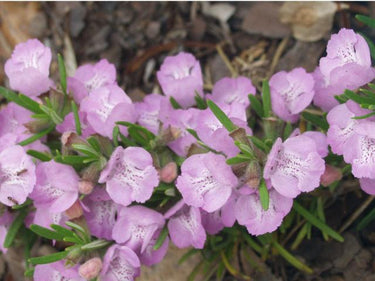
Lavender-pink flowers with darker throat spotting come in May and June, two-lipped and small but freely produced along the trailing stems. The low evergreen mat runs six to twelve inches high and spreads to two or three feet, the foliage holding through winter with a faint bronze cast in cold. Excellent in a rock garden, tumbling over a stone wall, or anywhere the conditions of the native cobble bars can be approximated: full sun, sharp drainage, acid sand or gravel, and no competition. Nursery propagation is the quiet argument for growing this one. When plants are easy to buy, there is no reason for anyone to lift a wild clump, and the Fish and Wildlife Service declined to map critical habitat at listing partly for fear of showing collectors where to look.
Photos courtesy of Sally and Andy Wasowski.
- Hardiness
- USDA Zones 5–9
- Sun
- Full Sun
- Soil
- Well-drained
- Mature size
- Height 6–10 Inches · Spread 18–24 Inches
- Growth rate
- Moderate
- Seasonality
- Evergreen
Lavender to rose-purple, dark-spotted throat, May to June
From rooting to shipping, our top priority is ensuring you receive healthy, thriving plants for your garden’s success.
Because most of our plants are grown from rooted cuttings — alongside seed, air layering, and grafting chosen for each variety — you receive a stronger, true-to-type plant that establishes quickly in your garden.
Raised on organic soil blends and eco-friendly pest management — never harsh chemicals — your plant arrives healthy for your garden, your family, and the pollinators they feed.
Every purchase gives back. We donate to the Aiken Arboretum and support local wildlife conservation, so growing your garden helps protect the wider ecosystem too.

All our plant material is carefully propagated, grown, and nurtured at our humble nursery in Aiken, South Carolina.

Your plant arrives carefully packed and ready to settle in. Unpack them promptly, give them a day or two to acclimate, then plant following the notes we include — that’s all it takes. Clear care guidance comes with every order, so success is the easy part.
What to expect upon delivery
All our plants are sold in 1-gallon sizes, though the height of each plant can vary depending on its growth rate and seasonality, typically ranging from 1/2 to 2.5 feet.
Each plant is carefully packaged with its roots enclosed in a secure plastic bag containing moist soil, forming a compact root ball. To ensure safe transport, the box is padded with recycled newspaper, providing both stability and eco-friendly protection from weather during shipping.
What is your return policy?
Review our full return policy information on our SHIPPING AND RETURNS POLICY page.
What payment methods can I use?
We offer 35 different payment methods including major providers like Mastercard, Visa, PayPal, American Express and Diners as well as many different local payment methods including Klarna, iDEAL, AliPay, Sofort, giropay, and many more.
Can I make changes to my order after it’s been placed?
At Woodlanders, we strive to fulfill orders as quickly as possible. Therefore, we can only accommodate changes to your order within the first 24 hours after it has been placed. These changes include adding or removing products and modifying the delivery address. If you need to make any changes or if there has been a mistake with your order information, please reach out to us promptly via our CONTACT page with your order number for the quickest resolution.
Your satisfaction is our priority, and we appreciate your understanding and cooperation.