


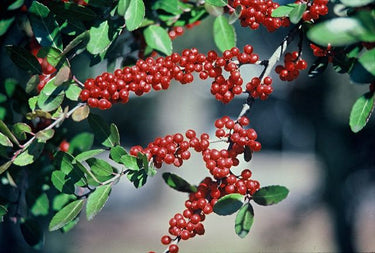

Yaupon Holly 'Hoskins Shadow'
Ilex vomitoria 'Hoskins Shadow'
Pickup currently unavailable at Aiken Nursery
Yaupon is the small-leaved evergreen holly of the southeastern coastal plain, native from Virginia to Texas and a member of the holly family, Aquifoliaceae. Adaptable almost to a fault, salt tolerant, drought tolerant, and content in sun or shade, Ilex vomitoria takes shearing as neatly as boxwood and has served Southern gardens for generations as hedge, screen, and clipped structure. ‘Hoskins Shadow’ is a standout among the named forms: a dense, fast-growing shrub or small tree, 15 to 20 feet in time, chosen for unusually large, dark green foliage and, above all, for cold hardiness well beyond the ordinary yaupon.
The plant carries history as well as good manners. Roasted yaupon leaves and twigs were the source of the caffeinated black drink that Indigenous peoples of the Southeast brewed for ceremony and trade, and that coastal settlers later adopted as a homegrown coffee or tea. Yaupon remains North America’s only caffeine-bearing native plant. The harsh species name, vomitoria, records a European misreading of the ritual purging that sometimes accompanied the drink, a blame the plant did not earn, since modern analysis of the leaves finds no emetic or toxic compounds at all; the common name is kinder, from the Catawban ya’pa, a diminutive meaning small tree. The fruit is another matter, mildly toxic to people and pets, and better admired than sampled.
‘Hoskins Shadow’, also listed in the trade as ‘Shadow’s Female’, was selected for that big dark foliage and toughness by the Tennessee nurseryman Hoskins Shadow, of Winchester, Tennessee. The plant has reportedly come through minus ten degrees Fahrenheit, a cold that would kill most yaupons outright, which pushes this holly a full zone north of where the species usually stops. Female and generously fruitful, ‘Hoskins Shadow’ hangs abundant scarlet berries that hold from fall through spring when a male yaupon grows within reach.
Few evergreens give this much for so little trouble. Use ‘Hoskins Shadow’ as a fast, dense screen or a large clipped hedge, or let a single plant grow into a small multi-stemmed tree limbed up to show the pale trunks. The dark leaves make a fine backdrop for lighter foliage and for the scarlet winter fruit, so site where the berries can be seen from a window or walk, and set a male yaupon within bee range to guarantee the crop. Our straight Ilex vomitoria male does the job, and the narrow ‘Will Fleming’ does it in a footprint two feet wide, which is useful when there is nowhere obvious to put a second shrub. One male serves six to eight females. Gardeners in the upper South and lower Midwest, long shut out of yaupon, finally have a form worth trying.
- Hardiness
- USDA Zones 6–10
- Sun
- Full Sun, Part Shade
- Soil
- Well-drained
- Mature size
- Height 15–20 Feet · Spread 8–10 Feet
- Growth rate
- Fast
- Seasonality
- Evergreen
Tiny white spring flowers; abundant scarlet-red berries fall through spring (female; needs a male pollinator)
These statements have not been evaluated by the Food and Drug Administration. This information is shared for traditional and educational interest only and is not intended to diagnose, treat, cure, or prevent any disease. Please consult a qualified healthcare professional before any medicinal use.
- Contains caffeine.
- The concentrated traditional black drink was linked to ritual vomiting, attributed to fasting, large volumes, or other additives rather than the holly itself.
- Traditional and early-research information only, not medical advice.
From rooting to shipping, our top priority is ensuring you receive healthy, thriving plants for your garden’s success.
Because most of our plants are grown from rooted cuttings — alongside seed, air layering, and grafting chosen for each variety — you receive a stronger, true-to-type plant that establishes quickly in your garden.
Raised on organic soil blends and eco-friendly pest management — never harsh chemicals — your plant arrives healthy for your garden, your family, and the pollinators they feed.
Every purchase gives back. We donate to the Aiken Arboretum and support local wildlife conservation, so growing your garden helps protect the wider ecosystem too.

All our plant material is carefully propagated, grown, and nurtured at our humble nursery in Aiken, South Carolina.

Your plant arrives carefully packed and ready to settle in. Unpack them promptly, give them a day or two to acclimate, then plant following the notes we include — that’s all it takes. Clear care guidance comes with every order, so success is the easy part.
What to expect upon delivery
All our plants are sold in 1-gallon sizes, though the height of each plant can vary depending on its growth rate and seasonality, typically ranging from 1/2 to 2.5 feet.
Each plant is carefully packaged with its roots enclosed in a secure plastic bag containing moist soil, forming a compact root ball. To ensure safe transport, the box is padded with recycled newspaper, providing both stability and eco-friendly protection from weather during shipping.
What is your return policy?
Review our full return policy information on our SHIPPING AND RETURNS POLICY page.
What payment methods can I use?
We offer 35 different payment methods including major providers like Mastercard, Visa, PayPal, American Express and Diners as well as many different local payment methods including Klarna, iDEAL, AliPay, Sofort, giropay, and many more.
Can I make changes to my order after it’s been placed?
At Woodlanders, we strive to fulfill orders as quickly as possible. Therefore, we can only accommodate changes to your order within the first 24 hours after it has been placed. These changes include adding or removing products and modifying the delivery address. If you need to make any changes or if there has been a mistake with your order information, please reach out to us promptly via our CONTACT page with your order number for the quickest resolution.
Your satisfaction is our priority, and we appreciate your understanding and cooperation.